The order was braciole. Joey Grassia knew the dish from childhood holidays, when his family’s Italian cooking gave the day something to organize itself around. Years later, helping launch Shef in New York, he encountered a cook named Gessica who made it too. He called his father. His father bought dinner for the team. The founder sat down to eat and found himself in tears.
Grassia later said it tasted like his mother’s version, down to the sauce. A customer had ordered a meal; a son had recovered something familiar. For a company trying to connect people with individual cooks, it was a useful demonstration of the proposition. Even a founder occasionally needs the product explained to him by a plate.
That Brooklyn dinner in 2020 sits near the center of his story because it joins two things he had spent years trying to bring together: a food business that could work commercially and a reason to care about who made the food. He had already built and sold two brands. Shef asked him to think beyond what could be put on a retail shelf.
A shelf full of experience
Grassia studied at UCLA, earning a bachelor’s degree, then worked at Facebook. He worked there from 2010 to 2013, in marketing and client services. It was an education in how a technology company operates, before his own working days became occupied by the rather less virtual business of moving food.
KUTOA began in 2011, while he was still at Facebook. It sold snack bars and attached a giving model to the purchase: buy a bar and help provide food for a child. It reached national distribution through retailers including Whole Foods, Kroger and Sprouts. A short product, in other words, could produce a long list of people to negotiate with.
Steamm Espresso followed. The idea emerged while he was pitching KUTOA and wanted a stronger coffee option. Bottled espresso became a second consumer business. By 2017, Forbes had included him in its Food & Drink 30 Under 30 list. He sold KUTOA that June and Steamm that December.
Those dates make a tidy career summary. The work between them was less tidy. Grassia has recalled living in a warehouse storage room for much of 2016. Building a brand had placed him close to the inventory in a fairly literal sense. The episode gives the exits some necessary texture: a company can reach stores while its founder’s own arrangements remain distinctly improvised.
Two founders, one family question
Grassia and Alvin Salehi met at a Forbes Under 30 gathering in 2018. They arrived from different professional worlds. Grassia knew consumer food. Salehi was an attorney who had worked as a White House technology adviser and helped launch Code.gov. Their family experiences gave them something more personal to discuss than their résumés.
Grassia’s father came from Italy. Salehi’s parents came from Iran. Both households knew the demands of trying to make a living in a new country. Salehi’s family had attempted the restaurant route and found the operating costs punishing. Cooking skill alone could not make that arithmetic forgiving.
The founders wanted an easier route into selling food for people like their parents. A person might already have recipes, practice and an appreciative audience at home. Finding paying customers required a different set of tools. The space between being asked to bring a dish and being able to sell it was where they chose to work.
Even the name retained the family connection. Shef combines “she” and “chef,” honoring their mothers and the work of feeding a household. It is a compact acknowledgment of labor that often comes with compliments instead of compensation. A family can be lavish with praise and remarkably casual about the invoice.
Dinner needs a timetable
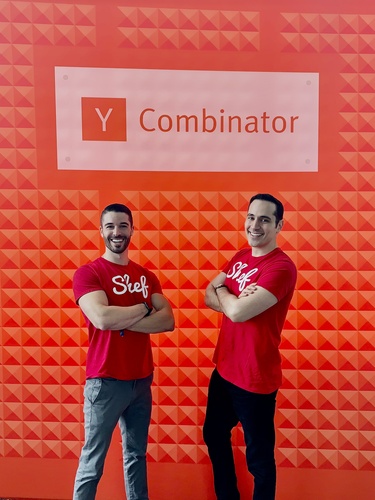
Shef launched in the Bay Area in 2019 and joined Y Combinator’s Winter 2019 batch. An accelerator can supply introductions and advice. A marketplace still needs something customers can actually order. Grassia has said that he, Salehi and a chef friend cooked early meals themselves to get things moving.
He also describes an early hot-food, on-demand model that collided with domestic reality. A parent receiving an order at six might already be making dinner for their own children. Shef went through thirteen versions in its first four months, by his account. The cook’s evening had to be part of the design.
There is an ordinary courtesy hidden inside that product problem. Asking someone to cook for other households means understanding how their day works. A service can look wonderfully simple on the customer’s screen while being awkward for the person expected to fulfill the promise. The screen is rarely the one peeling anything.
A workable marketplace has to make both calendars meet.
That tension helps explain why the business requires more than enthusiasm for home cooking. Availability, menus and delivery all influence whether a customer returns. A cherished family recipe can get someone interested. Receiving the right dinner when expected gives them a reason to order it again. Affection starts the conversation; dependable work keeps it going.
Room for the person at the stove
Shef’s current company story describes a shared personal-chef service connecting busy households with local culinary professionals. The individual cook remains visible. Their story and their dishes sit together, rather than disappearing behind a brand whose employees the customer never encounters. That choice reflects a persistent interest of Grassia’s.
“We talk about community. We talk about people.”
Joey Grassia
He has said that Shef’s first full-time hire was a head of storytelling. For founders without coding backgrounds, that was an unusual early priority. It makes sense alongside the braciole experience: a meal’s appeal can include the person who knows how to make it and the history that gave them the recipe.
The business also supplies practical help. Grassia has described support with menu formulation, marketing and coaching as cooks establish themselves. These are less romantic subjects than a grandmother’s sauce, but they belong in the same account. A recipe does not photograph itself. A satisfied customer cannot reorder a dish they cannot find.
Helping someone enter commerce means taking that surrounding work seriously. The cook still has ingredients to buy and time to account for. The marketplace has to earn its place in the arrangement by helping bring customers and orders within reach. The personal connection can give the transaction meaning; the operating details determine whether there is another transaction.
There is room here for two kinds of discovery. One customer recognizes a dish and wants to recover a familiar taste. Another orders something they have never eaten before. The same cook can serve both without making the recipe mean the same thing to each. Grassia’s attachment to braciole illustrates the first experience. The wider range of cooks gives the second somewhere to begin. A marketplace has to explain enough about a dish to welcome a stranger while leaving its maker’s particular way of cooking intact. That is a more interesting task than simply making every menu look alike.
The money around the meal
Investors began financing a larger version of the idea. M13 joined an $8.8 million seed round announced in 2020, alongside Y Combinator and Craft Ventures. Its investment note pointed to the founders’ immigrant-family experiences and Grassia’s Sicilian culinary roots. The family history had become part of the investment case.
A $20 million Series A followed in 2021, led by Andreessen Horowitz. In March 2023, Shef announced a $73.5 million Series B package closed the previous year, led by CRV, with Andreessen Horowitz and Amex Ventures participating. That package included $7 million in venture debt. Total company funding had passed $100 million.
Series B package, including $7m in venture debt.
Closed in 2022.
The announcement described thousands of cooks, with 85 percent women and 80 percent people of color. Those were company-reported figures at that point in time. They give the founding intention a visible constituency: people whose cooking had found a commercial setting through the service.
Capital can pay for expansion and product work. It also makes the original question more demanding. Helping a few cooks sell dinner is different from making the arrangement repeatable across many communities. Every additional market adds more individual working lives to understand. The promise still has to arrive as an actual meal, at an actual door.
A bigger table, a different job
By February 2026, Grassia was describing a company working in person in San Francisco and New York, with his time divided between the offices. He talked about a flatter organization and four direct reports. He also credited time together with helping the team reconsider the product in 2023.
His account of leadership had moved away from doing everything himself. The emphasis was on direction, people with complementary abilities and making room to think. After two earlier brands, he had another chance to decide which responsibilities belonged to him and which called for someone better equipped.
There is a family resemblance between that lesson and Shef’s purpose. Grassia learned that his own effort had limits. The marketplace assumes that other people have abilities worth making room for. Both ideas ask a founder to look beyond his own capacity and organize work around what someone else can contribute.
The braciole story supplies a modest test of the ambition. Somewhere in a new city, someone knew how to make a dish he remembered. Shef helped the two find each other. His father paid for the team’s dinner, and the founder became a customer with a very particular reason to be pleased. For that evening, the business made sense all the way down to the sauce.
Stay for another course
Visit Shef and its company story. Follow Grassia on LinkedIn, X or Facebook.
Read the 2026 founder conversation, hear The Kara Goldin Show interview, and revisit the braciole conversation. For the business milestones: Y Combinator and the 2023 financing announcement.