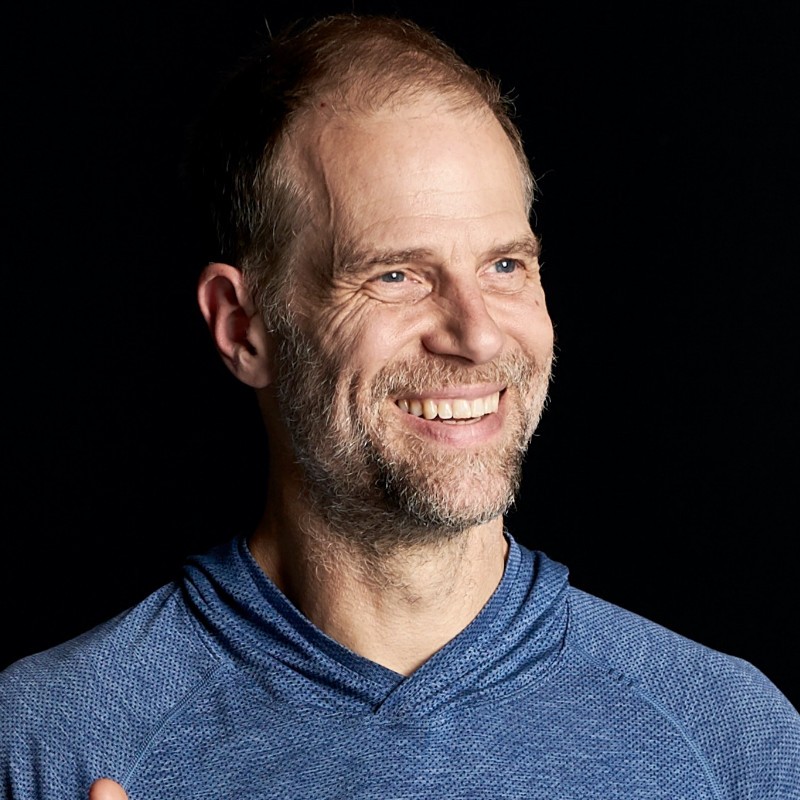
Joe Betts-LaCroix walks into the longevity conversation with a stopwatch. The number he keeps repeating is ten - ten more years of healthy human life. Ask him why not nine, or eleven, and you get the most honest answer in biotech: "Because I don't know how."
That mix of audacity and candor is the engine of Retro Biosciences, the San Francisco company he co-founded in 2020 and runs as CEO. Retro is not chasing immortality or selling supplements. Its stated goal is narrow and brutally hard: add a decade of healthy years - healthspan, not just lifespan - by going after the cellular machinery that drives aging. The company emerged from stealth with $180 million, all of it from a single backer, OpenAI's Sam Altman. By May 2026, a fresh raise valued Retro at $1.8 billion. Roughly 90 people now work toward a target most of biology considers science fiction.
Retro runs three programs at once, which is unusual for a company its size. One pushes autophagy - the cell's recycling system that clogs with age. One pursues blood plasma rejuvenation, the idea that something in young blood resets old tissue. The third works on partial cellular reprogramming, nudging aged cells back toward a younger state without erasing what they are. Betts-LaCroix likes to put the ambition in plain words: "A 95-year-old person can start having zero-year-old blood." Retro's first clinical trial is already underway - a pill designed to help Alzheimer's patients clear the protein aggregates that gum up the aging brain.
When the AI redesigned the proteins
In January 2025, Retro and OpenAI announced something that sounded like a press release and turned out to be a result. They built GPT-4b micro, an AI model trained on biological data, and pointed it at the Yamanaka factors - the four proteins that can turn an ordinary adult cell back into a stem cell. The model proposed redesigns. The redesigns worked. Pluripotency markers jumped more than fiftyfold, and the time to generate induced pluripotent stem cells dropped from about three weeks to roughly one. An OpenAI researcher on the project put it bluntly: the AI's proteins "seem better than what the scientists were able to produce by themselves."
For Betts-LaCroix, this is the whole thesis. Aging is not one broken gene. It is twenty thousand genes interacting in ways no human can hold in their head at once. He has spent a career betting that automation and computation are the only way to wrestle that complexity into something a clinic can use - a belief he first put to work two startups ago.
The long way to biology
Born Jonathan Betts in Seattle in 1962 and raised in Oregon, he finished high school with a D average. What followed was not a comeback montage but six years of living in shared houses with, by his own account, "musicians, artists and weirdos," doing electronics, hardware and software for whoever needed it. Then he started over - straight A's at a local college, a transfer to Harvard, and a major in Earth sciences he reportedly landed on after following a girlfriend east.
The detours kept being interesting. He did a biophysics research fellowship at Caltech and ended up at MIT, ostensibly working toward a PhD in ocean chemistry. On one mission he helped pull a two-kilometer ice core out of a Greenland ice sheet. Along the way he co-discovered, with David Beratan and Jose Onuchic, the principles governing how fast electrons tunnel through proteins - work published in Science that has been cited hundreds of times. It is the kind of resume that does not point anywhere obvious, which may be the point.
The world's smallest computer
In 2000 he co-founded OQO and built a full Windows PC small enough to slip in a pocket - the device that earned a Guinness World Record as the world's smallest Windows computer in 2006, and a shelf of design awards. OQO was eventually acquired by Google. It was a gadget triumph, and also the moment he started asking whether gadgets were what he wanted on his tombstone.
In 2010 he joined Halcyon Molecular, the Musk- and Thiel-backed venture trying to sequence DNA with electron microscopes, to lead automation. In 2012 he founded the Health Extension Foundation to convene and fund the aging-research field he felt was being ignored. In 2013 he co-founded Vium, which automated in-vivo lab research with robotics and AI; Recursion Pharmaceuticals acquired it in 2020. He has also angel-invested in StemCentrx, Recursion and Spring Discovery, and spent stretches as a part-time partner at Y Combinator mentoring biotech founders. Every step bent the same direction: machines plus biology, aimed at time.
What he actually believes about aging
Betts-LaCroix has a quietly radical framing. "Aging is essentially a default process," he says. "It's everything else that goes wrong after you subtract the needed health to get to reproduction." Evolution, in other words, never built us to last - it built us to reproduce and then stopped optimizing. He points to the bowhead whale, which can live more than two centuries, as proof that nature has already solved problems humans assume are unsolvable.
He arrived at Retro partly out of irritation. When he went looking at Silicon Valley's longevity scene, he found it "steeped in marketing, not actual science." His response was to build the science version and put a clock on it. He calls his team "critical optimists" - people who fully respect how hard the biology is and refuse to let that stop them. It is a useful phrase for a man who got A's only after he learned to ignore the schedule everyone else was keeping.
The quantified life
He has been part of the Quantified Self movement since its early days, treating his own body as a lab. The most-cited example: he once ran his life on a 28-hour day to see what would happen. It fits a pattern that runs through everything from the ice core to the pocket PC to the Alzheimer's trial - a refusal to accept that the defaults, biological or otherwise, are fixed. The man building ten extra years for everyone else started by rearranging his own.