Jinsi Lee’s first venture in renewable energy had a problem that sunlight could not solve. In 2007, he wanted to build a thin-film solar manufacturing plant in Singapore. Solar module prices fell faster than expected, and the venture failed. Cheaper solar was good news for the people buying panels. For someone planning to manufacture them, the same news could close a door.
He stayed in energy. He later worked on international solar projects at Sunseap, and in 2018 co-founded Oyika. Today, the proposition comes in a form considerably easier to carry than a solar farm: a battery for an electric motorbike, available through a service rather than a one-time purchase.
There is a pleasing economy to that change in scale. A solar project answers a question about where electricity comes from. A battery service answers the next question: how does that electricity become useful when somebody needs to get somewhere? Lee’s career has moved between the two.
A factory, then a smaller bet
The factory belongs at the beginning of this story because failure was part of the route to Oyika. Lee returned to entrepreneurship after working in solar development. The founders of Sunseap helped back the new venture. A previous employer’s founders becoming supporters of the next business is a rather more useful souvenir than a farewell card.
His Sunseap work had taken him beyond Singapore. In January 2016, he was the company’s Head of International Markets when a consortium won a tender for a 140 MWp solar project in Rajasthan, India. The consortium included Sunseap International, Charisma Energy Services and Rising Sun Energy.
The award sat within the Bhadla Solar Park development. Its commercial arrangements included a 25-year power purchase agreement with India’s National Thermal Power Corporation. That is a long horizon for a business decision. It also places Lee’s later interest in everyday transport in perspective: he had already worked where engineering, pricing and partnerships had to agree for years.
Rajasthan solar tender won by the consortium that included Sunseap, where Lee led international markets.
A solar panel is tangible. A viable arrangement for selling its electricity is less photogenic, but just as necessary. Lee’s move into batteries kept the commercial question close to the equipment. The energy needed a customer, and the customer needed a service worth paying for.
Before the panels, a classroom
Renewable energy was not Lee’s first experience of building a company. In a public recommendation for Roderick Chia, he recalled their collaboration at Postkid in Singapore’s late-1990s technology startup scene. Lee was president; Chia was Chief Knowledge Officer. The company worked in online and offline education for school-age children.
Lee described an operation that grew to more than 100 full-time employees before an acquisition by Horizon Education and Technologies. The recollection is his own, and its most revealing detail concerns the relationship afterwards. The two continued exchanging notes on technology and crossing paths after pursuing separate ventures.
He valued Chia’s openness to alternative views, practical ideas and ability to execute. Those are fairly specific things to remember about a colleague. They concern the work itself: whether a person can listen, contribute something useful, and help turn a discussion into a result.
Chia later became part of Oyika’s leadership. The connection gives Lee’s career continuity across otherwise different fields. Education, solar power and motorbike batteries do not share a showroom. They can, however, share people who have learned how to work together.
The customer has a Tuesday to get through
Oyika’s offer starts with a familiar inconvenience. An electric motorbike needs a charged battery. The rider needs to know where the next one will come from, how long getting it will take, and what the arrangement will cost. A vehicle can look perfectly sensible at the point of sale and still ask awkward questions halfway through a working day.
Lee’s company provides Battery-as-a-Service. A rider exchanges a depleted pack for a charged one at a swap station. The battery is part of an ongoing service, with subscription options, rather than an expensive component the customer must purchase and later replace.
The business borrows an understandable idea from telecommunications: bundle the equipment with the service that makes it useful. A phone and its plan are a familiar pair. A motorbike and access to charged batteries apply the relationship to movement.
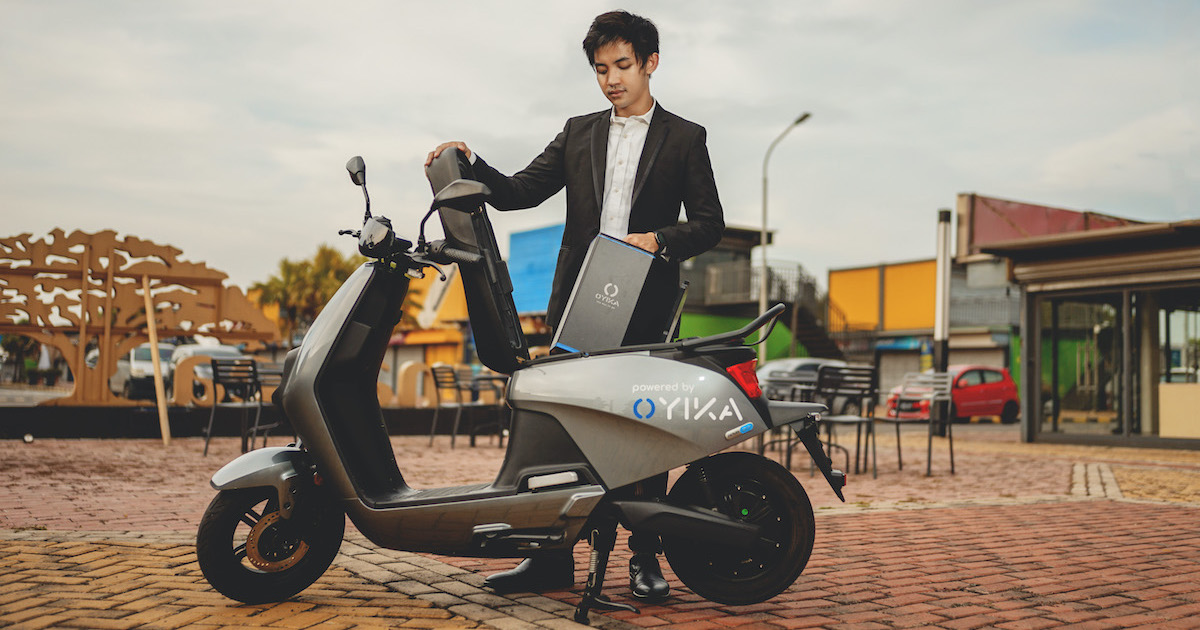
Oyika describes its platform as compatible with a range of motorbike brands and models. That gives Lee another audience besides riders: manufacturers and fleet partners. Their vehicles can participate in the service without every customer being steered towards one bike brand.
The attraction is practical. A battery is useful when it is charged, accessible and compatible with the vehicle waiting for it. Ownership is only one way to arrange those conditions. Lee’s business takes responsibility for arranging them repeatedly.
The rider keeps moving. The returned battery goes back into the charging cycle.
Cambodia gave him a second question
Cambodia was already familiar to Lee from his solar work. It became an early proving ground for Oyika. The company introduced a monthly motorbike subscription there in the second half of 2019, but the offer met apprehension. A lower price did not immediately make an unfamiliar vehicle comfortable to choose.
In May 2020, Oyika introduced pay-as-you-go sharing. Customers could try an electric motorbike through a smaller commitment. It was a change in the invitation: take a ride, learn how the service feels, and discover whether it suits the journey.
The sequence gives the story a useful pause. The entrepreneur had a proposition about affordability. The rider still had a decision about familiarity. Those questions can coexist, and a business has to answer both. A monthly bill looks different once someone has actually used what it pays for.
For Lee, the early Cambodia experience put adoption alongside engineering. A working battery system needs people willing to enter it. Giving them a manageable first experience became part of building that system.
The people around the cabinet
Oyika was founded with Carl Wong, its co-founder and president. Around their battery business sit energy companies, bike makers, delivery platforms and local operations. The swap cabinet is the visible object; the relationships make it possible to put that object to work.
In June 2021, Yinson announced an investment in Oyika. The energy group saw the arrangement as part of its work towards greener logistics. For Lee, the partnership brought resources and a wider network to an undertaking intended to reduce riders’ costs and support the transition to electric transport.
Later that year, Oyika signed a memorandum of understanding with Foodpanda to provide its powered electric motorbikes to delivery riders. The date matters: this was an operating use case, alongside the effort to make the service accessible to ordinary customers.
Delivery puts the next journey close behind the last one. In this context, battery access becomes part of the working schedule. A rider needs the service to remain useful across repeated trips, while a fleet business needs an arrangement that makes commercial sense.
“Our initial focus will be on the logistics and delivery sectors.”Jinsi Lee · Banpu NEXT partnership announcement, 2023
When Banpu NEXT announced its investment in 2023, Lee named those sectors as the initial focus. The partnership placed Oyika alongside another energy business with interests in generation, storage and electric mobility. His work was again crossing the boundary between supplying power and finding a practical use for it.
Following the power upstream
In 2022, Oyika and NEFIN announced a partnership connecting battery swapping and charging infrastructure with renewable electricity. Here, Lee’s solar background returned directly to the motorbike story. An electric vehicle needs electricity, and the way that power is generated belongs in the plan.
The announcement described an initial focus on business logistics and delivery before a wider consumer motorbike market. It also named affiliated bike brands including Yadea, TailG, Niu and Gesits. The agreement concerned several parts of the journey: the electricity, the infrastructure, the vehicle and its customer.
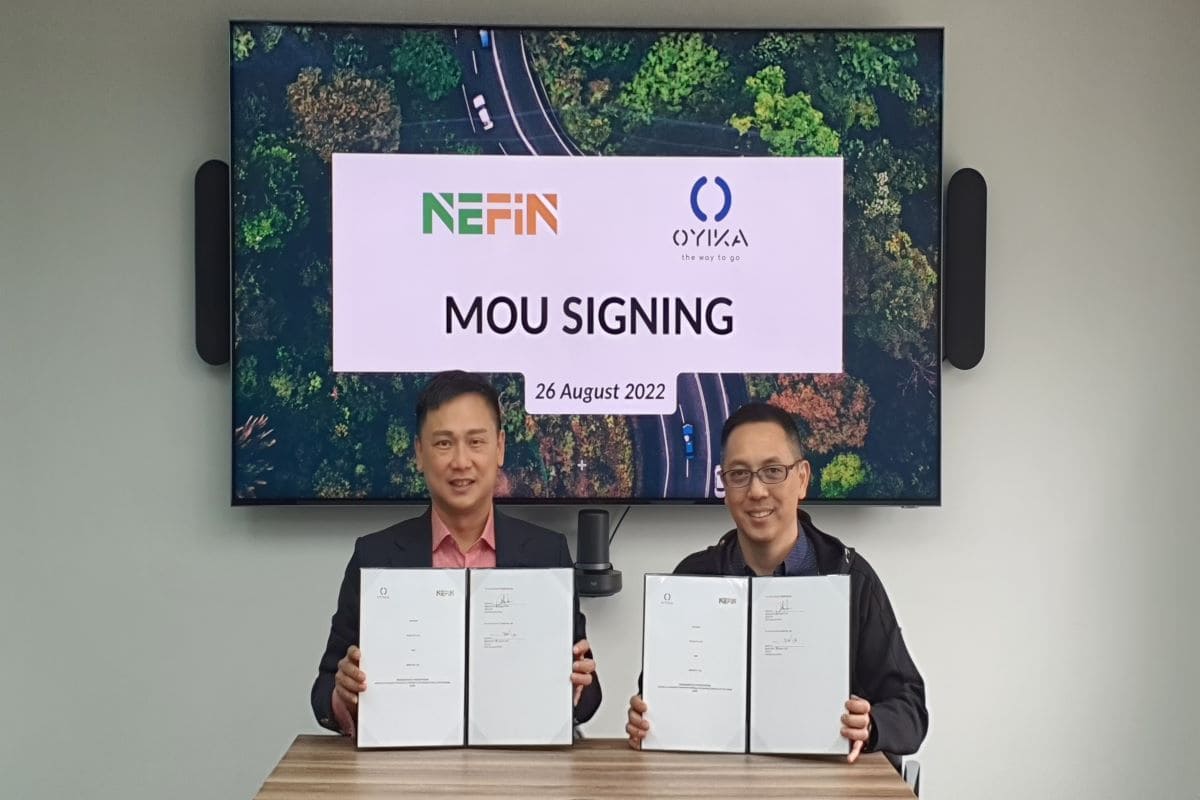
The picture of Lee holding the agreement is a quieter image of entrepreneurship than the usual launch-stage performance. It shows one of the objects a battery business needs: a document that lets another part of the system join in. The cabinet may do the swapping. People still have to agree on what comes before it.
A portable ambition
Oyika’s ambitions also extend beyond vehicles. Its portable batteries have been proposed for supplying electricity to off-grid homes. The NEFIN partnership announcement included that possibility alongside the transport work. A pack useful under a motorbike seat can have another job once a journey ends.
This returns Lee to a question larger than the bike: how to make energy accessible in the form people need. Generation, storage and delivery are connected stages. His career has given him work at each boundary, from the attempted factory to solar projects and now the swap network.
Regional growth brings that question into different settings. Oyika described a presence in Cambodia, Indonesia, Malaysia and Thailand in 2023. Its official Thailand launch followed in May 2024, with the Thai subsidiary led by Lionel Lee. The dates mark developments in the business Jinsi helped build, rather than a single interchangeable regional market.
In a 2021 interview, Jinsi put his conviction plainly: “The electrification of mobility will happen.” His own record gives that confidence some texture. There was a manufacturing plan that failed, a career in solar development, and a motorbike offer that needed customers to become comfortable with it.
The next mile is a modest unit for an energy ambition. It is also a useful test. Somewhere, a rider needs a charged battery and a workable way to get it. Lee’s business has to make that encounter ordinary enough to repeat tomorrow.