In 2023, Jimmy Carrion asked Christopher Finlay for an unusual piece of professional development: permission to live in the buildings. Finlay, the founder of Lloyd Jones, wanted to know whether he was serious. Carrion was. He had arrived in senior housing from hotels and construction, and he wanted to understand the business at the hours when an office visit would already be over.
There is a pleasantly inconvenient quality to the request. An executive can order a report without changing his evening. Moving in requires a different commitment. Dinner becomes part of the investigation. So does the morning routine. A building has plenty to say once the visiting party has gone home and the people who work there resume their ordinary day.
The education at six in the morning
Carrion’s account of the experience is specific. He observed working patterns, ate the food, and spoke with families at the door on Sundays. He noticed employees carrying several responsibilities at once. He came away convinced that understanding an operating business required proximity to the people doing the work. The experiment supplied an education in the difference between a community’s reported performance and its daily rhythm.
“So I moved in.”
Jimmy Carrion, on learning the business from inside
The brevity is part of the appeal. Four words dispense with the grand language that often accompanies a management initiative. Carrion chose a place to stay, then let ordinary circumstances teach him. A Sunday conversation does not arrive with an agenda. A meal does not improve because someone has prepared a presentation about it. The encounter has fewer opportunities for rehearsal.
His story puts a modest activity at the center of a substantial responsibility: paying attention. An investment can be described in percentages, but a community is experienced through routines. Those routines are where a plan meets its audience. Carrion’s decision gave him another way to examine the assumptions behind the numbers, one that depended on being available when the building was being itself.
A career with rooms, teams, and budgets
Before Lloyd Jones, Carrion’s working life already involved places that had to function for other people. He served as director of operations at the Atlanta Razorback Sports Complex, with responsibility for facility budgets, financial reporting, managers, and staff. He later became director of sales and operations at a construction management firm. At OYO USA, he led a regional business-development team involved in expansion across the southeastern United States.
Sports, construction, and hospitality make an interesting preparation for real estate leadership. Each involves a physical place and an organization whose work gives that place value. The guest sees the room. The manager sees the people, expenditure, and coordination required to make the room ready. Carrion’s career moved across those settings before bringing operating experience into an investment firm.
He studied marketing and international business at Georgia State University. His earlier Lloyd Jones biography identifies a dual bachelor’s degree in those subjects and describes his responsibility for relationships with institutional equity partners worldwide. That work added a second audience to the operating picture: the people supplying capital, who need to understand what the company intends to do with it.
A contemporary welcome announcement in 2020 introduced him as vice president of business development. His assignment included finding acquisitions and building relationships with potential clients and partners. By 2022, he appeared in the PEI Investor Relations, Marketing & Communications Forum agenda as senior vice president of investor relations, speaking in a session about communication and protecting relationships.
- 2020Joins Lloyd Jones in business development
- 2022Investor relations and a PEI speaking engagement
- 2024Chief Operating Officer appointment announced
- 2026President and Chief Executive Officer
His Blueprint biography also records a Chief Investment Officer role between COO and CEO.
The progression matters because capital raising and operations have different daily demands. One involves explaining why a business deserves backing. The other involves making it work after backing arrives. Moving between them gives an executive repeated opportunities to compare the explanation with the outcome. It also makes the temptation to leave operational detail to someone else rather less comfortable.
In April 2024, Lloyd Jones announced Carrion’s appointment as chief operating officer. Finlay described a colleague who had worked across investor relations, acquisitions, underwriting, and asset management. He also singled out Carrion’s habit of staying on-site during property visits. What Carrion later described as a learning exercise had become something his founder considered relevant to the job.
The interview before the investment
Carrion’s public account of hiring is similarly concrete. He says he interviews every Executive Director the company hires, alongside the rest of the leadership team. His preferred question concerns a difficult dismissal: a candidate has to explain a time they let someone go who had been with the organization for years. He wants to hear why, and what they attempted before reaching that point.
It is an awkward question by design. A candidate can speak fluently about standards without describing a decision that cost anything. This question asks for particulars: the history, the alternatives, the judgment. Carrion says he does not seek someone who enjoys dismissal. He wants someone able to account for it. The distinction gives the conversation a human scale.
He connects that attention to the influence an Executive Director has over staff, residents, and families. The choice reaches well beyond one line on an organizational chart. A building’s leadership sets expectations that others have to live with. For an investor, that makes the hiring conversation part of understanding how the business will perform, rather than an administrative matter to be settled later.
Those are Carrion’s own three words for how he wants his leadership remembered in five years. They are useful companions. Demands require an explanation people can respect. Fairness needs standards to apply. Reward gives effort a destination. Together, the words describe a working relationship, and they leave colleagues with a fairly clear way to judge whether he has lived up to it.
There is also something refreshingly unornamental about the list. It could be tested in a staff meeting or a difficult review. No one needs a consultant to translate it. The ambition is legible to the people who would experience it, which is a sensible quality for a leadership ambition to possess.
A badge in Las Vegas, a question back at the building
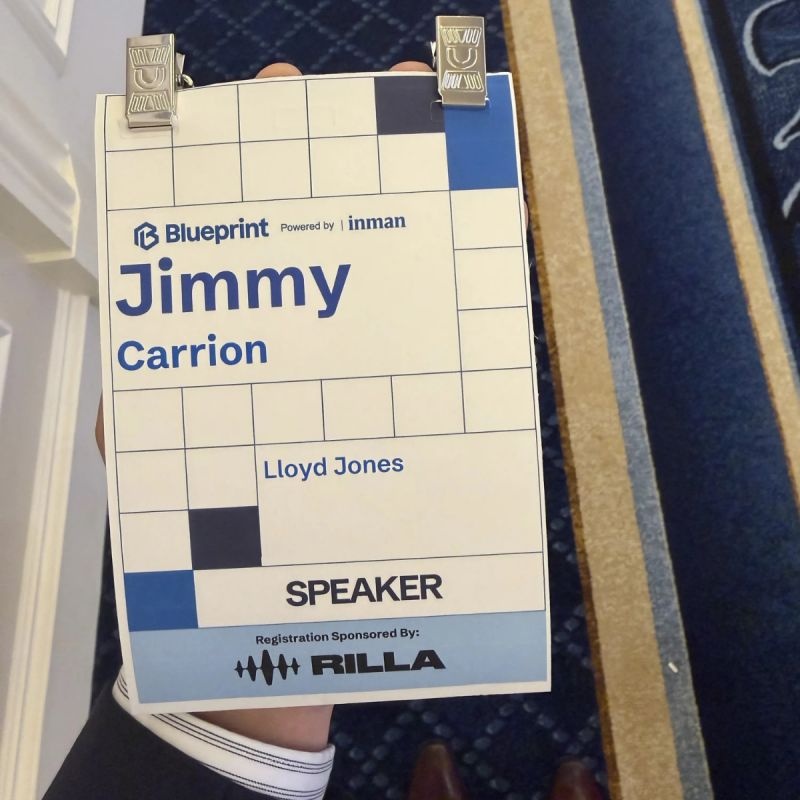
In September 2026, Carrion took that operating perspective to Blueprint in Las Vegas. The event scheduled his presentation for September 22, with a focus on modernizing middle-market senior housing. Its synopsis used Baldwin Park as an example and reported a 65 percent increase in net operating income during the first twelve months. That was a company presentation claim, a result attached to a particular property and period.
Baldwin Park gives the discussion a physical setting. Lloyd Jones announced the purchase of the 136-unit Staunton, Virginia, property in January 2024. It described two three-story buildings on fifteen acres, originally built in 1987 and refurbished in 2003. The acquisition announcement set out a $3.1 million renovation budget. A library, courtyard, and views toward the surrounding Virginia landscape belong to the same investment story as the budget.
After Blueprint, Carrion explained his test for technology. He begins with a question that needs answering, such as how many labor hours a building used that week. A tool that determines the question for you has reversed the order. He also emphasized the need for connected information before artificial intelligence can produce useful answers.
“You just get faster answers to the wrong question.”
Jimmy Carrion, after Blueprint
Speed has a persuasive sales pitch. Carrion’s objection gives the buyer a more troublesome task: decide what the answer is for. His practical threshold is whether a tool helps an executive director make a better decision that week. The test places an expensive-sounding subject inside a recognizable working day. Someone still has to decide what to do on Tuesday.
Before the conference, he had offered a smaller admission. He enjoyed presenting and wanted to improve. Familiar colleagues already understood his context; a few hundred unfamiliar listeners would need their attention earned. He asked other speakers what they had learned. The question sits comfortably beside the earlier request to move in: in both cases, he identifies a gap in his experience and invites a way to close it.
The founder stays. The responsibility changes.
On July 9, 2026, Lloyd Jones named Carrion President and CEO. Finlay became Founder and Executive Chairman after more than 46 years leading the company. He would remain involved in strategy and establish a Board of Advisors. The firm also announced that its headquarters had returned from Dallas to Miami, with expansion of Aviva Senior Living among its stated priorities.
Carrion expressed gratitude for Finlay’s confidence and mentorship. His stated ambition includes growth of the platform and long-term value for residents, partners, investors, and employees. That is a broad group to answer to. The interests meet inside buildings, where an operating choice has consequences for several people who may describe success rather differently.
The succession gives Carrion more authority over the questions he had been learning to ask. There are acquisitions to evaluate, leaders to appoint, and decisions about where technology belongs. His career offers a recurring place to begin: the actual work. A founder’s confidence can put someone in the CEO’s chair. Carrion’s earlier choice was to pull up another chair at dinner and stay long enough to learn something.