An obligation due sixty years from now is an awkward thing to put on a to-do list. The calendar will accept it. The person making the entry may never see it arrive. Somewhere between those two facts lies a large part of Robert Forsythe’s working life.
Forsythe has described obligations due forty, fifty or sixty years into the future. His observation gives family-office work a timescale rarely found in an ordinary business meeting. A decision can be made today, written into a trust, and become somebody else’s responsibility decades later. The paperwork needs a longer memory than its authors.
Forsythe is chief executive officer of Third Lake Capital, a Tampa single-family office, and founder and senior managing partner of Third Lake Partners. His work ranges from the administration of private wealth to investment strategies and real estate. It is a career with two very different kinds of evidence: records that must remain useful and buildings that people can walk into.
An accountant’s route to the corner office
Before the chief executive titles came accounting and finance. Forsythe graduated from Georgetown University’s McDonough School of Business with a bachelor’s degree in business administration, majoring in both subjects and minoring in economics. He then worked in PwC’s Banking and Capital Markets practice on audit, transaction advisory and management consulting engagements.
He joined Third Lake as chief operating officer in 2015. The office had been founded in 2013 and moved from an embedded family-office arrangement to an independent operation. That gave the job a particular setting: a young organization serving wealth whose intended lifespan was much longer than its own.
His earlier executive responsibilities included alternative investments, allocation, estate planning and public-market portfolios. He remains a CPA licensed in Florida, New York, Virginia and Washington, DC, and holds the Chartered Global Management Accountant designation. Those credentials sit comfortably beside a job that involves both choosing investments and keeping their consequences organized.
The route matters because operations recur throughout his career. Investing produces obligations as well as assets. A signature starts a relationship; administration keeps that relationship intelligible. For an executive trained in accounting, the record is part of the work rather than an accessory to the announcement.
The inbox had become part of the investment process
Third Lake’s growing operations had accumulated a familiar problem in unfamiliar quantities. More than a thousand statements, tax forms and other documents arrived annually from more than ten custodians, over a hundred alternative funds and at least fifteen accounting and legal firms. Formats and delivery schedules varied. Staff collected, renamed and uploaded files by hand.
The office had ledger and portfolio tools, yet the work between those tools depended heavily on people and email. That is a peculiarly expensive place to keep a routine. A message can tell someone to act; it is less helpful when a successor needs to understand every action already promised.
Third Lake expanded to include Third Lake Solutions, a multi-family office led by President and CFO Tebbi Purvis. A process that works through personal familiarity becomes harder to repeat as more families are served. The practical question becomes whether the office can offer the same care without having to reconstruct its own instructions each time.
A meeting in Florida, then a different routine
In 2019, Forsythe met iPaladin founder Jill Creager at a Florida conference. Her approach connected records, relationships and assigned tasks in one system. Third Lake implemented iPaladin, then added Canoe’s automated document collection. The work crossed a boundary that many offices know well: a document had to become something somebody could act on.
By September 2024, Third Lake Capital was the first shared client using the companies’ integration. Canoe collected capital calls, distribution notices, statements and tax forms. iPaladin connected those documents to tasks and alerted the people responsible. The distinction is practical. Receiving a notice and carrying out its instructions are separate events, and both need to happen.
The integration also gave the office a way to connect incoming records with an existing process. Instead of treating every PDF as a fresh administrative puzzle, the system could carry it into the work already defined around it. A document’s usefulness grew when it could point to the next action.
Forsythe discussed that work publicly alongside Purvis, Creager and Canoe’s Mike Purcell in an October 23, 2024 webinar. The subject was document management, which sounds modest until one considers the breadth of the documents involved. Tax records, investment notices and approvals are the small moving parts of a much larger financial undertaking.
The reported results were measurable: monthly statement processing fell from 40-66 hours to fewer than ten, with the remaining time spent on exceptions. The annual document flow reached 9,772. These are operational figures, not investment returns. They show the scale of the administrative task that Forsythe and his colleagues chose to address.
Hours spent processing statements each month
A sixty-year horizon needs colleagues
Forsythe describes the purpose of the operational work as “being more useful to the family.” The measure is usefulness: whether a family and its advisers can get the service they need, with less of the team’s attention consumed by the passage of a file from one place to another.
Third Lake Capital’s leadership includes Dhvani Shah as president and chief investment officer, Daniel Baron as executive vice president and chief financial officer, and Beth Horner as president and chief legal/trust officer. Investment, finance and legal responsibilities have distinct homes. Forsythe leads an organization that has to bring those responsibilities together.
The office serves a US-based Forbes 400 family and provides investment advisory and administrative services. Its stated objective is to grow and manage wealth across generations through a globally diversified portfolio. The two kinds of service belong side by side: investments require decisions, while administration helps those decisions survive changes of personnel and time.
Third Lake Partners reaches beyond that single-family mandate. It advises private funds, families and individuals across real estate, private equity, private credit, venture capital and public markets. Its platform also includes structured strategies. The breadth makes collaboration a daily requirement; no single specialty covers all the work.
“40 to 50 to 60 years in the future.”
Robert Forsythe
When the portfolio becomes a place
A public proposal for the Tropicana Field site offers an earlier view of Forsythe’s real estate work. It named him a principal and described responsibilities spanning due diligence, investment monitoring, finance, compliance and information technology. The list is revealing in its range: the same executive was concerned with evaluating a project and the systems needed to oversee it.
The proposal’s reference projects included ONE St. Petersburg, with Third Lake Partners named as financial sponsor. Forsythe appeared among the participating key personnel alongside Ken Jones and Luke Thomas. The development comprised 253 condominium units in a 41-story tower, a project recorded as beginning in 2015 and finishing in 2019.
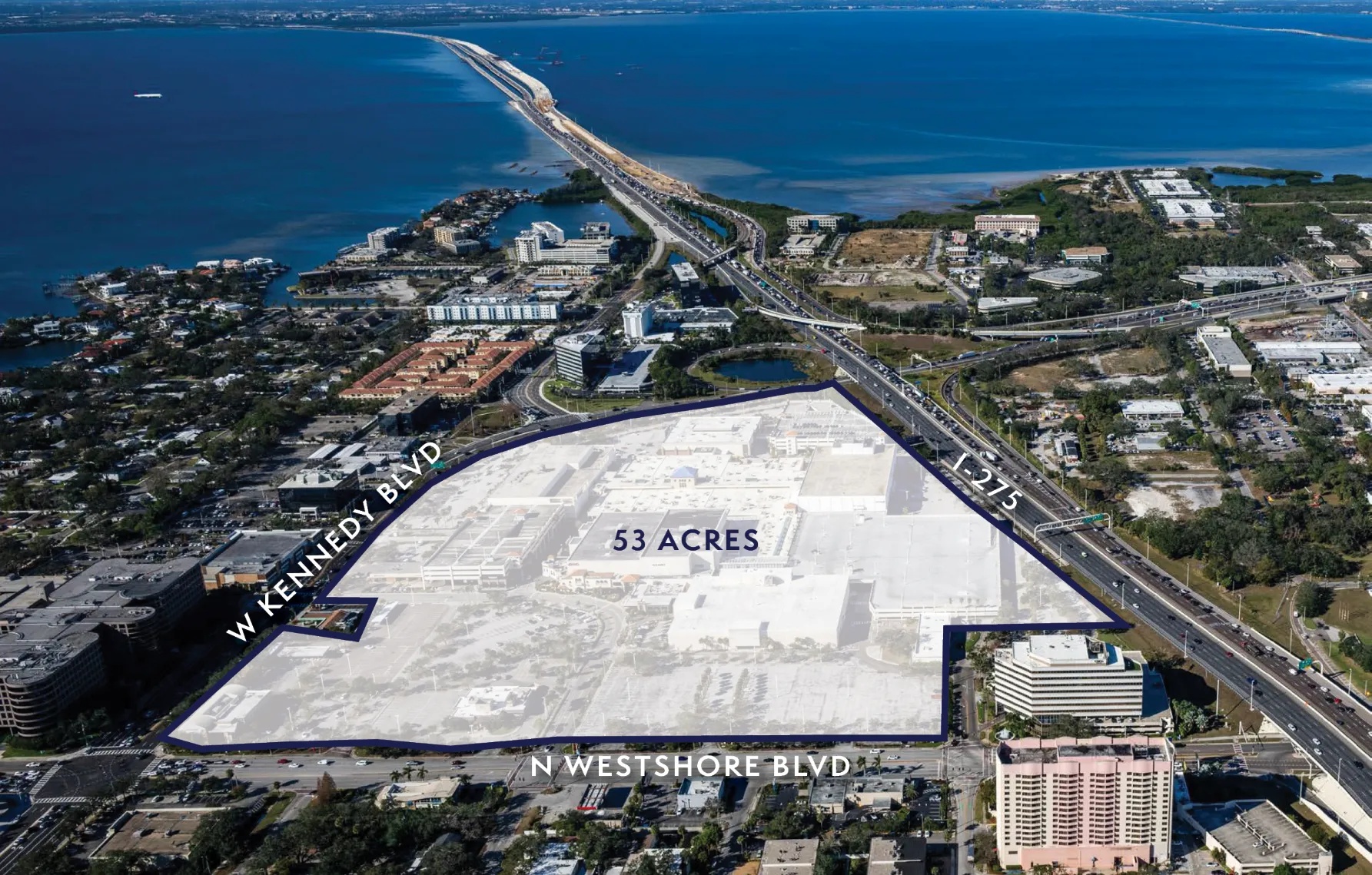
By July 2026, another familiar Florida property was on the agenda. Third Lake Partners and Echelon announced plans for WestShore Plaza in Tampa to become a mixed-use district with homes, shops, dining, entertainment and public gathering spaces. Forsythe’s investment work was now attached to a site already embedded in the habits of a city.
The team said it did not anticipate significant changes to the redevelopment plan approved in 2024. Design and timing would be developed further. That distinction matters to anyone reading an announcement about a place: an approved plan, a detailed design and a finished neighborhood represent different stages of work.
The people already inside the plan
WestShore Plaza also came with people already doing business there. In July 2026, mall tenants were explaining that they remained open despite speculation surrounding the sale. Urban Native Store’s Erik Swope-Wise described the effect of reduced foot traffic and the need to remind customers that the shop was still operating.
The shopping center was 57 years old, occupying a 54-acre property. Westshore Alliance executive director Michael Maurino pointed to the approved 2024 plan while explaining that specific tenants and targets had yet to be identified publicly. For a retailer, the future of a site is also a question about next week’s customers.
That makes redevelopment a different kind of test from document processing. The administrative problem can be expressed in hours and files. The property problem involves a transition that businesses and residents experience in real time. Forsythe’s responsibilities place him in both settings, where the promised future still has to accommodate the present.
Two announcements, two kinds of expansion
On September 4, 2026, Third Lake Partners announced the Alternative Yield Strategy Fund, ticker PAYSX. It converted a private strategy managed since February 2021 into a registered interval fund investing in equity-linked structured notes. The notes’ coupons and repayment terms depend on defined conditions, including the performance of their reference indices.
The announcement described an intended quarterly repurchase offer of up to 25% of net asset value. It also identified Nathan Sheldon as the strategy’s leader. For Forsythe, the launch extended an internally developed investment approach to a broader audience. It added another form of organization around an existing strategy, with a different structure for investor access.
On October 5, the firm announced completion of ClearView at Echelon City Center in St. Petersburg. Developed with Echelon, the community contains 363 units and ground-floor retail; its first residents had arrived earlier in the year. KAST Construction, ARC3 Architecture and Interior Design Group were part of the development team, with ZRS Management managing the property.
ClearView belongs to a wider mixed-use development whose everyday attractions include nearby shops, restaurants and a supermarket. The partners also described 3rd & 3rd, another residential development with retail, as expected to open in the first quarter of 2027. Completion and expectation were again side by side.
The sequence provides a useful ending to Forsythe’s story so far. A fund opens an investment strategy to more people. A residential community opens its doors. Behind each sits a collection of agreements, responsibilities and future actions. His career keeps returning to the work of making those collections usable, year after year, when the people involved will inevitably change.