Before Joe Andrasko was responsible for investment portfolios, he had a rather smaller collection of assets to consider: a fishing boat, a summer job and some unexpectedly promising conversations with customers. In 2004, fresh from Bowdoin College, he was working aboard Captain Tom’s Charters on Nantucket. His winter occupation was teaching at Delbarton, his former school in New Jersey. Boat clients kept mentioning children who needed tutors.
A request from Bambi Mleczko, the captain’s wife, got him started. He tutored a client’s son, hesitated to charge, and received a check anyway. He took it to the bank and started the Nantucket Learning Group. By 2013, the business had fifteen teachers working on Nantucket and Martha’s Vineyard. An afternoon’s conversation had acquired a payroll.
That beginning offers a pleasingly practical introduction to Andrasko, now chief executive officer and chief investment officer of Sands Capital Horizons. His first business grew from a service someone wanted and a skill he already possessed. The later job titles are more elaborate. The problem underneath them remains recognizably human: deciding what to do with an opportunity before its outcome is known.
Two questions that survive the spreadsheet
Years later, at the University of Virginia’s Darden School of Business, that problem had a classroom and a case study. Mike Gaynor, a 2026 MBA graduate, remembered Andrasko teaching “Speed Ventures,” a case in which students consider whether to enter a car in a race despite the possibility of engine failure. The discussion eventually reveals its connection to the Challenger shuttle disaster.
Gaynor recalled two questions Andrasko urged the class to ask in uncertain circumstances: “Is it a smart bet?” and “Can I live with the consequences?” Their usefulness lies partly in their sequence. The first invites analysis. The second asks the decision-maker to stay in the room after the calculations are finished.
“Is it a smart bet?”
Joe Andrasko, as recalled by Darden graduate Mike Gaynor
“Can I live with the consequences?”
A probability can look manageable on a page while the associated loss remains intolerable to the person exposed to it. Conversely, an uncomfortable possibility does not automatically make a decision foolish. These questions leave room for both observations. They also make a wonderfully economical antidote to the meeting in which everyone has admired the model and nobody has discussed what happens if it is wrong.
The emphasis fits Andrasko’s teaching interests. His academic work includes the behavioral side of investment decisions and the development of investment skill through deliberate practice. That second subject gives his classroom a particular edge. A person can accumulate years of experience without examining how those years have changed the quality of their judgment.
A career with several kinds of capital
Andrasko graduated from Bowdoin in 2004 with a degree in economics and Spanish, then worked as an analyst in Deloitte Consulting’s strategy and operations practice from 2006 to 2008. He earned his Darden MBA in 2011. The chronology includes both conventional professional training and the less conventional experience of starting a business while still young.
His investment work has crossed very different settings. He was a founding member and principal of Sustainable Development Capital, a partnership focused on early-stage investments in underserved parts of sub-Saharan Africa. From 2011 to 2019 he worked at Murray Enterprises, a single-family office. He founded Fry’s Path Capital, where he was managing partner from 2019 to 2025, before joining Sands Capital in 2025.
The family-office chapter involved a global portfolio of external investment managers alongside direct investments. Fry’s Path served families with multigenerational wealth and their related foundations. Those assignments put more than one kind of decision on the table: which business to own, which manager to trust, and how different investments should live together in a portfolio.
It is a career that resists being reduced to a favorite stock or a single market sector. The distinction matters. Selecting an investment and selecting someone else to make investments are different tasks, even when both arrive dressed in the same vocabulary. In a family portfolio, they may need to work together for years.
The classroom insists on a defense
Darden announced Andrasko’s appointment as a professor of practice in its Quantitative Analysis area in August 2020, noting that he had already taught decision analysis and finance courses. Sands Capital dates his Darden work to 2015. His teaching has therefore overlapped with his investment career rather than following it as an epilogue.
That overlap becomes visible in students’ descriptions of the work. In September 2026, graduate Carlos Pardal named Applied Security Analysis, taught by Andrasko and Will Snellings, as his favorite MBA course. He described building real investment theses and defending them against forceful questioning. He singled out deliberate practice as a lesson that had changed his approach to development beyond investing.
There is a useful social discomfort in having to defend an idea aloud. A spreadsheet does not interrupt. A classmate can ask why the revenue assumption looks so generous. A teacher can ask what evidence would change the recommendation. The result is a setting where explaining an investment becomes part of evaluating it.
Another graduate, former Army officer Dan Gogue, credited Andrasko and fellow Darden professors Saša Zorc, Max Biggs and Dana Popescu with helping him see how analytics and database tools could support business decisions without requiring him to become a statistician. That is a different sort of teaching result: giving someone permission to use a discipline they had considered distant from their own experience.
In 2021, Darden Capital Management’s student investors also thanked Andrasko for helping them develop mental models for investing. Taken together, these accounts describe practical instruction with a long afterlife. A course ends. A question learned there can turn up much later, inconveniently, just as someone is about to approve a deal.
A famous company still has to pass the test
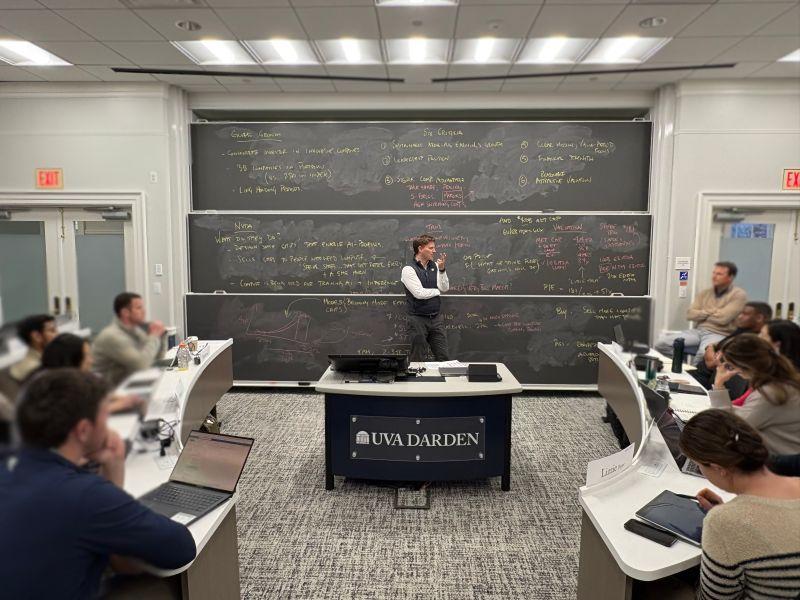
One example of the connection between office and classroom is Andrasko’s invitation to Sands Capital colleague Daniel Pilling to help teach an investment case on NVIDIA. Students used the firm’s six investment criteria to consider the company as a prospective investment, examining growth and earnings power. The familiar name did not remove the analytical work.
The distinction between a company’s visibility and its attractiveness as an investment is easy to lose in a room full of headlines. Teaching a widely discussed business creates a useful problem: students may arrive with an opinion before they have assembled an argument. A case gives them a reason to inspect the machinery beneath that opinion.
Andrasko’s published teaching materials offer other ways into the same exercise. In “Twitter, Inc.: Deal on Hold,” coauthored with Chas Cocke and Stephen E. Maiden and published in January 2025, students take Cocke’s position as an investor evaluating Twitter stock in May 2022. The shares traded at a 35 percent discount to Elon Musk’s agreed purchase price after his announcement that the deal was on hold.
The apparent gap between trading price and purchase price supplies the temptation. The chance of the transaction failing supplies the complication. The case asks students to use decision trees and expected values to weigh the alternatives. A large spread is an invitation to ask a question; it does not contain its own answer.
Family money, software contracts and a toy shop
Other cases move away from celebrity transactions. “DeSouza Family Holdings,” written with Saša Zorc and published in 2022, places students alongside a family-office CIO considering two real-estate proposals brought forward by siblings. The portfolio already contains properties, hotels, grocery stores, stocks, bonds and alternative assets. Risk and expected return have to be considered within that broader collection.
In “Grappling with Uncertainty: Fintop Technology Advisors,” coauthored with Zorc and Samuel E. Bodily, the choice concerns compensation for a software-development project. A proposed $4.5 million contract meets a counteroffer involving a lower payment or a riskier arrangement with a potential bonus in cash or stock options. The setting changes; the obligation to compare possible outcomes remains.
His technical work includes a 2023 note on logistic regression with Benjamin Boatright and Kenneth C. Lichtendahl Jr. It explains how a model generates probability forecasts for binary events, using loan-default data and an Excel add-in. This is the quieter end of investment education: tools that help a person put a number beside uncertainty before arguing about what that number means.
The July 2026 case “Toy Plaza,” coauthored with Zorc, Alvint Sheth and Davide Tomio, considers short selling a struggling retailer. Students examine valuation, investor behavior, institutional ownership and margin requirements. A deteriorating business can make a persuasive thesis while the trade itself still demands scrutiny. The case makes room for that awkward difference.
Horizons, with the homework still attached
At Sands Capital Horizons, Andrasko holds both the executive and investment leadership titles. The firm’s relationship summary describes discretionary and non-discretionary advisory services and investments spanning equities, fixed income, pooled vehicles and real assets. Horizons’ SEC registration became effective on May 6, 2025. That gives the newest chapter a concrete institutional starting point.
The classroom continues alongside it. As recently as September 2026, a graduate was describing the value of having an investment thesis questioned in Andrasko’s course. The recurring activity across these roles is judgment under scrutiny: a proposal, an argument, another person’s objection, and a decision that will eventually meet events.
That is what makes the two classroom questions stick. They are short enough to remember when the presentation is over and specific enough to spoil an easy answer. The numbers deserve attention. So does the person who will have to live with them.