The first time Jim Taylor came to David Spawn’s office to ask for his opinion, he stayed for 45 minutes. There had been no invitation, no advance notice, no carefully rehearsed presentation. Spawn, who had spent years in retail research, remembered being nervous. A chief executive was sitting in his office, interested in what he knew.
Then Taylor came back. Sometimes he brought other leaders. The visits became familiar enough for the initial discomfort to ease. Spawn’s recollection offers a useful way into a career usually described in the language of transactions: a senior decision-maker choosing to spend time with somebody whose job was to understand the market.
Information has an awkward journey through a large company. It can lose its detail as it moves upward, acquiring polish at every stop. Walking into an office shortens the journey considerably. It also makes a small promise to the person inside: your work might change what we do.
Taylor ran Brixmor Property Group from May 2016 through the end of 2025. He retired before Brian Finnegan became CEO and president on January 1, 2026. Brixmor announced Taylor’s passing that June. Looking back at his working life, the office visit belongs beside the financial milestones. It shows how he went looking for things that a report alone might miss.

Several careers before the corner office
Taylor’s professional training gave him several ways to read a business. He worked as a senior accountant at Price Waterhouse in Washington, practiced corporate and securities law at Hunton & Williams, and moved into real estate investment banking. He held both a commerce degree and a law degree from the University of Virginia.
At Eastdil Secured and Wells Fargo, his responsibilities grew to include leading real estate investment banking. His transaction experience exceeded $100 billion, spanning public debt and equity offerings, mergers, property sales, private placements, mortgages and bank loans. Those were different instruments for answering a recurring question: how should a real estate business finance what comes next?
In 2012, he joined Federal Realty as executive vice president, chief financial officer and treasurer. The role extended beyond raising money and accounting for it. He evaluated opportunities in the East Coast portfolio and had operational oversight of the Southeast portfolio. He was now working inside the business that would live with the decisions after a transaction closed.
When he left four years later, Federal Realty CEO Don Wood described a colleague whose advice the management team would miss. The announcement carried the ordinary mechanics of an executive departure, including the search for a successor. It also recorded the trust built during those four years.
- AccountingPrice Waterhouse
- LawHunton & Williams
- 1998–2012Real estate banking
- 2012–2016Federal Realty CFO
- 2016–2025Brixmor CEO
Brixmor announced his appointment in April 2016, with a May 20 start. He succeeded interim CEO Daniel Hurwitz. At the time, the company described a portfolio of 518 properties and approximately 87 million square feet. It was a substantial collection of places where the quality of a national strategy would eventually be tested by a very local question: did people want to come here?
The business inside the familiar address
Shopping centers can become so familiar that their possibilities disappear from view. Customers know where to turn into the parking lot. They know the grocery store, the discount retailer, the place to collect dinner. For an owner, that familiarity is useful only if the center keeps earning the next visit.
By 2017, Taylor was explaining a strategy that combined selling properties with improving those Brixmor retained. Private buyers were interested in community and neighborhood centers, giving the company an audience for asset sales. Redevelopment offered a route to growth inside the remaining portfolio. Specialty grocers and quick-service restaurants were among the businesses he identified as traffic drivers.
There was judgment in both decisions. Selling a property could release capital. Keeping one created an obligation to consider its next use. The balance mattered more than a headline property count. An owner could get smaller while concentrating its attention and money on places with a stronger future.
By 2023, Taylor was describing another advantage: retailers still wanted locations, while relatively little new open-air shopping-center space had been built. Some tenants saw disruption elsewhere in retail as a chance to secure their next stores. A vacant space could therefore be a problem with an interested replacement waiting nearby.
He also pointed to the land around existing buildings. Portions of large parking lots could accommodate more retail. In some cases, existing space could be converted to a more productive use. The familiar outline of a shopping center concealed decisions about density, circulation and what belonged beside what.
“Great real estate matters, but great people matter far more.”
Jim Taylor, 2024
During 2024, Taylor kept returning to the relationship between limited supply and retailer demand. He also spoke about acquisitions beginning to fit Brixmor’s financing costs and geographic priorities. Opportunity depended on price as well as property quality. A promising address still needed numbers that worked.
Later that year, his account of tenant turnover was equally practical: replacing a struggling occupant with a stronger business could improve rent and bring more customers to the center. That described a chain of effects rather than a single leasing victory. A better neighbor could matter to the businesses already there.
Patience, with numbers attached
In a 2025 interview, Taylor described the financial distance Brixmor had traveled. Average rent already in place had been about $12 per square foot when the strategy began; it was then above $18. New leases, previously signed in the middle to upper teens, were being signed in the middle twenties.
He paired that progress with a change in the balance sheet. Debt relative to earnings before interest, taxes, depreciation and amortization had fallen from more than 7.5 times to about 5.5 times. He described an annual reinvestment program of $150 million to $200 million funded by free cash flow.
A rent roll that moved
Average annualized base rent in place, per square foot. Historical figures described by Taylor in his 2025 interview; bars are illustrative, with a $20 scale.
These are historical measures, tied to when he discussed them. They explain what patience meant in his account: reinvestment that could support higher rents while reducing financial pressure. The appealing part of such a plan is its repeatability. The demanding part is that it has to keep working, property by property.
A lease signed at a better rate is a result. The daily work that makes a retailer willing to sign it is harder to summarize. Construction must finish, the center must function, and the surrounding mix must make sense. A financial strategy eventually arrives at somebody’s work order.
Making room for other people’s judgment
Taylor’s 2024 message to the company described that division of labor plainly. Leasing teams brought in tenants. Redevelopment and construction teams improved centers. Property managers attended to condition and customer experience. Investment teams handled purchases and sales, supported by the company’s finances. His account gave each group a place in the result.
The photographs of Taylor at work often include other people: around an earnings-call table, at an employee meeting, beside a visiting speaker. At Brixmor, employee learning acquired its own recurring event, Big Brain Day. The gatherings began in 2017 and brought in speakers from different fields.
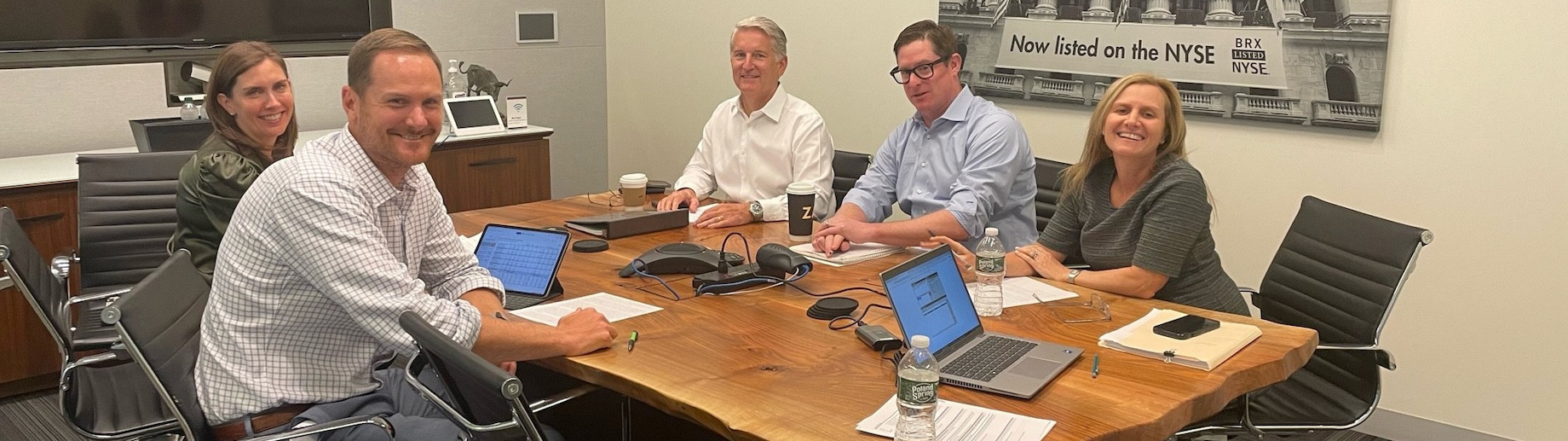
After Taylor’s passing, Finnegan recalled the thinking behind those sessions: even helping one colleague improve made the effort worthwhile. He said the company would continue them. That is a modest, testable form of continuity. The calendar provides the evidence.
Marketing executive Kristen Moore remembered Taylor asking for her opinion and pausing when she disagreed. Her recollection adds something consequential to the pleasant description of an approachable boss. Listening becomes useful when disagreement can survive the conversation.
That was the larger implication of Spawn’s unexpected office visitor. Curiosity from the person at the top gives people permission to offer something less polished than a consensus. A business with hundreds of properties needs local judgment. It also needs a way for that judgment to reach someone who can act.
A Thunderbird, a river, and work that continued
Away from business, Taylor’s interests included books, classic cars and the University of Virginia Cavaliers. He owned a 1964 Ford Thunderbird given to him by his grandfather. He enjoyed historical nonfiction and John Grisham novels, and found relaxation by Southern Maryland’s St. Marys River. These details put a person back into a résumé crowded with institutions.
He also served as ICSC’s 2024 chair, extending his work into an industry association where retailers, owners and the people who connect them meet. His career had repeatedly brought those different perspectives into the same conversation.
In September 2026, Brixmor offered a tangible account of what continued in his name. Its Jim Taylor Day of Service brought employees together for food drives and local volunteer projects. The food collections generated more than 36,000 pounds. Teams also supported projects ranging from foster-care supplies in Orlando to habitat work near Detroit.
The connection to his working life is straightforward. A shopping center belongs to a place before it belongs in an investor presentation. The employees who operate it know that place through daily contact. Taylor’s habit was to get close enough to hear what they knew. The office door, like the shopping-center entrance, was somewhere to begin.
Continue the conversation
Interviews, career records and the work that continues.