Jim Continenza can run Kodak. He cannot make its film. He is unusually happy to explain the distinction. In conversations with employees, the executive chairman and chief executive has made a point of acknowledging that the people operating the equipment possess knowledge he does not. For a company whose name once seemed to explain itself, that is a useful place to begin: with somebody who knows how something actually works.
One encouraging encounter involved experienced employees thinking about retirement. They wanted to pass their knowledge to younger colleagues. Continenza heard something beyond a staffing problem. People were imagining a future worth preparing for. After years of upheaval, that was a consequential change in the conversation. A spreadsheet could record the cost of a new hire. It would struggle to record the moment someone decided there ought to be one.
His response to Kodak’s predicament has the practical emphasis of that exchange. Find the skills. Understand the customers. Repair the machinery and the finances. Make something people will pay for. The difficulty, naturally, lies in the distance between saying those things and getting an old, complicated organization to do them.
A chair at the kitchen table
Continenza grew up in Saint Paul, Minnesota, in a large Italian family. His father was an immigrant and a blue-collar worker; money could be tight. He studied at the University of Wisconsin-River Falls, graduating in 1984, and met his future wife, Sandi, there. These are modest biographical details beside the corporate titles. They help explain why his account of leadership so often returns to work, family and the people doing the making.
Cooking is one of his preferred ways of talking about it. His Italian mother made food from scratch, including noodles and sausage. He inherited the enthusiasm, along with an appreciation for doing something useful with the ingredients at hand. A kitchen is an unforgiving place for vague intentions. Dinner has to arrive, preferably before the guests begin considering the bread basket a main course.
In describing his management approach, Continenza welcomes disagreement and direct conversation. The cooking comparison is appealing because it puts expertise ahead of ceremony. Having the recipe does not confer the cook’s judgment. A company can own equipment, patents and a familiar name, yet still need to learn how to put them together in a way a customer wants.
“I don’t need yes people around me.”
Jim Continenza
Learning to arrive after the trouble
Before Kodak, Continenza’s career crossed telecommunications and marketing technology. His leadership roles included AT&T, Lucent Technologies Product Finance, Teligent and STi Prepaid. He also led Vivial. His board experience extends across businesses including Sorenson Communications, Cenveo, Tembec, Neff and Datasite. The list matters less as a collection of names than as evidence of a career spent dealing with different operating problems.
At Vivial, the assignment involved helping businesses connect with consumers as marketing moved across digital, social and mobile channels. In 2018, he was leading more than 1,000 people across 20 markets. Simplifying a complicated set of services was part of the proposition. A small business owner had customers to find and limited time to spend becoming an expert in every new channel.
His writing from that period also paid attention to employees. He described Vivial’s ambassador program, which let people in different offices share their work, interests and community activities. Recognition and belonging featured prominently in his argument. Long before Kodak’s factory conversations became part of his public identity, he was making the case that employees help determine what a business means to the outside world.
The famous name and the awkward question
Kodak entered Chapter 11 in 2012. Continenza joined its board in April 2013, during the bankruptcy process, and became chairman that September. His executive chairmanship began in February 2019; the CEO title followed in July 2020. The sequence is worth keeping straight. He had spent years around the business before taking responsibility for its daily direction.
He has described asking more than 1,000 employees assembled in Kodak’s theater what the company did. The answer proved elusive. That is a peculiar problem for such a recognizable brand. Almost anyone could tell a story about Kodak. A useful description of the business it should become was harder to produce.
His diagnosis concentrated on capabilities and customers. Manufacturing products that attracted little demand was an expensive habit. Understanding what the company could make well, and who needed it, offered a more workable starting point. The resulting emphasis on industrial manufacturing gave the familiar name a specific job to do.
There is a temptation to treat a turnaround as a speech followed by a rising line. Continenza’s account is more concerned with maintenance: investment in equipment, fewer competing directions and a clearer understanding of what earns its place. Corporate identity, in this version, has to survive a visit to the factory.
A phone call from the movies
One person with a very definite view of what Kodak should keep doing was Christopher Nolan. Continenza has recalled the director calling on his first day and asking whether Kodak would remain in film. In another account, the immediate concern was the proposed shutdown of an acetate factory, part of the physical chain that makes film possible. A director’s creative preference had arrived as an industrial question.
It is an unusually revealing connection. A filmmaker needs the material; the manufacturer needs a reason to maintain the capability. Keeping film available requires decisions about equipment and capacity long before an audience sees the finished picture. The glamour occupies one end of a chain whose other end involves considerable machinery.
Continenza says Kodak stayed with film because it belonged to the company’s identity, rather than solely because a director requested it. The distinction gives the story some weight. Listening to an influential customer can open a discussion. Committing to production requires believing the work belongs in the business.
The small word in his printing argument
In commercial printing, Continenza has argued for a modest conjunction: “and.” Offset and digital. Existing machinery and newer methods. The proposition has the advantage of acknowledging what customers already own. A printer’s investment does not vanish simply because a more recent technology has acquired a persuasive demonstration booth.
Writing after drupa 2024, he emphasized that offset still accounted for more than 90 percent of printed pages, while inkjet was advancing. That was his description of the market at the time, rather than a timeless forecast. His practical argument was that printers needed to understand how different production methods could serve different jobs and work together.
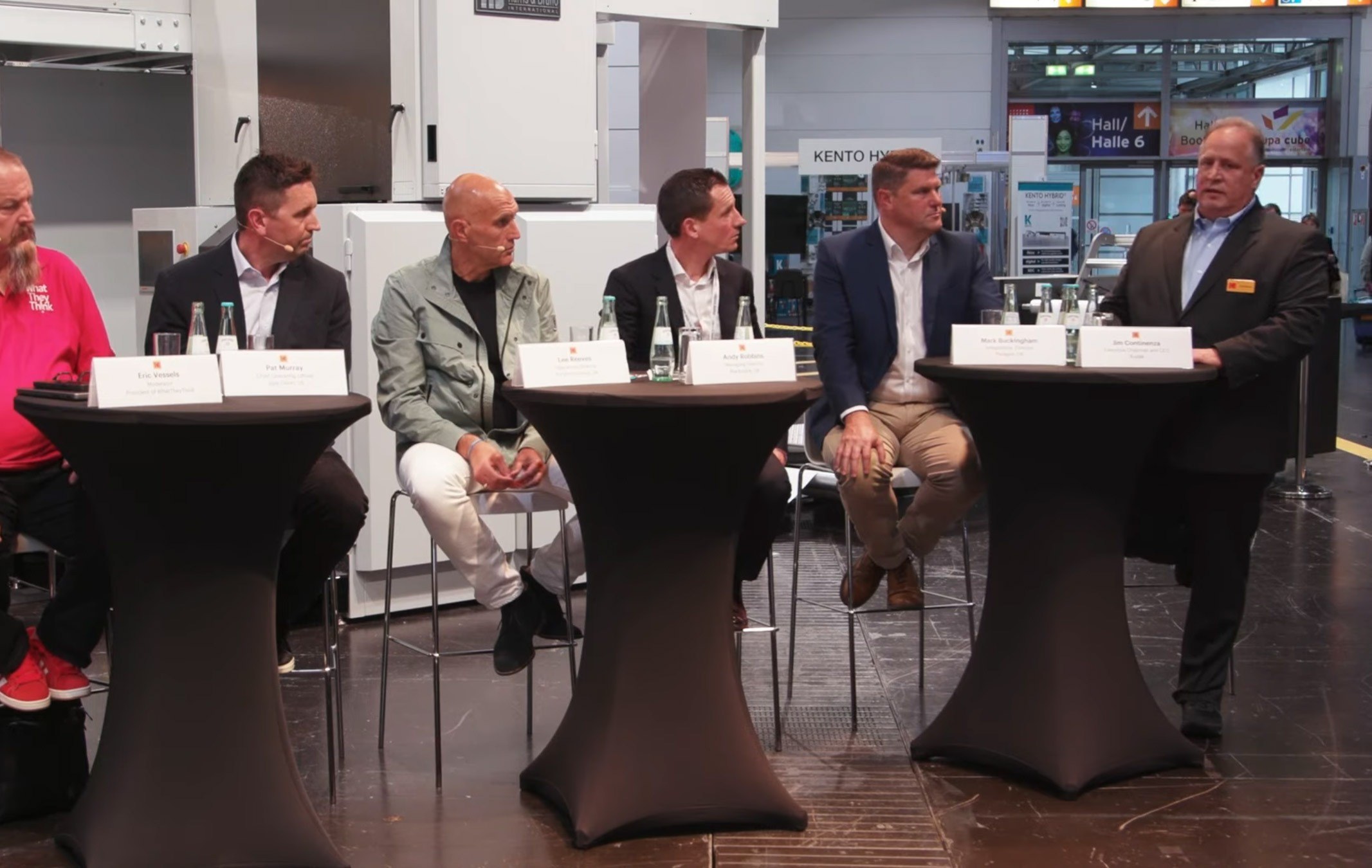
The customer roundtable at Kodak’s booth brought him into discussion with representatives of Japs-Olson, Pureprint, Blackmore and Paragon. It put buyers into the argument about the industry’s direction. The photograph has none of the usual solitude of executive portraiture: several people, several microphones, and machines close at hand.
For Continenza, a sale has to make economic sense on the other side of the table. “We only win if our customers sell,” he said in a 2022 interview about printing and packaging. It is a useful constraint on enthusiasm. A manufacturer can enjoy its own technology indefinitely. A customer eventually needs a paying job to put through it.
Chemistry · coating · print↓Production
Equipment · people · investment↓Customer demand
A product with a paying purpose
Getting out of the office
Continenza’s preference for visiting plants and customers runs through his descriptions of the job. He has argued that sales and operations should drive a company organized around serving customers. He values the people who can make film, inks and printers, repair equipment and improve processes. That is a fairly concrete definition of whom an executive ought to listen to.
He has supported meetings across reporting levels and customer participation in product development. The organizational implication is straightforward: useful information should have a route to the people making decisions. An impressive chain of command can become a very long journey for a small, fixable problem.
The machinery has needed attention too. In November 2024, Kodak temporarily shut down film manufacturing in Rochester for planned modernization. Chief technical officer Terry Taber described upgrades to air handling, dehumidification and air supply for the coating machine. Kodak was also recruiting and strengthening apprenticeship programs. These are less picturesque details than a director’s telephone call, but they belong in the same story. Continuing to make film involves maintaining the conditions in which it can be made.
A comeback measured in quarters
By August 2026, there were clearer signs of progress. Kodak reported second-quarter revenue of $311 million, up from $263 million a year earlier. Gross profit rose from $51 million to $82 million. The company reported GAAP net income of $17 million, compared with a $26 million loss in the corresponding quarter of 2025.
Advanced Materials & Chemicals revenue increased 40 percent to $105 million. Print revenue increased 10 percent to $195 million. Kodak said this was its fourth consecutive quarter of year-over-year growth in revenue, gross profit and Operational EBITDA. The last measure is non-GAAP and should be read alongside the reported accounts.
More work coming through
The annual picture provides a necessary second view. Kodak’s 2025 revenue was $1.069 billion, up from $1.043 billion in 2024, yet it recorded a full-year GAAP net loss of $128 million. Progress in an operating business and the final accounting result can tell different parts of the story. A good quarter deserves attention without being asked to settle every question about the future.
Continenza’s stated next steps include expanding core businesses, improving efficiency and investing further in research and development. Those ambitions leave plenty of work for the people he visits on the shop floor. The test continues with the next product, the next production run and the next customer willing to place an order.
That early conversation about passing knowledge on remains a fitting measure of his project. An experienced worker needed someone to teach. The company needed a reason to keep teaching. Continenza’s job is to make those two needs meet, with a business sturdy enough to carry the knowledge forward.
Keep the conversation going
- OfficialKodak biography
- Personal profileJim Continenza on LinkedIn
- Company channelKodak on X
- Company channelKodak on Instagram
- Company channelKodak on Facebook
- Watch · YouTubeConversation about print and packaging
- Listen · BBC interviewReinventing a brand
- Watch · Sponsored interviewKodak business update with David Zwang
- Watch · Customer discussionThe drupa customer roundtable
- Read · Sponsored interviewCooking and management
- Read · InterviewThe June 2026 conversation
- Read · Company resultsSecond-quarter 2026 results