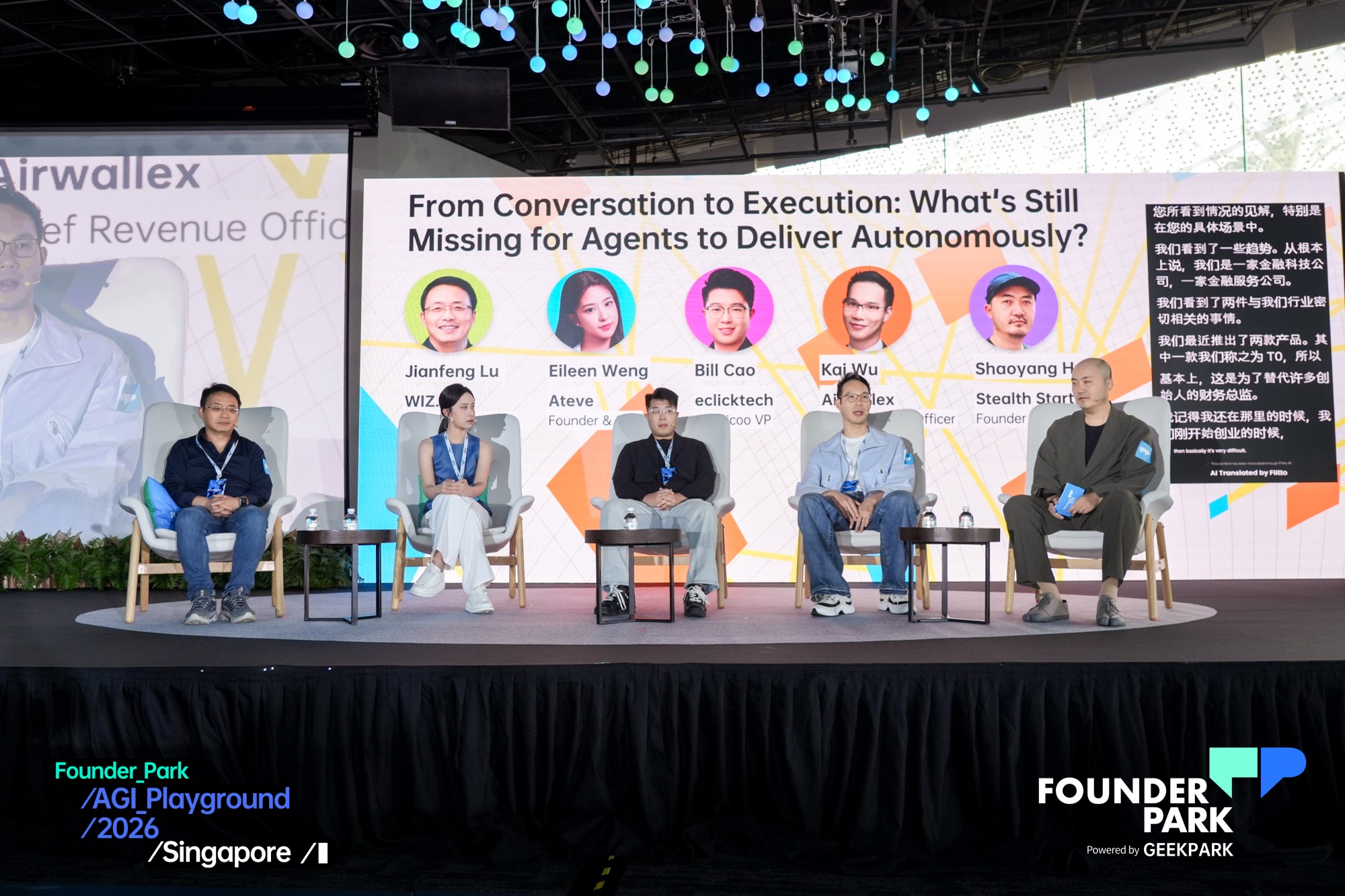
At a Singapore panel in August 2026, Jianfeng Lu put a surprisingly small number on a very large ambition. A voice agent, he said, should begin replying within two seconds after a caller stops speaking. Let the pause stretch and the person at the other end may simply hang up. The future of artificial intelligence has an appointment with someone who has other things to do.
Lu is WIZ.AI’s co-founder, chairman and CEO. His business makes AI systems for enterprise customer conversations. In his telling, their examination takes place on telephone networks, mobile connections and corporate phone systems, under conditions that a polished demonstration can politely leave outside the room. A customer calling a business has brought a problem. They are unlikely to award extra marks for an impressive underlying model.
That gives his story a useful tension. He wants to build across borders, yet the work keeps pulling him toward particulars: a language, a business process, a caller’s expectation. His public appearances return to this ground with the persistence of someone checking whether a door really locks. Intelligence gets attention. Dependability gets another call.
Lu’s stated target for beginning a reply after the caller stops speaking.
A response target discussed in August 2026, not a measured performance result.Before the voice came the software
Lu’s route to WIZ.AI runs through software businesses with very different jobs. He spent nearly a decade at Trend Micro, serving as a senior director and heading its China Development Center. He then founded and led Mozhe, a social interaction platform acquired by Qihoo 360 in 2009. After the acquisition, he served as a vice president at the buyer.
The sequence matters because WIZ.AI was a return to company building, rather than his first encounter with it. He had worked inside an established technology organization, built a venture of his own and crossed the boundary between startup and acquirer. These are different vantage points on the same awkward question: what happens to a piece of software once people depend on it?
He also became an angel investor, with activity spanning China, the United States and Southeast Asia. That gives him a seat on both sides of the founder’s conversation. A product must persuade customers to use it; a company must persuade other people that the effort can last. Lu’s career has required both kinds of persuasion.
A global company, one accent at a time
In 2019, Lu co-founded WIZ.AI in Singapore with Jennifer Zhang. They chose a base from which the company could work internationally. Singapore offered access to regional markets and a setting for a team with ambitions beyond one country. Lu’s formulation was direct: “If you want to become a global startup, you must begin as a global startup.”
That is an appealing sentence for a pitch deck. The practical consequences are less tidy. A regional map makes neighboring countries look conveniently adjacent. A conversation reveals how much separates them. Speech carries local pronunciation, vocabulary and expectations. A customer service product has to meet those differences where they occur, rather than ask callers to tidy themselves up for the software.
WIZ.AI’s early approach put research, product and delivery people into markets before sales teams. It built for speech varieties including Singlish, Bahasa Indonesia and Tagalog. The order is revealing. Understanding how a product should behave came ahead of asking someone to buy it. Local knowledge belonged in the construction of the product itself.
Even preparing training material became an operating problem. Data annotation initially took four months. A crowdsourcing system using annotators in different countries brought that turnaround below three weeks, according to the company. The improvement made expansion more manageable. Hidden inside an international growth story was a rather practical achievement: shortening the wait for useful information.
The approach also changes what counts as preparation. Language work and delivery capacity become commitments made before a customer signs. That requires patience from a young business. It puts resources into understanding a place while the return is still a possibility, and makes the team’s local experience part of what the company is selling.
For Lu, the global ambition therefore involves a curious discipline. The company must repeat its ability to learn without assuming that what it learned in one place transfers intact to the next. Each market offers another test of that distinction. A border may take seconds to cross on a slide; earning comprehension takes longer.
A global ambition creates local homework.The WIZ.AI approach
The boss, the tea and the daily huddle
There is a more domestic version of Lu in a 2020 discussion about remote engineering teams. He recalled the appeal of working from home: time saved on commuting, his favorite tea and the pleasure of listening to his expensive speakers. He could see the attraction perfectly well. He could also see the distractions.
His response as a manager was a daily huddle, giving colleagues a way to state what they intended to accomplish and prepare for each other’s handoffs. He favored short goals and quick feedback. The picture is recognizable: someone who enjoys the comforts of home trying to arrange a working day in which everyone can still get something finished.
The anecdote puts a human scale on his interest in execution. A plan is useful when the next person can act on it. The same is true of software. A voice system may sound fluent, but its contribution becomes clearer when a conversation leaves the business and the customer ready for the next step. There is some comedy in finding the future of automation sharing a concern with the morning team meeting.
An impressive answer still needs a useful ending
By 2022, Lu was describing a Talkbot that could speak ten languages, including English, Bahasa Indonesia, Malay, Thai and Spanish. He named DBS, Singtel and SeaMoney among its enterprise customers. The product had moved into situations where a conversation was part of a business relationship, with expectations attached to both sides of the line.
The arrival of large language models widened the possibilities and made the familiar problems more conspicuous. In an April 2023 discussion, Lu identified accuracy, data security and response time as hurdles. He described people stepping in when bots failed to respond properly, alongside a correction process that allowed customer experience designers to update them. Human involvement was part of making the system usable.
It is easy to be charmed by a machine’s confident delivery. Customers have a sterner test available: whether its answer helps. Lu’s attention to correction makes room for an unfashionable virtue in a technology business, the willingness to revise something that already looked convincing. Fluency can be heard immediately. Usefulness may require following the conversation all the way to its consequence.
At the August 2026 panel, his test included first-call resolution and comparisons with human agents. He described evaluating replacement models against actual conversations before deciding whether they were ready for production. The question was how well the system completed work. For a company selling conversation, that is a sensible place to put the full stop.
Making room for other people to learn
Lu has also taken his interest in AI beyond WIZ.AI. He founded One North Foundation, a nonprofit initiative rooted in Singapore and concerned with AI research, applications and talent development. Its team includes computer scientist Hongjiang Zhang as chief advisor. The organization gives his public ambitions a second address, outside the commercial company.
One foundation event paired Lu with MyScale founder Cheng Tai for a discussion intended to connect advanced AI with everyday applications. The invitation explicitly welcomed people without technical expertise. That choice of audience matters. If AI is to become part of ordinary work, the conversation has to make room for the people expected to use it.
His own public posts describe a desire to connect entrepreneurs, developers, practitioners and researchers. Building a community involves another sort of translation: helping people with different professional vocabularies understand what they can do together. A founder, an engineer and a business user can all say “AI” while picturing rather different afternoons.
At a Business China dialogue on 14 August 2025, moderated by Kwek Poh Heok, Lu discussed adapting technology to multilingual and multicultural markets. He also addressed the relationship between people and AI, describing a movement toward “human-machine co-evolution”. The phrase carries a practical implication. Adopting a new system changes the work around it, including what people need to learn and where they exercise judgment.
The ambition survives the ordinary call
By the time of his current public speaker biography, WIZ.AI reported serving more than 300 enterprise clients across 17 countries. Those are company figures, and they describe a substantial distance from the Singapore start in 2019. They also bring the original problem into sharper focus. More markets mean more occasions for a small misunderstanding to become a real customer problem.
Lu’s trajectory has a pleasingly stubborn continuity. The tools have changed, and the vocabulary has grown to include large language models and multi-agent systems. His recurring interests remain legible: software that people can use, teams that can deliver it, and enough attention to context to make expansion work. The fascination lies in how much detail an international ambition demands.
A telephone conversation is a modest setting for all this. There is no requirement that the caller admire the engineering or know the founder’s name. They may only want to settle an issue and return to their day. For Lu, that ordinary ending is a demanding ambition in its own right: a voice understood, a task completed, and a customer with a reason to stay on the line.