In 1984, Dimitris Vassos taught a home computer to respond to clapping and control the lights. The machine could recognise a sound pattern. It could not hold a conversation. For a child fascinated by the traffic between people and computers, that was enough to get started. Before there was a company, a funding round or a customer service platform, there was a small domestic experiment: make a machine do something useful without typing instructions into it.
There is something pleasingly direct about that beginning. A clap is an instruction with the paperwork removed. The experiment also gives Vassos’s later career a recognisable shape. He kept working on the distance between what a person means and what a computer can do with it. The rooms became contact centres. The sounds became sentences. The ambition acquired a commercial address, but the basic problem remained surprisingly familiar.
A mother, a telephone, a design brief
Vassos often returns to his mother when explaining the customer he has in mind. An engineer can learn the conventions of a computer. His mother should be able to deal with her bank without learning the conventions of a telephone menu. This is his practical reference point for natural language technology: someone who wants a service and has no professional interest in the machinery delivering it.
That is a useful person to keep in the room. A customer calling a bank has already supplied the purpose of the conversation. Asking that customer to translate the purpose into a sequence of numbered options adds another job. The menu may be perfectly orderly while the experience is perfectly irritating. Vassos has spent much of his working life inside that mismatch.
His education gave the interest technical substance. At Imperial College London, he studied Information Systems Engineering from 1989 to 1992, then Digital Communications and Signal Processing for a master’s degree from 1996 to 1997. Speech processing offered a way to pursue the interface that had attracted him as a child. Sound could become usable information; language could become an instruction a system understood.
His career began at IBM UK in 1997, working on voice technology. He contributed to the development and international rollout of IBM’s voice products. It was an education in delivering systems beyond the laboratory, across markets and customers. It also placed him close to automated telephone services and the frustrations they produced. A technology can work according to its specifications and still leave its user wishing for a human.
“Everybody hated IVR, including me.”
Dimitris Vassos
The garage had customers to answer to
In 2002, Vassos returned to Greece and founded Omilia, starting in his garage. Pelias Ioannidis was his co-founder and financial partner; John Nikolaidis became part of the founding team. Their starting business was integration: assemble other vendors’ software into automated voice systems for customers. Owning every component was still ahead of them.
Integration is a modest word for an unforgiving responsibility. A customer buys a working service. The customer has little reason to care which supplier made the part that fails. Vassos and his colleagues were promising a better interaction, then discovering that some of the products they had bought did not deliver the language capabilities advertised. The gap arrived on their doorstep because the promise to the customer was theirs.
He has described how Omilia began replacing those components with its own software, piece by piece. This makes the garage story more interesting than the usual romance of cheap rent and ambition. The technical independence grew out of a delivery problem. Building software gave the team a way to control the parts on which its commitments depended.
There was a commercial pressure too. In Vassos’s account of the early years, an American technology supplier requested Omilia’s customer list, then approached those customers directly. The relationship exposed the risk of depending on a supplier that could also compete for the business. Omilia’s development of its own technology gave it a different footing. The company responsible for the customer’s experience could increasingly own the tools behind that experience.
An introduction across an ocean
Vassos’s account of entering the American market has a welcome lack of inevitability. The United States had seemed a distant prospect. Then a Ukrainian bank presented Omilia’s product to an American audience, helping attract interest in 2016. A customer’s experience travelled further than the founders had expected their company to travel at that point.
He also credits a successful Royal Bank of Canada implementation with helping establish Omilia’s North American presence. The two episodes show the importance of customers in this story. A bank using a system has a different sort of persuasive power from a founder explaining what the system might eventually do. The introduction comes attached to a working relationship.
By 2017, Vassos had been named one of Speech Technology’s Speech Industry Luminaries. The recognition concerned his work on natural language interaction and the stack Omilia was developing across speech recognition, language understanding, dialogue and authentication. It was a public marker for a career already two decades into the voice business.
That stretch of time is easy to miss when conversational AI is discussed as a recent arrival. Vassos’s work began with telephone automation, well before today’s familiar generative tools. His titles at Omilia combine CEO, co-founder and chief architect. The combination suits this history: the commercial promise and the technical choices have been intertwined since customers first relied on the company.
An interface that gets out of the way
Vassos has a compact design principle: “good tech is invisible tech”. It is a demanding idea for a business selling technology. The product succeeds when the customer can get on with the purpose of the call. Attention belongs to the task, rather than to the system’s need for a particular phrase or sequence.
Consider identity checks. Vassos has described the irritation of answering repeated questions before a service conversation can begin. Voice authentication is one part of Omilia’s work, alongside understanding language and managing dialogue. The attraction is straightforward: an identity check that fits the interaction can remove a separate obstacle. The engineering challenge is to make that convenience dependable.
The same principle helps explain why conversational software involves several jobs. Hearing the words, understanding a request, preserving the context and carrying out the next step each matter. A fluent response can still leave a caller with unfinished business. An elegant interface has to survive the untidy details of the request it receives.
- HearRecognise the speech.
- UnderstandIdentify the request.
- ContinueKeep the context.
- ActAdvance the task.
A conceptual guide to the work involved, rather than a product architecture diagram.
A bank call becomes a lunch order
By December 2023, Vassos was discussing drive-through ordering as another setting for Omilia’s work. He described a restaurant project aimed at taking orders by voice and freeing staff to concentrate on preparing food. The customer had moved from the telephone to the car, but the requirement was recognisable: understand an ordinary request and help complete it.
In the same conversation, he stressed that enterprise AI needed control, privacy and security. He discussed synthetic voices and the work required to detect fraudulent use. For him, the ability to generate a convincing voice also creates a reason to scrutinise one. A natural-sounding interaction and a trustworthy interaction have to be built together.
His 2024 predictions put human agents inside that development process. He envisaged staff training and supervising bots, with their experience improving automated service. He also predicted wider restaurant adoption and greater automation of contact centre transactions. These were ambitions for how work could change. They should be read as his expectations, rather than as a timetable already fulfilled.
The restaurant work has since acquired a named customer and a reported footprint. Omilia’s August 2026 announcement described an expanded Taco Bell agreement and a deployment spanning more than 1,000 US drive-throughs across 38 states. The company also announced Lexis, its text-to-speech model for enterprise contact centres. The sound coming out of the machine had become another part of the stack.
Twenty-four years, and another round of building
On August 6, 2026, Omilia announced a $67 million Series B led by Expedition Growth Capital. The announcement reported annualised recurring revenue above $60 million and more than tenfold growth since its Series A. These are company-reported measures of the business Vassos and his colleagues have built, rather than a measure of his personal wealth.
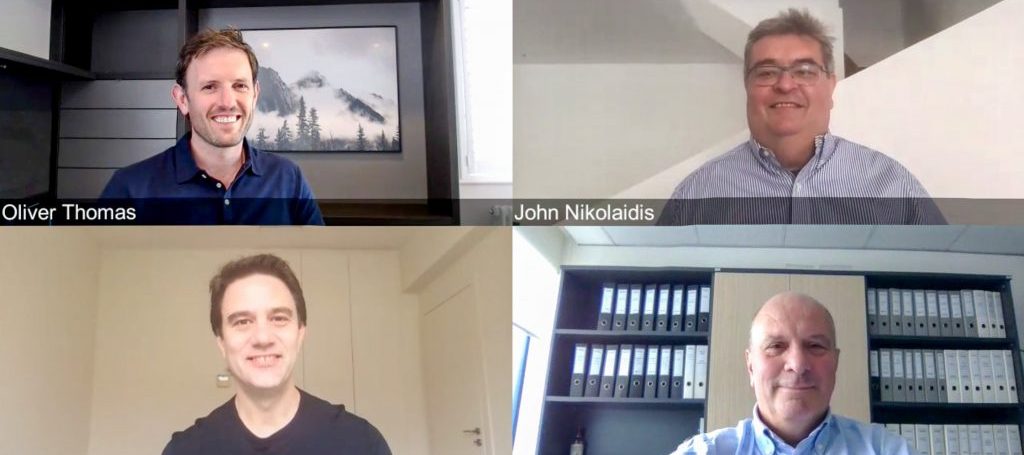
The investor relationship has its own continuity. Oliver Thomas led the 2020 Grafton investment and joined Omilia’s board. Expedition invested in December 2021 and led the new round in 2026. Vassos has described Thomas as someone who understands how the founders work and supports them. The money comes with a relationship that predates the latest announcement.
The next commercial task is wider distribution. Omilia said the funding would support North American and global expansion. For Vassos, that means more enterprises using the capability his team has spent years developing. The founding problem remains a useful test of all that growth: can an ordinary person ask for something, be understood and get the job done?
The child’s lighting experiment offered an unusually neat result. A sound could change a room. Customer service supplies messier results, with more words, more intentions and more people depending on what happens next. Vassos has stayed with that difficulty for decades. A caller who finishes the task may never think about the architect behind it. His own design principle makes that a rather satisfying ending.