She spent ten years asking people why they do what they do. Then she built a court and sold them a reason to keep coming back.
Walk past the Ferry Building in San Francisco and you'll see them: glass-walled courts, blue surface, people swatting a low-bouncing ball off the back wall and laughing about it. That is Jessica Talbert's doing.
She runs Park Padel, the company she co-founded in 2022 and now leads as CEO. The pitch is simple and slightly audacious. Take a sport that 20,000 courts' worth of Spain already adores, drop it into the most foot-trafficked plaza in downtown San Francisco, and dare commuters, tourists and tech workers to ignore it. They didn't.
Park Padel is a women and minority-owned business with a $5M seed round behind it, a six-court flagship in South San Francisco, an outdoor club up in West Sacramento, and a founder who talks about membership the way a behavioral scientist talks about an experiment. Because that is what she was. For more than a decade, Talbert worked as a strategic UX researcher - the person companies hire to figure out why humans actually behave the way they do - at Chime, Lyft, the kids' fundraising startup Boon Supply, and Stanford's Graduate School of Business.
She didn't leave that world to escape it. She brought it with her. Every decision at Park Padel - where to put a court, how to price a membership, who feels welcome walking in - runs through the same human-centered lens she sharpened studying app users. The product just got a lot more physical.
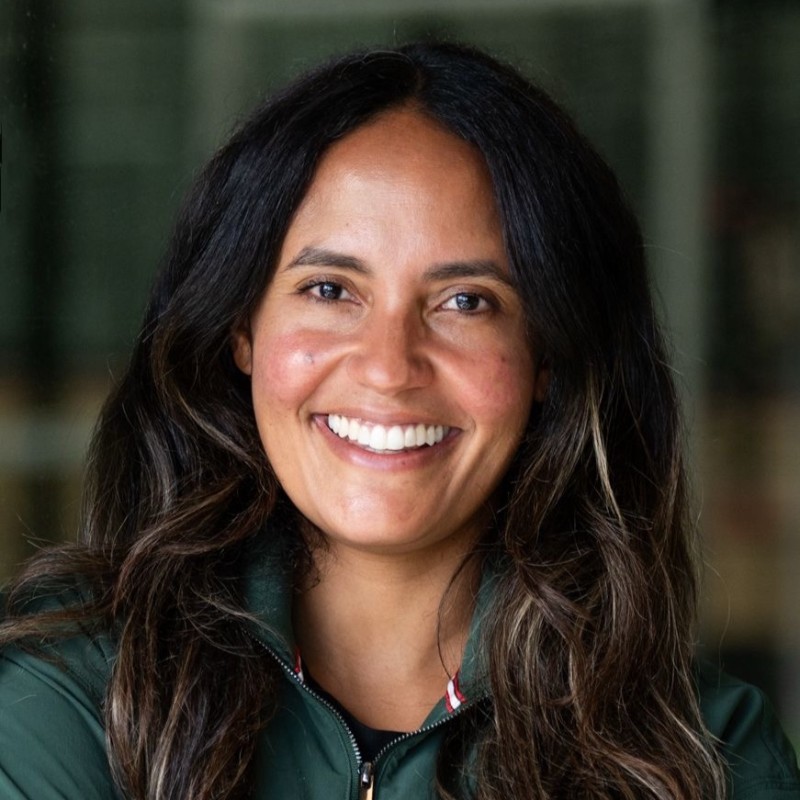
The summer of 2022, Talbert was traveling through Europe with Neil Chainani and Katie Lampert. Somewhere in Spain - the country with more padel courts than almost anywhere on earth - they stopped to take a few lessons. The hook set fast.
"We stumbled upon padel while traveling through Europe in the summer of 2022 and were enthralled by how much fun it looked like all the players were having," she has said. Padel is the friendly cousin of tennis: same scoring, smaller court, glass walls you can play the ball off, and a solid paddle instead of a strung racket. It is almost always doubles. It is almost impossible to play alone, which turns out to be the whole point.
By November of that year, the trip had become a company. Talbert took the CEO seat, Chainani became COO, Lampert took on product and experience. They didn't open in a cheap warehouse on the edge of town. They opened pop-up courts on the Embarcadero in 2023, in full view of the Ferry Building, and called them the most visible padel courts in the United States.
A padel court needs four people. A membership that needs four people sells itself - if you design it right.
That insight became Park Padel's squad memberships: sign up with at least five others and the rate drops by half. It sounds like a discount. It is actually a recruiting engine. Every new member arrives pre-loaded with the people they intend to play against.
"Your strongest marketers are going to be your customers," Talbert told Padel Business Magazine. "They're incentivised because they need somebody else to play with - they'd like to play with their friends." The program tripled Park Padel's membership. It is the kind of move that looks obvious in hindsight and almost never is. A researcher who spent years watching how people actually make decisions saw the flywheel before she built the courts.
Illustrative weighting of Park Padel's stated priorities, drawn from company keywords and interviews.
"We stumbled upon padel while traveling through Europe in the summer of 2022 and were enthralled by how much fun it looked like all the players were having."
"Your strongest marketers are going to be your customers. They're incentivised because they need somebody else to play with."
"Pickleball is to the US as padel is to a lot of the rest of world. It's very social. It's always played in doubles."
"We are excited to partner with an investment group like EEP Capital, the first VC firm to support padel entrepreneurs in the US."
"Our goal is to open 100 total courts over the next couple of years under the Park Padel banner."
She co-founded the company with the two people closest to her - her now-husband and her best friend from college.
The Oyster Point flagship has ceilings taller than most padel halls in the country. Padel needs the air.
Park Padel calls its Embarcadero courts the most visible in the United States. Location was a strategy, not an accident.
Before she sold a single membership, she spent a decade studying how people actually make decisions.
She has talked padel, culture and reality TV on the podcast "Giving You Everything" - building a sports business grounded in passion.
Former pro tennis player Brian Vahaly, once CFO of a boutique fitness chain, sits on Park Padel's board.
The target is 100 courts under the Park Padel banner over the next couple of years.
It is a number that only makes sense if you believe padel does to the US what it did to Spain, Sweden, France and Dubai. Talbert is betting it will - and that downtown San Francisco's slow comeback can run, in part, through a glass-walled court by the bay.
The expansion is already underway: the flagship in South San Francisco, the outdoor courts up in West Sacramento, and a pipeline of locations behind them. For a founder who spent her career studying behavior from the outside, it is a chance to shape it from the inside - one doubles match at a time.
Reporting compiled from public interviews and coverage including Padel Business Magazine, ABC7 San Francisco, Axios, SHACK15, The Padel State and EEP Capital. Quotes are reproduced from those public sources. Where details could not be independently verified, they have been omitted.