At 4:55 in the afternoon, a messenger arrived with the money. Jerry Sanders had spent July 22, 1969, trying to get a semiconductor company financed before the business day ended. The closing required $1.5 million. The checks and transfers assembled so far amounted to $1,405,000. Then came a $100,000 check from Henry Harris in Pennsylvania. AMD cleared the threshold with five minutes to spare.
There are tidier ways to begin a company. This one suited Sanders. He could sell confidence, but he still had to collect the checks. Eight founders were waiting for a business to become possible; customers would eventually need actual chips. At the end of the day, the group celebrated at the Luau restaurant in Beverly Hills. The financing had taken months. Dinner, at least, could be ordered immediately.
The story contains much of what would follow: a difficult industry, an impatient timetable, a leader determined to keep the enterprise moving, and a celebration once it did. Sanders would run Advanced Micro Devices for 33 years. Keeping AMD in contention became his occupation, his public personality, and an ambition that survived one product generation after another.
A salesman learns to read the accounts
Sanders was born in Chicago in 1936 and grew up on the South Side, raised by his paternal grandparents. An engineering degree offered a practical route out. He graduated from the University of Illinois in 1958, worked at Douglas Aircraft, moved to Motorola, and joined Fairchild Semiconductor in 1961. The sequence carried him from designing to selling, and toward the California semiconductor business.
His grandfather’s idea of encouragement had an accountant’s precision. When Sanders came home after graduation, he was presented with a bill for the canned goods and laundry associated with his upbringing. Sanders later recalled laughing at the extravagance of the record-keeping. He understood the affection behind it. The family send-off came with an itemized statement.
Fairchild gave him room to advance through sales and marketing. Its circles included Robert Noyce, Gordon Moore, and Charles Sporck, people whose subsequent companies would become competitors and collaborators. Silicon Valley’s family tree was already acquiring awkward branches. In 1968, new management at Fairchild dismissed Sanders. The expected promotion had become an invitation to find something else to do.
By early 1969, he was preparing to lead a company of his own. Selling semiconductors had equipped him for part of the job. Financial management required study. He read Peter Drucker, worked on the business plan, and later placed a blunt reminder over his second-hand desk: “GET A FINANCE GUY.” Richard Previte became that person. Even a confident founder could benefit from a sign telling him what to do next.
The pitch had to survive the factory
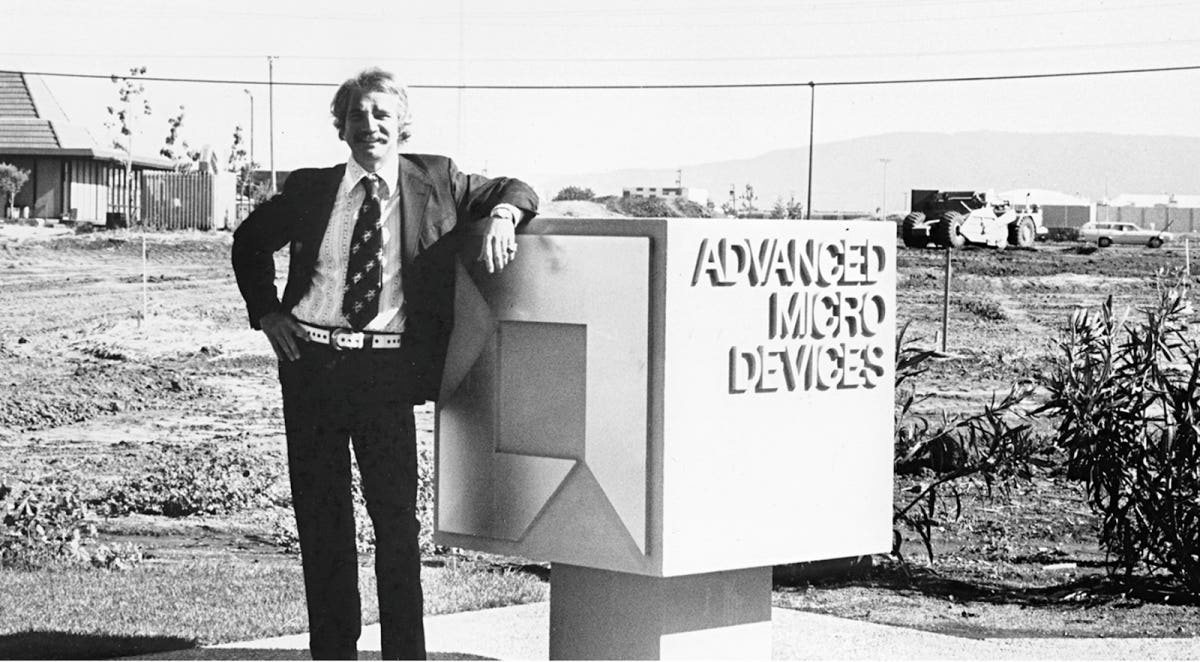
AMD began on May 1, 1969, with Sanders and seven other former Fairchild employees. Its public introduction featured the founding team together. A company selling components could still sell the people behind them. Their experience was part of the proposition: here were people who knew the business, asking customers to trust a new name.
That trust had to extend beyond a persuasive presentation. A supplier’s parts needed to work reliably and arrive when promised. AMD’s early advertising stressed testing to standards associated with demanding aerospace applications. The sales message addressed a buyer’s reasonable worry about placing an order with an unproven manufacturer. Sanders’s charm could open a conversation; quality gave the purchasing department a reason to continue it.
Even Noyce initially doubted the plan to manufacture chips. Yet he became an early AMD investor. The future rivalry with Intel therefore began within a shared professional world, with overlapping acquaintances and an investment that looks wonderfully inconvenient in hindsight. Semiconductor history rarely offers the clean casting of a western. Sometimes the rival helps finance the opening scene.
Sanders had an engineer’s education and a marketer’s instinct for making an abstract promise visible. The company’s campaigns could be teasing, theatrical, or simply clear about the problem a part solved. They made AMD recognizable while the organization accumulated products, manufacturing experience, and customers. Being memorable had commercial value when the better-known supplier was already on the buyer’s list.

Give people a piece of the company
Sanders wanted employees to feel that AMD belonged to them, too. In its first year, the company established a stock bonus plan that granted employees shares on joining and additional shares as their service continued. Profit-sharing followed in 1972. The distinction matters: ownership reached beyond the founding group and key professional hires to the people doing the factory work.
His approach mixed financial participation with spectacle. In 1980, an employee selected at random received a prize of $1,000 a month for 20 years. A workplace can produce many kinds of recognition. This one could make a substantial contribution to the household budget. The showmanship had a material consequence for the person whose name was chosen.
He also resisted treating employees as disposable when business slowed. During the difficult conditions of 1979, AMD promised to retain people meeting its work standards. Keeping trained staff carried a cost, but replacing them when orders returned carried one as well. His commitment reflected both a belief about loyalty and a practical concern about retaining semiconductor skills.
That policy belongs to a particular period, rather than a claim that AMD never cut jobs. What endured was the emphasis Sanders placed on the connection between the people and the products. A company demanding patience from customers and investors also needed employees willing to keep building through uncertainty. Ownership and recognition gave that request some substance.
An independent chip, and a very long race
AMD’s relationship with Intel became the central contest of Sanders’s tenure. A 1982 second-source agreement allowed AMD to supply Intel-compatible processors. The arrangement served customers who wanted another supplier, and it gave AMD an established product family to sell. It also linked the challenger’s prospects to access controlled by its larger rival.
Licensing disputes and litigation followed. Sanders described years in which profits could not entirely reassure him because the company’s legal position remained unresolved. Building an independent alternative became the next assignment. AMD needed processors that could run the software customers already used while giving those customers a reason to choose its implementation.
That requirement helps explain the scale of the undertaking. Buyers were purchasing entry into a familiar computing system, with existing applications and expectations. AMD’s engineers had to deliver a compatible product and a persuasive competitive case. The sales organization then had to translate the engineering into orders. Sanders’s career had brought those two tasks under the same roof.
Athlon supplied a visible turning point. In 2000, AMD brought a 1 GHz processor to market, crossing a much-watched clock-speed milestone. The number made good copy and offered an easily understood signal that the challenger could set a pace. Clock frequency alone does not describe a processor’s performance, but at that moment a gigahertz was a useful announcement in a race the public could follow.
- 1961Joins Fairchild Semiconductor
- 1969Co-founds AMD and becomes CEO
- 1982Intel second-source agreement
- 2000Athlon reaches 1 GHz
- 2002Hands the CEO role to Hector Ruiz
“Exuberant. Excited. Enthusiastic.”
The suit was part of the performance
Sanders’s presentation made him conspicuous among semiconductor executives. He enjoyed fine cars, clothes, and the theater. A reserved delivery was never obligatory merely because the product contained transistors. Asked how he viewed himself, he offered three words: “Exuberant. Excited. Enthusiastic.” They describe a person who expected the business to be worth talking about.
His promotional alter ego, “Illinois Jerry,” appeared in a 1992 adventure poster celebrating AMD’s renewed growth. The borrowed adventure-film language was knowingly extravagant. There was room in the chip business for a joke, particularly one that let colleagues imagine themselves participating in a continuing escapade rather than a sequence of quarterly meetings.

Some of his slogans traveled further than the campaigns. “Real men have fabs” tied manufacturing ownership to a rather pointed idea of corporate courage. It captured his commitment to making chips as well as selling them. After his tenure, AMD separated its factories into GlobalFoundries in 2009 and continued as a designer relying on manufacturing partners. The business eventually outgrew the slogan.
That change makes Sanders more interesting. A founder can give a company the will to persist without providing a permanent answer to every operational question. The infrastructure he defended belonged to his era’s strategy. Later leadership had to make its own choices. AMD’s continuity rests partly on being able to revise practices while keeping a reason to compete.
Leave another round for somebody else
Sanders recruited Hector Ruiz from Motorola in 2000. Ruiz took over as CEO in April 2002; Sanders stayed as chairman until 2004. Succession brought his daily stewardship to an end after three decades of work. The company would continue to win, stumble, and change without him directing each decision.
His connections also produced institutions beyond AMD. In 1977, he helped found the Semiconductor Industry Association alongside Noyce, Sporck, Wilfred Corrigan, and John Welty. The association formed the Semiconductor Research Corporation in 1982 to support university research. Competitors who fought for orders could cooperate over the industry’s shared future. Sanders counted that institutional work among the things he valued about his career.
His ties to Illinois acquired a practical expression as well: an AMD-endowed chair in electrical and computer engineering and a student robot competition bearing his name. The engineering graduate who became a salesman remained attached to the work of educating engineers. There is a pleasing circularity to that, without requiring the students to adopt his wardrobe.
In December 2024, he voiced confidence in Lisa Su’s leadership of AMD. It was a familiar impulse, now directed toward someone else’s campaign. The opening financing had depended on a messenger arriving in time. The later company depended on generations of people doing their work. Sanders’s contribution was to keep giving them a company in which to do it, and a competitive ambition worth returning to the next morning.