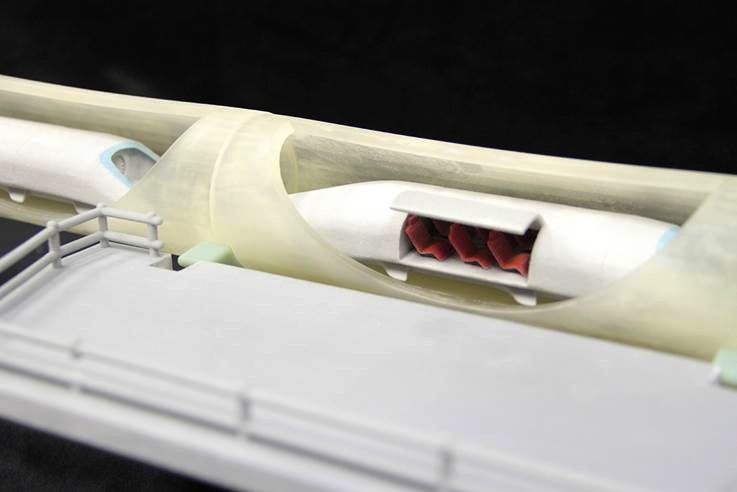
In August 2013, Jerry Ropelato gave five designers a peculiar assignment: turn Elon Musk’s newly released Hyperloop concept into something you could put on a desk. The proposed transport system existed in diagrams and argument. Ropelato wanted a model. Less than 24 hours later, WhiteClouds had one, complete with elevated tubes, passenger pods and a station.
It was a useful introduction for a young Utah business. While the wider world debated a transport system, his team had made an object people could inspect. A model could answer a modest question immediately: what would this thing look like? For an entrepreneur coming out of internet publishing, it also offered a familiar benefit. People had something to talk about.
Ropelato had spent a decade building the company later known as Purch. Now he was starting again with machines, materials and designers. The transition seems unlikely until you look at the customer on either side of it: someone trying to make sense of a complicated idea. A comparison page helps a reader choose. A miniature building helps a client see.
A publisher learns to work in layers
His route to that desk-sized transport system ran through the less photogenic parts of technology. From 1989 to 1993 he directed software development at Iomega, the storage company associated with the Zip drive. He founded the information technology services business Vitrex, then served as chief operating and technology officer at ContentWatch, later known as Net Nanny. These were different kinds of software businesses, with different customers and practical demands.
In 2003 he founded the publishing business that became TechMediaNetwork and, later, Purch. His tenure as chief executive ended in March 2013. The naming matters: Purch arrived as the corporate identity in 2014, after his period running the business. A career described simply as “former Purch CEO” folds several stages into three words.
The publishing group assembled specialist destinations, including Top Ten Reviews, Space.com and Live Science. Over time, its portfolio expanded to the Tom’s brands and other properties. Its appeal rested partly on specificity. Someone looking for a telescope and someone comparing laptops might both need guidance, but they were unlikely to ask the same questions. Separate publications could speak their languages.
There is an operational skill hiding inside that arrangement. An umbrella company has to make distinct businesses work together without flattening their reasons for existing. Ropelato’s subsequent interest in fabrication would involve another collection of specialties. Software development, model making and publishing have very different outputs. Each still requires a workable relationship between technical expertise and the person paying for it.
First, make something people can see
WhiteClouds formally launched in December 2013 with an offer that combined instruction and production. Visitors could learn about 3D printing through articles, images and video, then have an object made. The lab opened to visitors, too. An unfamiliar technology was easier to understand when a machine was doing it in front of you.
The early experiments had a pleasing lack of solemnity. A Kickstarter campaign offered steampunk dinosaurs and dragons, reaching its funding goal in October. A company explaining the future of manufacturing had found room for mechanical-looking prehistoric creatures. There are worse ways to persuade someone to look closely at a new process.
The name came from an equally approachable image. Ropelato remembered looking at clouds and recognising shapes in them. WhiteClouds carried that association into a business where imagined forms could become objects. It is an origin story a school group could understand without sitting through a presentation about addressable markets.
Early customers brought their own definitions of usefulness. One wanted a replacement refrigerator part. Another arrived with photographs and wanted figurines of her grandchildren. Those requests were small, particular and wonderfully resistant to a single grand theory of what 3D printing was for. They also made the service intelligible: bring a problem, or a picture, and ask what can be made.
The expensive part of a small building
By July 2014, WhiteClouds had 22 staff and a dozen industrial printers. Ropelato had invested $2 million. Equipment prices ranged from $65,000 to $350,000, a formidable shopping list for a startup. His team found an opening in architectural models, where designers and builders needed physical versions of projects before construction.
The work exposed an awkward distinction between printing and preparing to print. An architectural house model might need a week of preparation followed by only three or four hours in a printer. The visible machine could receive a disproportionate share of the applause. Much of the job happened before anyone pressed the button.
Ropelato said it took nine or ten months to become good at printing models. That admission gives the early demonstrations a different texture. A fast, attention-getting project could show possibility while the business was still learning consistency. A deadline is useful for producing a demonstration; a customer expects the next order to work as well.
The machine is only one part of the job. Times varied by project.
When the figurines grew up
By 2018, the question of size had changed. Ropelato described customers who increasingly wanted objects measured in feet rather than inches. The design team mattered because clients often needed help turning their requests into usable 3D designs. Owning a printer did not automatically supply that translation.
That October, WhiteClouds’ work appeared at New York Comic Con as an 11-foot She-Ra statue. The project included a throne and sword, with touch-sensitive electronics activating sound and lighting. A character usually encountered on a screen had become something visitors could stand beside. Even the pose of the audience had changed.
A commission like that broadens the definition of making. Scale introduces questions about how an object looks from across a room. Electronics introduce another discipline. A display has to function where people meet it, rather than merely survive the journey out of a printer. The finished piece is the point at which all those jobs become visible together.
Ropelato called the She-Ra build one of the team’s most enjoyable projects. The pleasure is easy to understand without assigning him a theatrical personality: an enterprise that began with small imaginary creatures was helping produce a much larger one. The dinosaurs had acquired a rather imposing neighbour.
“I would say we get asked the impossible almost every week”
Jerry Ropelato · on the work at WhiteClouds
The teacher in the workshop
There is another part of his career that fits this business better than a list of executive titles suggests. Ropelato previously taught information technology at Ogden-Weber Technical College. He also designed a student information system the institution used for years. He joined its board in 2011 and stepped down in November 2017.
Teaching and building a system for the same institution are complementary ways of making technical knowledge useful. One helps people work with an idea; the other puts it to work for them. WhiteClouds’ early mix of educational material and production services carries a similar practical concern. A potential customer needs enough understanding to know what to ask for.
His connection to education continued in public speaking. A 2019 university biography described eight startups and involvement in fourteen acquisitions, along with two technology books. He spoke about the next hundred years of technology. That is a fairly large syllabus for someone whose working day could also involve the details of a model.
The same biography lists family time, coaching basketball and participating in track and field among his interests. Those details give the futuristic subject matter a local setting. A person can talk about the next century and still have practice to attend. The future has to share a calendar with everyone else.
Back to the browser
In October 2025, WhiteClouds announced a partnership with RedHawks Media, a digital publisher building specialised “Street” websites. The proposed connection was direct: subject-focused content would lead interested readers toward fabrication services. Topography, characters and lettering each had an obvious relationship to things WhiteClouds could make.
It brought the two sides of Ropelato’s career into the same frame. Publishing could help people discover a subject; fabrication could turn an interest into a commissioned object. His public LinkedIn profile now names RedHawks Media, while WhiteClouds’ team page continues to list him as chief executive. The overlap has a practical expression in the partnership.
RedHawks describes an approach using AI tools with human review to build and maintain focused destinations. Its ambitions are stated in the language of online discovery, but the connection to a workshop keeps the proposition concrete. Somewhere beyond a page about terrain or typography, a customer may want a map or a sign.
Ropelato has a concise description for his recurring urge to improve things: “the entrepreneurial curse.” In a 2017 conversation, he also acknowledged that the revenue source he expected when starting a business had repeatedly changed. The useful trait in that account is a willingness to revise the plan after encountering customers. It makes his changing industries easier to follow.
The small Hyperloop remains a good place to begin. Five designers, a fresh set of diagrams, a deadline and a physical result. It was a publicity opportunity, certainly. It was also a demonstration of how Ropelato approaches an unfamiliar technology: give people a way to inspect it. Sometimes that takes a page on a screen. Sometimes it takes a tube, a platform and a tiny passenger pod.
Keep following the thread
Profiles, conversations and a closer look at the work.