The first useful thing Jerod Guerin learned about collision repair was that broken wheels travel in circles. After serving in the U.S. Army, where he trained as a medic at Fort Hood, he took a job with Wheel Technology. Each day he drove around Dallas-Fort Worth collecting damaged wheels and tires. Each night, a central facility repaired them. The next day, Guerin delivered them back to the shops. Pick up, return, repeat. It was logistics with a steering wheel, and it gave him a close look at an industry he had not planned to join.
One customer was then a small, independently owned Dallas-area collision business called Service King. The route driver became a service advisor intern in Irving. The intern became a service advisor. Then came general management, regional management and regional leadership. By 2018, Guerin was a senior vice president responsible for management across more than 240 Service King locations in the eastern United States.
There is a tidy founder myth in which a person spots an industry from a distance, develops a thesis and descends with a slide deck. Guerin's education was messier and more useful. He entered through the loading door. He learned how work moved through a shop, what customers worried about, what technicians noticed and what changed when a local operator became part of something larger.
The route before the roll-up
01 / The apprenticeshipThe shop floor is a better business school than it looks
At Service King, Guerin helped grow markets and absorb acquisitions. As a general manager, his locations won internal top-shop awards. In San Antonio, he had a hand in expansion from eight locations to 21. In the Northeast, the count moved from 21 to 37 during his regional tenure. He also played a role in the 2014 acquisition of 62 Sterling locations, a transaction large enough to expose every seam between finance, operations and culture.
The promotions matter, but the more revealing record is how colleagues described him. A 2015 industry award nomination emphasized mentoring. A later profile described an executive who held cookouts, included regional and marketing staff in shop celebrations, coached his sons' hockey and kept his phone available to employees on weekends and vacations. The picture is of an operator who treated access as part of the job.
“I really had no plan coming out of the Army.”Jerod Guerin, recalling his entry into collision repair
That lack of a grand plan became an advantage. Guerin collected a sequence of practical problems before he formed an answer. Collision repair was consolidating, but many respected regional businesses did not fit the dominant model. Modern vehicles were adding cameras, radar, sensors and software. Manufacturer certification was becoming more than a plaque in the lobby. And technicians, whose judgment makes the entire system work, were leaving the trade faster than replacements arrived.
02 / The thesisA beautiful repair can still be wrong
A repaired vehicle can leave the shop glossy, aligned to the eye and quietly unsafe. The forward-facing camera may need calibration. Radar hidden behind a bumper may sit a few degrees off. High-strength steel and aluminum can require specific joining methods. Pre-repair and post-repair scans can reveal faults no human can see by walking around the car.
Guerin's thesis was that manufacturer procedures should sit at the center of the business. In October 2020, with backing from Susquehanna Private Capital, Quality Collision Group launched through the acquisition of Brandywine Coach Works, a four-shop Pennsylvania operator. QCG would pursue OEM-certified shops, invest in the tools and training modern repairs require, and build estimates around the work manufacturers specify.
The phrase attached to the company is “no compromise.” It is easy copy for a coffee mug and a difficult constraint for an operating company. Following a procedure can demand expensive equipment. Training takes people off production. Original parts can complicate negotiations. Calibration adds steps at the moment everyone would prefer to hand back the keys. A principle becomes culture only when the inconvenient choice survives contact with the schedule.
“You get to go to bed at night knowing you are a part of a company that doesn't compromise.”Guerin on pride inside QCG shops
03 / The dealBuy the shop. Mind the sign.
QCG's more distinctive decision happens after an acquisition. It generally preserves the local brand. That may sound cosmetic until you consider what a body-shop name contains: decades of referrals, insurer relationships, family stories, technician pride and the memory of who answered the phone after a bad morning. A national operator can replace the sign in a week. It cannot manufacture the trust that was painted on it.
The clearest example came in Minnesota. QCG had entered the Twin Cities through Master Collision. In November 2024, it acquired LaMettry's Collision, a family company founded in 1976 that brought 14 locations and 22 OEM certifications. Instead of folding LaMettry's into the existing identity, QCG chose to move its five Master locations under the LaMettry's name. The acquired brand had the stronger local legacy, so the buyer allowed itself to be renamed.
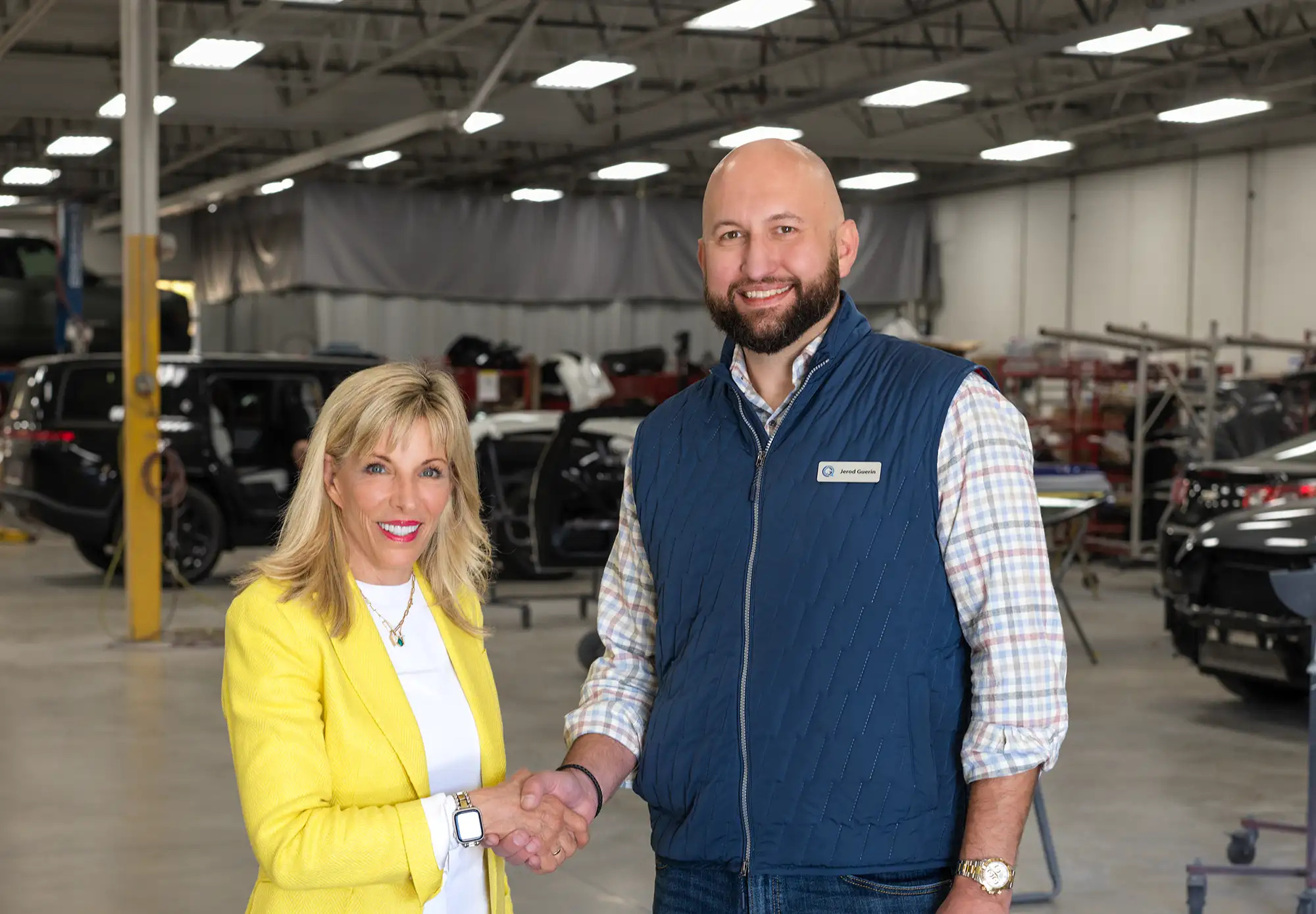
Guerin called LaMettry's a rare fit because of its commitment to manufacturer procedures and parts. He also called the Twin Cities a “frozen DFW,” a joke with an acquisition memo hiding inside it. Both are commuter markets with substantial economies. One bad Minnesota winter, he argued, would not spoil a long-term decision.
From first platform to national network
This is patient-capital language in a trade known for quick estimates. Guerin chose Susquehanna partly because its permanent capital did not impose the same fixed exit clock as a conventional fund. He has praised the investors for appearing when needed and avoiding day-to-day micromanagement. That arrangement gives QCG room to judge an acquisition over years, not weather reports.
04 / The peopleCraft is the scarce part
Tools can be purchased. Certifications can be pursued. A technician who can restore a complicated vehicle correctly may take a decade to develop. Guerin talks about that labor with the reverence executives usually reserve for proprietary software. In one company video, he called technicians the lifeblood of collision repair and argued that years spent mastering the craft deserve dignity, respect and a workplace that permits good work.
It fits the biography. His entry-level role was close enough to the customer and the repair bay to make competence visible. His leadership writing later borrowed from music: a song requires practice, repetition and coordination before it sounds effortless. So does a repair. So does an acquisition. The audience only hears the finished chord.
The hobbies supply an oddly accurate portrait of the business. Bass is structural but rarely the star. Chess rewards position before spectacle. Skydiving is thrilling only because the boring checks are performed correctly. Guerin also favors the Red Hot Chili Peppers, watches as much football as family life permits, and remains loyal to the Dallas Cowboys. His view of the disputed Dez Bryant catch is settled: it was a catch.
05 / The wagerScale without amnesia
By late 2025, QCG reported more than 90 facilities across 13 states. Its map had stretched from Pennsylvania and Virginia to Washington and California, with clusters in Texas, Utah, Minnesota, Missouri and elsewhere. It entered Florida through 1st Class Auto and continued adding certified operators. In 2026, the Tracy Collision acquisition extended the California footprint.
The network will test the very thing that makes it interesting. Every additional shop increases purchasing power, manufacturer reach and shared infrastructure. It also increases the temptation to standardize the character out of the place. QCG has to make a national promise while allowing regional businesses to keep their accents.
Guerin's career has prepared him for both sides of that tension. He spent years inside a large consolidator, negotiating contracts, evaluating businesses and moving people through organizational change. He also began with a route and an internship, where corporate strategy arrives as a new form, a new tool or a new person on the phone. He knows scale from the conference room and from the service drive.
The clever part of consolidation may be deciding what not to consolidate.
There is a lesson here for any founder buying businesses built on community trust. The local name is not clutter. The veteran technician is not interchangeable capacity. The procedure nobody sees is still part of the product. Growth can add resources without pretending history began on closing day.
Guerin once drove damaged wheels around Dallas-Fort Worth, completing the same circle each day. Now the route is national and the cargo is more delicate: reputations, livelihoods and vehicles packed with systems that must work after the paint dries. His company is built on returning all three intact.