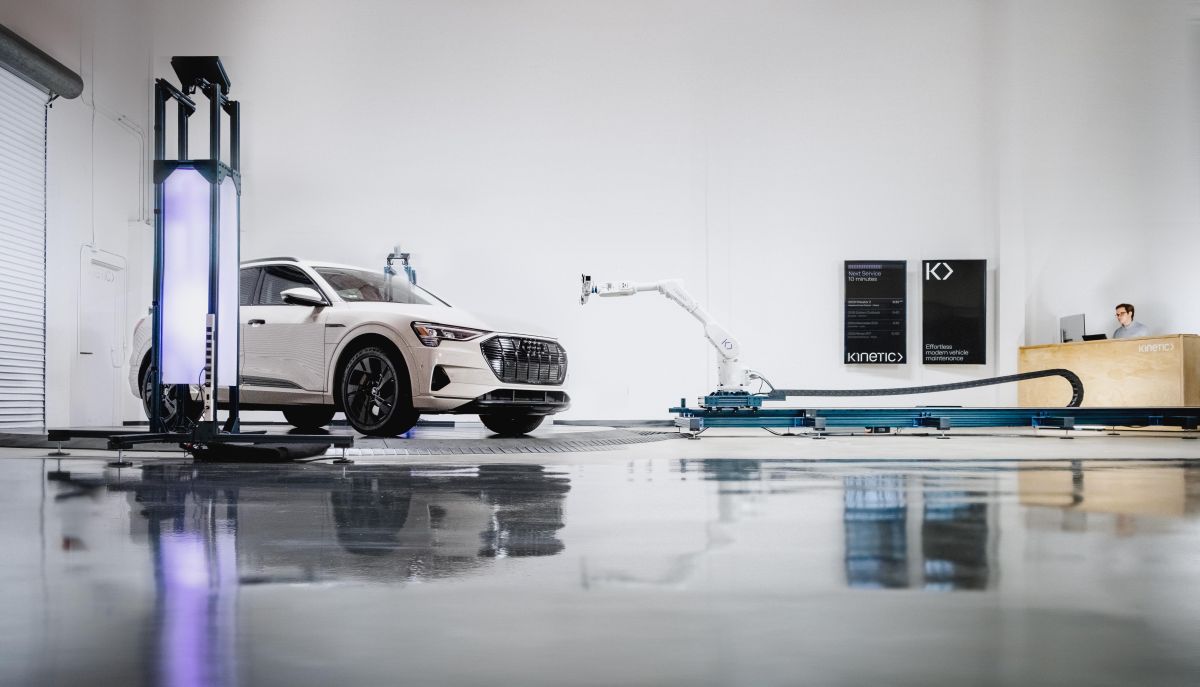
A car rolls into a warehouse in Dogpatch. It is not driven onto a lift. It is driven onto a turntable. The turntable rotates. A robotic arm, lit from above by a cool industrial white, swings around to meet the front bumper. Twelve minutes later, the car's forward-facing camera believes the world again.
This is what Kinetic does. The company will tell you it does many things - infrastructure, calibration, programming, scanning, vision - but what it really does is convince a confused car that the lane lines are where it left them.
The car, of course, is the easy part. The hard part is the industry that has to fix it.
Modern cars are computers on wheels. The repair industry is still mostly wrenches and goodwill.
- The premise of the entire pitch
The problem they saw
Section I // The Trouble With New Cars
Somewhere around 2018, the average new car stopped being a car in any sense your uncle would recognize. It became a rolling sensor platform: forward radar, side radar, a stereo camera behind the windshield, ultrasonic pucks in the bumper, a high-mounted long-range camera for adaptive cruise, and - increasingly - a LiDAR puck on the roof. Adaptive cruise. Lane keep. Automatic emergency braking. Blind-spot alerts. The car does the driving you used to brag about doing.
Now bump that car. Lightly. A parking lot tap, a fender bender, anything that moves a bumper by more than half a centimeter. The sensors are misaligned. They cannot be eyeballed back into place. They need calibration, in a controlled environment, against printed targets, at OEM-specified distances, by someone certified to do it.
The US has roughly 30,000 collision repair shops. Most of them are not equipped to do any of this. Many do not know they should be. The shops that try send the car out to a dealership, which sends it to a backlog, which means the car sits, which means the rental clock runs, which means the insurer pays, which means everyone gets a little more frustrated than they were last week.
The car gets fixed. Its brain doesn't. Then it drives away thinking everything is fine.
- The quiet horror story behind ADAS repair
The founders' bet
Section II // Three Engineers With A View Of The Future
Nikhil Naikal had been here before, sort of. He built Mapper.ai, sold it to Velodyne Lidar, then ran software engineering there. He spent years watching the autonomous-vehicle industry try to teach cars to see. When he left, the thing nobody wanted to talk about was what happens to all those sensors after the car is built. Cars get hit. Sensors drift. Calibration is annoying. Nobody at the AV companies was solving it because nobody at the AV companies wanted to.
In 2021, Naikal teamed up with Sander Marques (also ex-Velodyne, the engineering brain) and Chris Weber (ex-Uber, the operations brain) to do the unglamorous thing. They called it Kinetic. The bet was that the boring middle layer between car manufacturers and car owners - the recalibration of every sensor on every car ever sold with one - was about to be worth a great deal of money, mostly because nobody else found it interesting.
Investors, it turns out, found it interesting.
The most lucrative startups are the ones that look the most like plumbing.
- An unspoken rule of B2B infrastructure
The product, such as it is
Section III // Three Things That Look Boring And Aren't
/ hardware + service
Kinetic Hubs
Stand-alone calibration facilities. Robotic arm, LiDAR, optical cameras, a turntable. Vehicle in, recalibrated vehicle out, fifteen minutes later. The most photogenic part of the company.
/ hardware
Kinetic Vision
A scanning rig sold to repair shops. Detects collision damage. Produces a fast, accurate repair estimate without three people walking around the car with clipboards.
/ software
Kinetic ID
AI software that identifies, the moment a vehicle is plugged in, which calibrations it actually needs. Removes the guesswork; removes the unnecessary services; removes the awkward conversation with the customer.
The hubs are the headline. The software is the moat. Vision and ID exist because the hubs would not work without them, and because Kinetic eventually wants to sell both back to the 30,000 shops that aren't ready to build their own robot warehouses.
A short history of fixing the car of the future
// Milestones 2021 - 2026
2021
Founded in Santa Ana by Naikal, Marques, Weber.
2023
Series A led by Construct Capital and Lux.
2024
$21M Series B led by Menlo Ventures.
2025
Chilton Auto Body partnership opens Bay Area hub.
2026
8,000 sq ft Dogpatch facility opens in SF.
The proof
Section IV // Numbers, Investors, And A Bit Of Bragging
The argument for Kinetic, distilled, is a single comparison: the traditional way takes hours and gets it wrong. The Kinetic way takes minutes and gets it right. Customers like this argument. Insurers like it more, because they pay for the hours.
Time to recalibrate one ADAS-equipped vehicle
/ source: company-reported, industry-typical
~240 min
Traditional
dealership
A 16x reduction. Or, in body-shop terms: about one lunch break.
$31MTotal raised
75Employees
3+Bay Area hubs
15 minPer calibration
The cap table reads like a small conspiracy. Menlo Ventures led the Series B. Lux Capital and Construct Capital, who came in at the Series A, doubled down. Haystack joined. And then the more telling names: Liberty Mutual Strategic Ventures and Allstate, two of the largest auto insurers in America, both putting money into a company whose entire job is to reduce the time their customers' cars sit broken. That is not a curiosity. That is a signal.
When insurers invest in a repair startup, they are not betting on the technology. They are betting on their own loss ratios.
- A reading of the Series B cap table
The mission, said out loud
Section V // Infrastructure, Not Magic
Kinetic's stated mission is "effortless modern vehicle repair." This is not a particularly exciting sentence. It is, however, the right sentence. The company is not trying to invent the autonomous car. It is trying to build the service layer underneath the autonomous car, the part nobody at the AV companies is willing to staff a hub for in Santa Ana.
Naikal will tell you, when asked, that today the customers are EVs and high-end ADAS-equipped cars. Tomorrow the customers are robotaxis - because robotaxis crash too, and when they do, somebody has to recalibrate the LiDAR before the fleet can put them back on the road. Kinetic intends to be that somebody.
It is also worth saying that this is a Southern California story. Santa Ana headquarters, San Francisco hubs, a fleet of techs in branded jackets driving between MSO partners. The company has not gone east. It has not gone international. It is doing the unfashionable thing of getting one geography very right before moving on.
Why this matters tomorrow
Section VI // The Stuff Behind The Stuff
There is a popular and slightly tedious narrative that the future of cars is software. This is true but incomplete. The future of cars is also calibration. Every sensor on every new vehicle drifts. Every collision moves it further. Every software update from the OEM changes what the sensor is supposed to look at. The future of cars is, more accurately, a perpetual maintenance contract with the laws of physics.
If that future arrives - and it is mostly already here - somebody has to operate the physical infrastructure that keeps the sensors honest. The dealerships are not going to do it at scale. The independent shops are not going to do it at all. Kinetic is offering itself as the third option. The neutral, branded, fast, certified, robot-arm-equipped third option.
The autonomous future arrives in two parts: the cars, and the people who fix them. Kinetic is the second part.
- The thesis, compressed
A car rolls into a warehouse in Dogpatch. The turntable rotates. The robot swings. Twelve minutes later the car drives away, its sensors agreeing with each other for the first time in months. The owner does not know any of this happened. The insurer notices that the rental car invoice never arrived. The body shop on the corner sends Kinetic another five cars next week.
This is what infrastructure looks like when it works. Nobody notices. Everybody benefits. And somewhere in Santa Ana, three founders and 75 engineers keep building the boring middle layer of the autonomous age.