In April 2014, Jennifer Sherman received a new title for work she was already doing. Federal Signal named her chief operating officer, explaining that the appointment formalized responsibilities she had taken on over the previous two years. In a corporate world fond of announcing the future, this was an unusually useful acknowledgment of the present. The job had grown. The business card was catching up.
She had arrived twenty years earlier as corporate counsel. By January 2016, she would be president and chief executive. Between those dates lay contracts, personnel, information technology, governance and operating decisions: the internal workings of an industrial company, learned over time.
Today, her business makes equipment that earns its keep doing necessary, frequently messy jobs. Street sweepers. Sewer cleaners. Safe-digging trucks. Warning systems. Such products rarely invite lingering admiration from passersby. Their customers have other priorities. A machine that works, a part that arrives and a dealer who answers are quite sufficient reasons for affection.
The lawyer gets a wider brief
Sherman’s education joined two disciplines that would remain close throughout her career. She earned a business degree in finance at the University of Michigan in 1986, followed by a law degree in 1989. She graduated cum laude from the law school. Her first job was as an associate in a law firm.
Her early legal practice included commercial contract disputes, labor law, bankruptcy and securities. These are encounters with a business when the terms matter very much: what was promised, who carries the obligation, what happens when circumstances change. By the time she joined Federal Signal in 1994, she had a professional vocabulary for the consequences of decisions.
The responsibilities accumulated. She became vice president, general counsel and secretary in 2004, senior vice president in 2008, and chief administrative officer in October 2010. That last job encompassed legal affairs, human resources, information technology, compliance and government affairs. It required attention to the organization around the product.
There was a life beyond those titles. A University of Michigan alumni update in 2011 described Sherman and her husband, fellow law graduate Douglas Cherry, living in Hinsdale with their five sons. The brief entry placed an expanding corporate remit beside a rather substantial household. Both appeared in the same small paragraph, with the efficient understatement of alumni news.
Trust, with the instructions attached
Before she had the chief executive’s title, Sherman had put her approach to leadership into words. In 2013, she described spending time explaining goals, establishing achievable results and creating the mutual respect that made delegation possible. The sequence was practical. People needed to understand the destination before being trusted to choose a route.
“I know I can delegate work and decision making with confidence.”
Jennifer Sherman, 2013
She also described inviting different opinions and the difficulty of saying no without making disagreement feel personal. Her account treated authority as something that needed explanation. A rejected proposal could still come from a respected colleague. The distinction sounds straightforward until it must be maintained in an actual meeting.
Her 2013 reading choice was Kate Atkinson’s Life After Life. More directly relevant to her own changing career, she thanked mentors Jim Janning, Jim Goodwin, Joe Ross and Dennis Martin for helping her see possibilities she had not considered. The future CEO’s account left room for other people to have spotted a next step before she did.
A succession plan meets the industrial cycle
The 2014 COO announcement made the succession path explicit. Dennis Martin, then chief executive, said the appointment recognized Sherman’s expanded duties. She would oversee operations for what the announcement described as an $850 million global manufacturing business employing more than 2,500 people. Her earlier work had included operating leadership within the Safety and Security Systems Group.
In December 2015, Federal Signal announced that she would take over as president and CEO on January 1. Martin would become executive chairman. Goodwin, the outgoing chairman, credited Sherman with a significant role in the company’s turnaround and emphasized relationships built with employees, customers, dealers and financial partners over twenty-one years.
The transition provided continuity. It offered no exemption from the industrial cycle. Early in 2016, Federal Signal warned of difficult industrial markets, with weakness in oil and gas affecting customers. Its shares fell sharply after the outlook. A succession plan can organize a company’s leadership; customers remain free to postpone an order.
Full-year revenue fell 8 percent to $707.9 million. Lower demand for equipment including hydro-excavators weighed on the business. Sherman’s assessment was direct: “It is clear that 2016 was a challenging year.” The first year belongs in the story because it establishes the conditions under which the later results were earned.
The work that comes after the signature
Federal Signal’s acquisitions in 2016 included Westech Vac Systems and Canadian distributor Joe Johnson Equipment. In 2017, it bought Truck Bodies and Equipment International, adding six dump truck body and trailer brands. The transactions expanded the collection of products and the routes through which equipment reached customers.
For Sherman, growth increasingly meant making those additions useful together. A manufacturer gains something different from a distributor than it does from another factory. A customer’s relationship with a machine also continues well beyond delivery. Parts, repairs, rentals and training give that relationship a long working life.
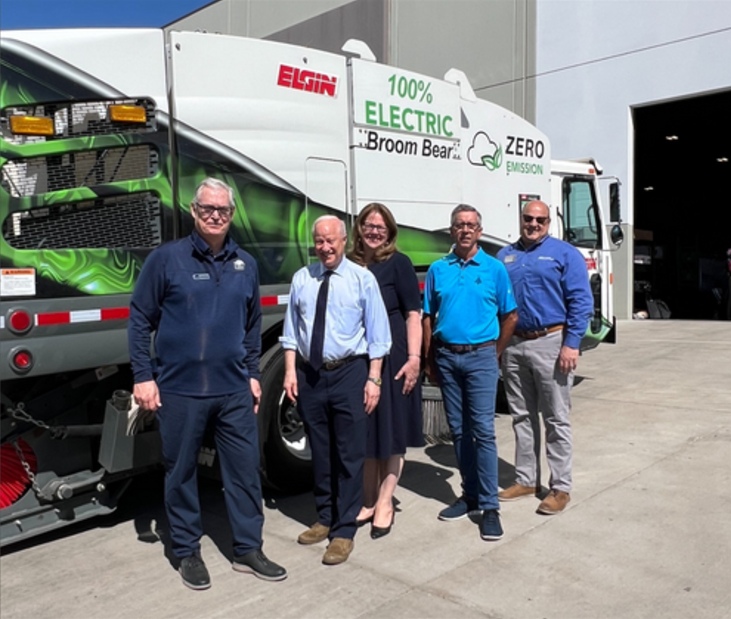
A photograph from the opening of Federal Signal’s Denver facility puts that idea on human terms. Sherman stands with colleagues beside an Elgin electric street sweeper. The truck is considerably larger than the assembled executives. It is a useful reminder of the scale of the object customers actually buy.
By 2022, annual sales were approximately $1.43 billion. Discussing that year’s results in March 2023, Sherman said acquisitions accounted for about two thirds of the revenue growth since 2016. Eight of the eleven announced transactions had been internally sourced. Existing operations and new initiatives supplied the rest of the growth. The proportions make the record easier to understand.
Federal Signal annual net sales · US dollars
Another board, another view of the machinery
Sherman joined Franklin Electric’s board in January 2015, while still Federal Signal’s COO. The company makes systems and technologies used in water, fuel and electricity applications. The connection gives her a second industrial setting in which to consider customers, operations and the decisions that determine where capital goes.
Ten years later, she became its chairperson, effective May 2, 2025. Chief executive Joe Ruzynski welcomed the appointment by pointing to her decade of familiarity with the company and the work of developing its strategy. Her operating career had become a resource for another boardroom.
She had also spoken publicly about the preparation board work requires. In a discussion about director-investor communication, Sherman described investors arriving with increasingly specific questions about company strategy and capital allocation. She emphasized the need to consider a director’s knowledge, available time and commitment before asking that person to take part in investor discussions.
Those observations have the practical texture of someone who has organized the meeting as well as attended it. Governance brings obligations that survive the formal appointment. Understanding the company, preparing for questions and making time for the work all remain part of the assignment.
The award goes to the team
In June 2024, Sherman was named an EY Entrepreneur Of The Year Midwest Award winner. Federal Signal was already more than a century old. The award program also recognizes leaders who change established businesses, a description that better fits her long apprenticeship than the familiar founder’s origin story.
Her response credited Federal Signal’s employees and their contributions to growth and shareholder value. Earlier recognition had included a Manufacturing Institute STEP Ahead award in 2018. She had also chaired the executive board of The Community House, extending her organizational work into a Chicago-area nonprofit.
In the account of her career, these appointments and honors sit alongside less ceremonial work: establishing responsibilities, choosing investments and maintaining relationships. They are also occasions when an executive gets to decide how much credit to keep. Sherman’s public response to the EY award made the employees part of the occasion.
Still adding to the job
In 2025, Federal Signal passed $2 billion in annual net sales for the first time, reaching approximately $2.18 billion. Its acquisitions included Hog Technologies and New Way Trucks. Sherman’s subsequent stockholder letter described an effort to connect businesses through distribution, procurement, operating practices and aftermarket support.
She used the image of a pearl, built through successive layers, to describe that accumulation. It was a surprisingly delicate metaphor for a company that sells machinery for moving material and cleaning infrastructure. Her stated ambition was to keep adding capabilities that strengthen the businesses already there.
The latest reported quarter as of October 23, 2026, supplied another set of results: second-quarter sales of $670 million, up 19 percent, and operating income of $118.2 million, up 21 percent. Federal Signal raised its full-year outlook. Its next earnings call was scheduled for October 29.
The work continues between those announcements. Sherman’s career began with the terms on which businesses operate and expanded into responsibility for the businesses themselves. More than three decades after joining Federal Signal, she leads an organization whose products must eventually leave the presentation and do a job. Somewhere, a street needs sweeping. The customer will have a perfectly reasonable interest in whether the equipment turns up ready.
Follow the work
More from Jennifer Sherman and the businesses she leads.
- Jennifer Sherman at Federal Signal ↗
- Jennifer Sherman on LinkedIn ↗
- Her account of trust and delegation ↗
- Federal Signal presentations and earnings webcasts ↗
- Federal Signal news ↗
- Her appointment as Franklin Electric chairperson ↗
- The Denver opening and 2024 stockholder letter ↗
- Her 2025 stockholder letter ↗
- Federal Signal’s first year under Sherman ↗