Hospitals are excellent at naming things. They have departments, service lines, committees, protocols, portals, pathways, and more acronyms than most crossword puzzles could tolerate. A patient, meanwhile, has Tuesday morning: the appointment, the discharge instructions, the prescription, the question that arrives after dinner, and the uncertainty about who is supposed to call whom. Jen Thomas has built a career in the distance between those two views.
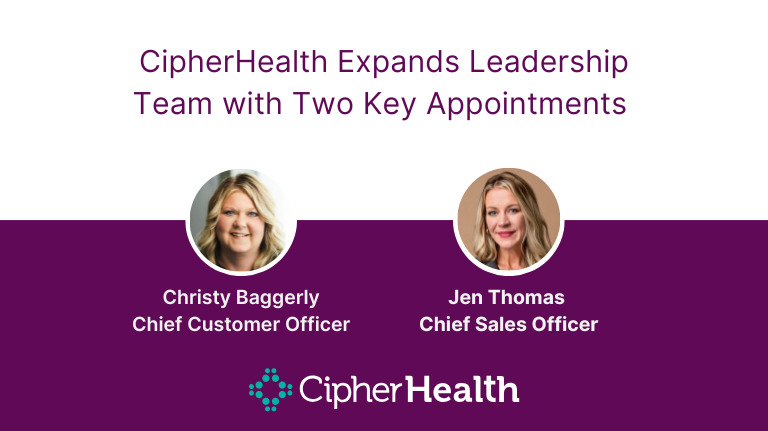
Thomas is the Chief Sales Officer at CipherHealth, a New York healthcare technology company focused on patient communication and care coordination. She joined the executive team in April 2025 with a mandate that sounds conventional on paper: lead sales strategy, improve performance, develop talent, and build durable customer relationships. Her way of describing the market is more revealing. “Healthcare owns moments. Patients live journeys,” she wrote in July 2026. Six words, one organizational headache.
The line gives shape to a professional life spent selling software into complicated institutions. Thomas has more than 20 years of leadership experience across technology and healthcare. Before CipherHealth, she held senior roles at HealthcareSource, Force Therapeutics, and WellSky. Her career also included strategic-account work at Phenom and began in recruitment consulting. The sequence matters because healthcare software is rarely purchased by one person, used by one team, or judged on one result. Selling it is part detective work, part diplomacy, and part long-distance running in sensible shoes.
A career built in the seams
At HealthcareSource, Thomas moved through regional sales leadership, senior director, and vice president positions. Later came Force Therapeutics, WellSky, and eventually CipherHealth. The products and company names changed; the buyer's problem kept a family resemblance. A healthcare organization might see separate budgets and workflows. The person receiving care encounters the handoffs between them, including every handoff that fails.
Colleagues remember her less for a favorite framework than for the questions. One former colleague wrote that if sales teams were assembled by draft, Thomas would be a first-round pick. The explanation was precise: she understood the value of the solution, presented at the executive level, asked the right questions and the tough ones, and sold value and return rather than features and price. Another praised her ability to identify the strengths of individual salespeople and help them improve.
“Healthcare owns moments. Patients live journeys.”Jen Thomas, July 2026
There is a useful tension in those descriptions. Thomas is portrayed as both challenger and coach. One presses an executive team to look squarely at a costly gap; the other notices what a salesperson can become. Enterprise leadership needs both. Pressure without trust becomes theatre. Encouragement without standards becomes a pleasant meeting everyone forgets. Her recommendations suggest she prefers the productive middle, where a difficult question can still feel like an invitation to solve something together.
The patient has no org chart
Thomas's recent public writing treats fragmentation as the central commercial and operational problem. Health systems have leaders for inpatient care, ambulatory care, quality, population health, operations, and patient experience. They also have technologies for each domain. The patient sees none of those boundaries. She sees a single experience, continuous even when the institution's responsibility is not.
The line is the experience. The dots are the departments. Coordination determines whether the line holds.
This is where Thomas's language becomes notably operational. She argues that patient activation works when it is clinically timed, available through multiple modes, and tied to clear escalation and accountability. A signal by itself is only a signal. Somebody needs to receive it, understand it, and own the next action. Otherwise, the technology has succeeded in creating information and failed in creating care.
The distinction is important in a sector fond of pilots. A demonstration can show that software sends a message or collects an answer. A live workflow must decide whose queue receives the answer, how urgency is recognized, what happens when the first attempt gets no response, and how the loop closes. Those details are not decorative plumbing. They are the product as experienced by the people using it.
What a good question buys
Thomas's emphasis on tough questions belongs to this same logic. A feature question asks whether the platform can send a message. An operating question asks what happens when the reply arrives at 4:47 on Friday afternoon. The first can be answered in a demonstration. The second requires the people in the room to discuss ownership, capacity, and consequence. It moves the conversation from software procurement to institutional design.
That shift helps explain why her colleagues mention executive-level selling. Senior buyers do not need a longer inventory of buttons. They need a credible connection between an investment and a result, including the organizational changes required along the way. Thomas's stated responsibilities at CipherHealth explicitly join strategy, execution, and talent. None of those nouns works alone. Strategy without execution is a handsome slide. Execution without the right people is a calendar full of apologies.
Her data-driven reputation adds the necessary discipline. In healthcare technology, “impact” can become an airy word unless everyone agrees what evidence will count. Thomas paired meaningful with measurable when she described her ambition on joining CipherHealth. That pairing is also a sales philosophy. It asks the customer to define the change they care about, then makes the vendor responsible for more than installation.
“Patient activation produces results only when it is clinically timed, multimodal, and anchored to clear escalation and accountability.”Jen Thomas, January 2026
That point of view also clarifies what Thomas is selling at CipherHealth. The company offers patient outreach and rounding tools, but her larger pitch is coordination as infrastructure. Infrastructure has a peculiar commercial disadvantage: when it works, attention flows to the thing it enables. Nobody applauds a bridge for every uneventful crossing. In healthcare, reliable outreach lets clinicians concentrate attention where it is needed. The glamour, if any, belongs to the outcome.
Old relationships, new room
Thomas's arrival at CipherHealth reunited some long professional threads. At the company's 2026 go-to-market kickoff, she wrote about standing among colleagues she had known for more than 15 years and others she had met within the previous year. “Different journeys, shared purpose,” she called it. For a leader whose thesis concerns continuity, the detail feels fitting. Careers also move through handoffs. Trust, unlike a login credential, travels with the person.
Her own journey contains a private counterweight to enterprise scale. Thomas lives in Pennsylvania with her husband and two children. She earned a B.A. from the University of Delaware, where she was involved with Chi Omega. Publicly, she keeps the focus on work: the customer, the team, the workflow, and the result. There is little appetite for the theatrical autobiography that executive social media often rewards.
When CipherHealth announced her appointment, Thomas said she was proud to join “a company with a mission that truly matters.” She connected healthcare to strong communities and said she wanted to partner with leading health systems to create meaningful, measurable impact. The paired adjectives do work. Meaning without measurement can dissolve into sentiment. Measurement without meaning can become a dashboard no one loves.
Her posts since then show the same instinct. She has discussed outreach after discharge, communication that accounts for language and preference, and the need to embed technology inside clinical work rather than beside it. The vocabulary is commercial, but it stays close to action. Who owns this? When do they learn about it? What can they do next? These questions are less fashionable than artificial intelligence and more likely to determine whether any artificial intelligence helps.
The sale after the sale
Healthcare technology can encourage the fantasy that one more system will finally make the institution whole. Thomas's argument is more sober. Tools have to cross organizational boundaries that software did not create and cannot erase by itself. The work demands agreement among people, a place in the workflow, and evidence that the result is better than the old habit.
This makes the chief sales officer's job larger than closing. She has to connect strategy to execution, and the buyer's ambition to the staff member's Tuesday afternoon. She must help a health system imagine one journey while respecting the reality of its many owners. Then the company has to deliver. A promise about connective tissue is tested at every connection.
Thomas appears to understand that the most persuasive answer is often another question. Who owns the patient journey? Where does an unanswered signal go? Which handoff depends on memory? The questions are uncomfortable because the answers cross neat lines on the org chart. They are useful for exactly the same reason.
A patient will never call this care-coordination infrastructure. She may only notice that the right person called at the right time and already knew what happened. In Thomas's corner of healthcare, that ordinary moment is the point. The system recedes. The journey continues.