Farbod Hagigi chose a peculiar place to build a career: the gap between one person's finished work and another person's next move. It is the place where a record waits to become an action, where an organization assumes another organization has taken care of something, and where an elegant plan meets an inelegant Tuesday afternoon. For roughly two decades, Hagigi has approached that gap from several directions. He studied it as a health-policy researcher. He saw it from the strategy floor at Boston Consulting Group. Then he made it the operating problem of ClinicalBox, the software company he co-founded and still leads.
The vocabulary around him is formal: coordination, interoperability, patient engagement, value-based systems. The instinct underneath is plain. Complex work does not improve merely because every participant owns a computer. The parts have to speak, and their incentives and workflows have to make sense together. Hagigi's public record is unusually consistent on this point. Even as the settings change, from academic papers to patent filings to founder mentoring, he keeps returning to the interface.
A researcher with an operator's question
Hagigi earned a BA from UCLA in 2002 and an MPH there in 2003. At Brandeis University's Heller School for Social Policy and Management, his doctoral work examined coordination practices and their relationship to the cost and quality of service delivery. His research toolkit included multidimensional measures of coordination networks and an application of non-parametric linear programming. He also received an Agency for Healthcare Research and Quality fellowship from the U.S. Department of Health and Human Services.
That may sound distant from startup life, but the question is already recognizable: how do relationships among participants affect what a system produces? In 2008, Hagigi appeared as a co-author on a conference paper titled “Modularity and the Coordination of Complex Work.” Modularity promises flexibility by breaking a large system into specialized pieces. It also creates more edges between those pieces. Every edge needs an agreement about what crosses it, when, and in what form.
The sequence of his education is revealing without requiring mythology. Public health supplied a view of outcomes at the level of populations and institutions. Doctoral research supplied tools for examining networks and performance. Neither promised the clean causality of a laboratory bench. Coordination is messier: people talk, teams form habits, organizations protect their boundaries, and measures lag behind reality. Anyone trying to improve that system has to be comfortable with several kinds of evidence at once.
Information exists somewhere in the system.
Someone decides what the evidence means.
The right people receive context and responsibility.
A clear next step is completed and recorded.
After academia, he worked in Boston Consulting Group's Boston office, where he was a project leader and collaborated with senior executives on strategic and operational problems. Consulting added a practical pressure test. A system can be coherent in a paper and still collide with budgets, legacy tools, professional boundaries, and the small matter of getting busy people to change how they work.
It also put Hagigi in rooms where a good diagnosis had to become a decision. Executives do not buy coordination as an abstract virtue. They want to know which delay will shrink, which task will disappear, and which outcome will become more predictable. That discipline survives in the way ClinicalBox has presented its products: the language is about episodes, workflows, evidence, and completed exchanges. The grand systems idea keeps returning to a concrete next action.
ClinicalBox begins between the boxes
ClinicalBox was founded in 2012 by Hagigi, technology executive Murali Menon, and surgeon Salim Afshar. The composition matters. Policy, engineering, and frontline practice were present at the start. Hagigi's present-day brief spans product development and innovation, corporate strategy, and business development. The company describes its work as digitizing and automating coordination, engagement, and administrative exchanges among payers and providers.
In a 2014 Boston Consulting Group report on mobile technology, Hagigi drew a line between “systems of record” and “systems of engagement.” The first stores information. The second helps participants coordinate around it. He argued that technology should reflect a broader move toward coordinated, value-based models and that modular, interoperable ecosystems would matter to both technology and business design.
“Health care technology needs to mirror this shift by moving past a focus on systems of record ... to systems of engagement, focused on care coordination and patient engagement across the value chain.”Farbod Hagigi, 2014
At the time, ClinicalBox's CoordinationBox platform was described as connecting with more than 110 electronic record and information systems deployed across more than 750 facilities. Those are historical 2014 figures, but the more interesting claim was architectural. The platform treated an episode of care as the organizing unit and charged customers on that basis. Instead of asking a buyer to admire a new repository, it tried to align the unit of software with a unit of coordinated work.
The product thesis then met public tests. Following a ClinicalBox appearance at TEDMED, the company announced a 2014 partnership with Biome Analytics that paired analytics with coordinated operational action. In 2015, ClinicalBox and Lowell General Hospital were selected in a nationwide health IT innovation challenge. Hagigi framed the work with typical systems ambition: “The ClinicalBox team believes that the right software can power the value-based healthcare system of the future.”
That same period produced a trail of technical ideas. A U.S. patent application published in 2015 names Hagigi, Menon, and Afshar as inventors of “Adaptive Medical Testing.” Its premise was that tests could be selected or modified dynamically using clinical, contextual, sensor, coordination, and outcome data. The application was later abandoned, but as a document it shows the team thinking about software as an active participant in a changing episode, not a passive cabinet of facts.
A career that compounds by returning
In November 2015, Hagigi gave a University of Victoria seminar on applying modular design to technology systems and service operations. The talk positioned specialization as both a strength and a source of integration complexity. In 2016, he presented ClinicalBox in the startup pitch segment of MIT's Digital Health Conference. The venues changed, but the material held together: specialized organizations need interfaces; information needs to travel with context; and a useful product has to respect the operating system around it.
BA and MPH at UCLA.
Research on modularity and the coordination of complex work.
ClinicalBox founded with Murali Menon and Salim Afshar.
TEDMED participation, a strategic partnership, federal challenge work, a patent publication, and an MIT pitch.
Brandeis roundtables on coherent technology and digitally enabled ecosystems.
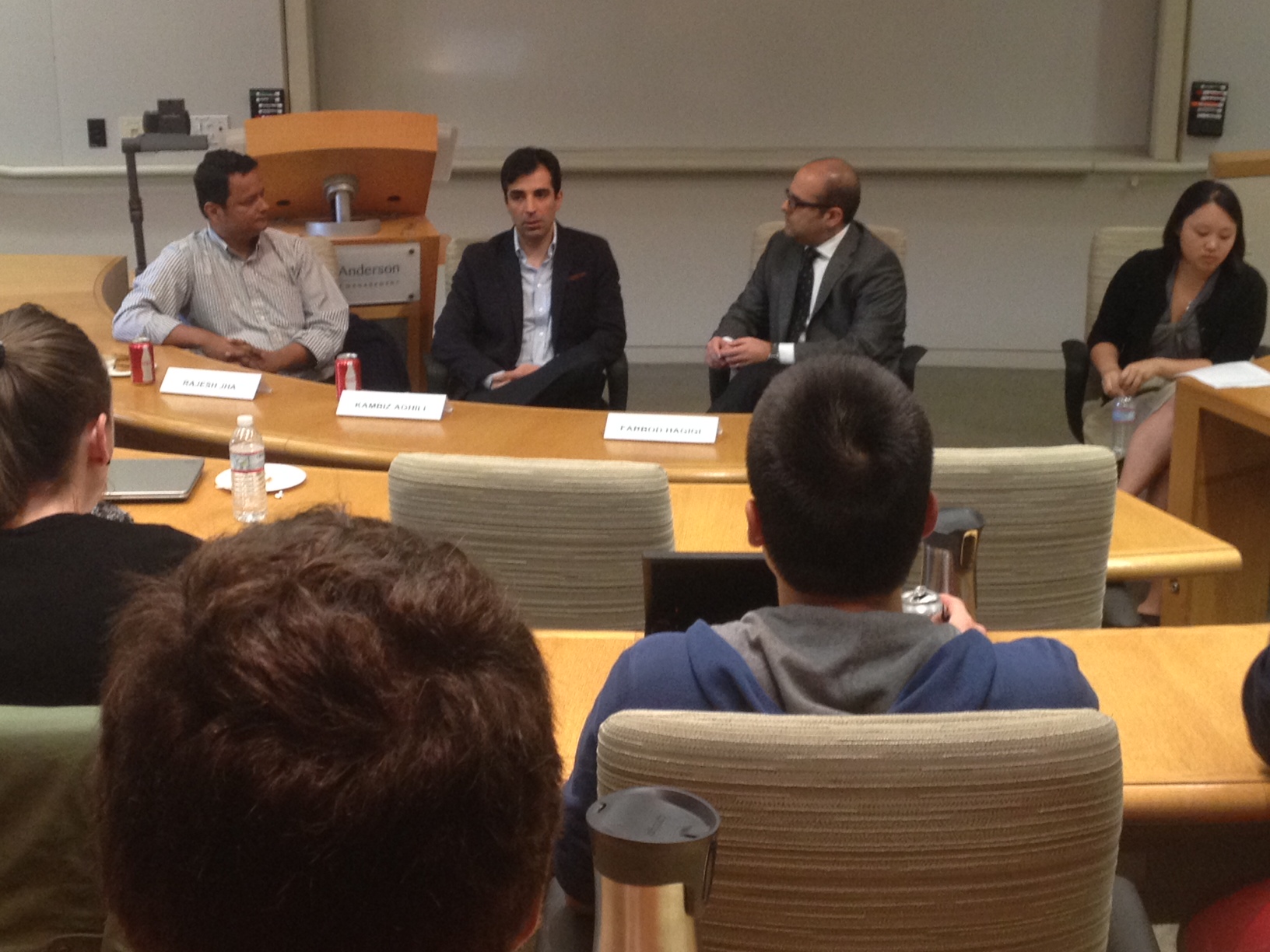
Hagigi has also kept one foot in the classroom and incubator. He mentors in UCLA Anderson's Easton Technology Management Program and Harvard Innovation Lab's Venture Incubation Program. The connection feels less like a ceremonial sideline than an extension of the work. Early-stage founders are forever discovering interfaces they forgot to design: between buyer and user, product and regulation, technical possibility and organizational appetite.
His continued participation in Brandeis's Relational Coordination community adds another loop. In 2022, he presented on designing coherent technology solutions for care coordination using relational coordination theory. In 2024, he helped facilitate a roundtable session on digitally enabled ecosystems. The founder returns to the research community with operating experience; the research community gives the operator a sharper language for the same stubborn knots.
The durable idea in Hagigi's career is modest enough to miss: a system is only as useful as its next hand-off.
Look where competence stops
There is a lesson here for builders far beyond healthcare. When every department appears individually competent and the overall experience remains frustrating, inspect the borders. Ask where context gets stripped away. Ask which participant has responsibility without authority, or authority without the evidence needed to act. Ask whether the software reflects the actual unit of work or merely the org chart that purchased it.
Hagigi's path also offers a useful model for a long career. He did not abandon research when he entered consulting, or abandon systems thinking when he became a founder. Each setting supplied another view of the same question. The academic view measured relationships. The consultant's view tested incentives and operations. The founder's view had to ship something that people could use. Mentoring, in turn, makes the accumulated pattern available to someone at the beginning.
ClinicalBox's own language has evolved with its products and market, yet Hagigi's underlying aspiration remains legible: make coordination less accidental. It is not glamorous work. Interfaces rarely get the ribbon cutting. A clean hand-off often looks like nothing happened at all. The right evidence arrived, the next person understood it, and the process moved.
That invisibility may be the point. A well-designed seam does not demand applause; it lets everyone get on with the work. Hagigi has spent two decades giving the seam his attention anyway. In a world delighted by impressive boxes, he keeps looking at the small, consequential space between them.