A founder offsite in Jamaica is an excellent place to discover that the thing you dismissed as boring may become your next company. In January 2024, Jeevika Makani and her co-founder, Celilsemi Sam Erkiner, were looking for a new direction. Their fashion-resale work had plateaued. Erkiner had been watching OpenAI's new store for custom GPTs. Makani heard the phrase and felt no immediate romance. It sounded technical. It sounded like somebody else's hobby.
Erkiner suggested she build one before judging it. Half an hour later, Makani had made a small app from a side project called Books of Color, recommending books by writers from diverse backgrounds. The exercise collapsed the distance between a platform announcement and a personal use. She could see how someone without a technical identity might make a useful, narrow application inside an interface people already knew.
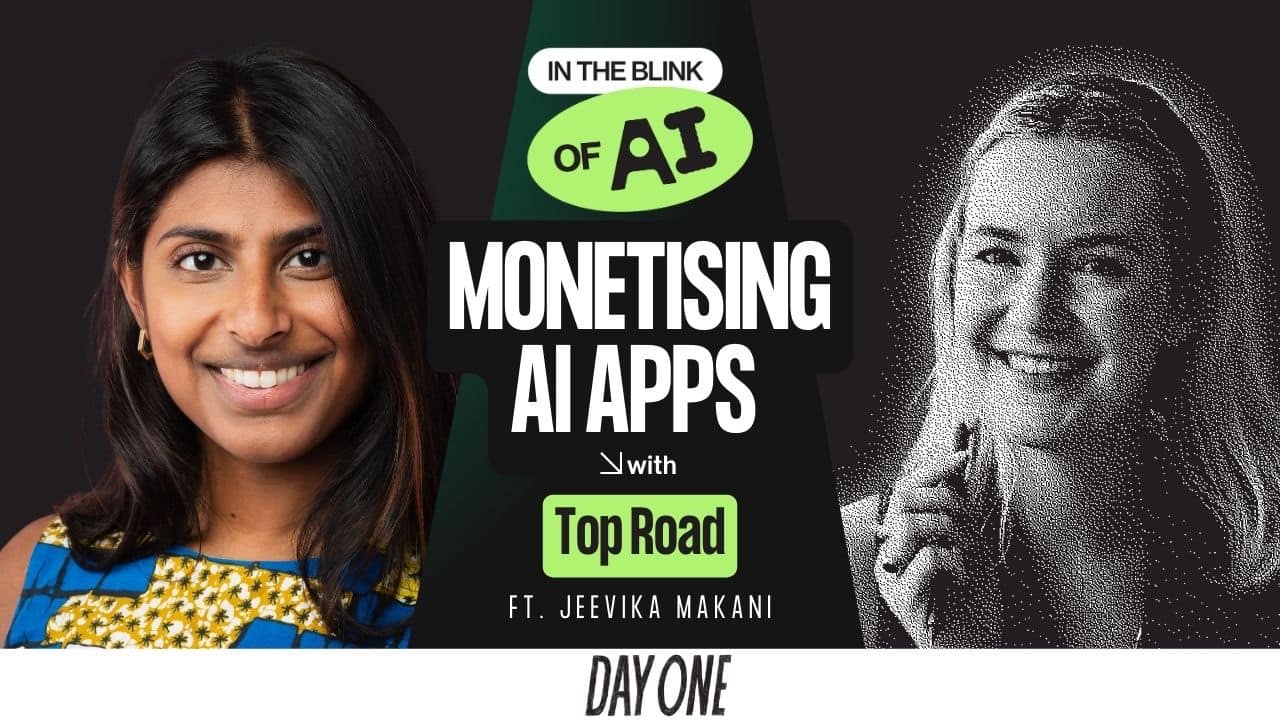
Then came Erkiner's more commercial observation. Developers will visit a new platform because it is interesting. They will keep building only if the economics make sense. That pair of insights became Top Road: make the apps approachable for users, and give their makers payment and analytics tools to learn, charge and improve. Makani had found another awkward little gap.
An education in useful detours
Makani's career makes more sense as a sequence of questions than a ladder of titles. At the University of Melbourne, she studied economics and history, but also used the latitude of an arts degree to take subjects such as Modernist Avant-Garde Art and Global Justice and Human Rights. She has said she never carried a fixed plan. Curiosity was the organising principle.
The early ambition was impact, a word she has used with deliberate caution. Development studies left her aware of problems but dissatisfied with her grasp of why they persisted or what might change them. Inspired by thinkers including Amartya Sen and Martha Nussbaum, she considered development economics. Advice arrived: first become a good economist. She joined the Australian Competition and Consumer Commission as an economic analyst, and public regulatory records place her in the work around energy-consumer consultation in 2013.
A move to Africa was motivated by life, not a polished career plan. Development-economist jobs did not appear. A fintech job did. Lendable, then at an early stage in Nairobi, hired Makani as its first employee. She did due diligence and business development while the company began deploying capital. Eventually the growing loan portfolio required a formal risk function. Her boss asked whether she would create it.
The next move is the important one. She read the theory, spoke with risk practitioners and built the function. Economics had supplied rigorous analysis. The startup supplied an unfinished problem and no instruction manual. She liked the combination. It turned out that uncertainty suited her better than carefully bounded work.
The recurring route: learn the system, find the blockage
The marketplace apprenticeship
At Fat Llama, a peer-to-peer rental marketplace, Makani worked in the sort of operations where abstract marketplace diagrams meet damaged goods, identity checks and impatient customers. She later said the pace reset her idea of hard work: arrive, blink, and the day is gone. It also gave her a close view of the circular economy. Students who could not buy a filmmaking lens could rent one. Access expanded without another object being manufactured.
But rental had stubborn mechanics. An item needed to move from one customer to another and back on time. The platform earned a fraction of a rental price, itself a fraction of the item's value. Resale looked simpler and economically roomier. Makani noticed Facebook groups where fans of particular clothing brands already bought and sold among themselves. The communities were real; the commerce layer was accidental. A sold listing could jump back to the top because someone commented, while an available one disappeared below it.
That observation became re-mint, co-founded with Erkiner in 2021. She had returned to Sydney after completing an INSEAD MBA, with a pandemic in progress and only a thin local startup network. She met Erkiner socially. A mutual mentor knew his previous startup had folded and suggested she call him. The operating founder and technical founder found each other through a human recommendation rather than a matching algorithm, which feels almost quaint.
Re-mint began as a storefront for those informal groups, then moved towards partnerships with brands. Makani wanted circularity to work as a business incentive, not a moral accessory. If a brand could earn from resale, or keep a customer by offering store credit, more sustainable behaviour had a commercial ally. She was candid that good intentions alone were not enough.
The founders applied to Y Combinator's Winter 2022 batch early, did not lavish time on the form, and then forgot about it. An interview invitation arrived months later. Inside the program, advice pushed them to work with brands sooner, closer to their stated long-term vision. Makani did not describe advice as instruction to obey. Her rule was to listen twice when it came from people who had watched many startups succeed and fail.
The plumbing beneath the magic
Top Road changes the setting but preserves Makani's favourite problem. A developer can make a specialised GPT for mortgage brokers, teachers, consultants or a company team. The app may use private knowledge, connect to an outside service or complete an action. But a clever demo still needs ordinary software machinery: user access, trials, payments, pricing and evidence of what people actually use.
Top Road's public description is plain: no-code analytics and payment tools for creators in the OpenAI ecosystem. Makani argues that monetisation is part of product quality. If makers can charge for niche work, they have a reason to keep iterating. If they can see how people interact, they can find the weak point. The thesis is economic before it is technical.
The small-app incentive loop
This is also where her nontechnical background becomes an advantage rather than an apology. Makani does not expect most people to become experts in prompting. She wants applications to arrive ready for a task. Her own route into custom GPTs began with reluctance, followed by a half-hour experiment. She knows what the threshold feels like because she crossed it herself.
The company remains deliberately small. Y Combinator lists Top Road as active, with a team of two in Sydney. Makani once joked that her role is everything that is not coding: strategy, finance, operations, sales and product development. The work she enjoys most is time with clients and users; lawyers and company administration occupy the opposite end of the ranking.
Ambition, with the theatre removed
Makani is optimistic about AI without sounding impressed by every AI product. In a January 2025 podcast, she called the moment a knowledge revolution and argued that AI-first companies could challenge incumbents with lower costs or better products. In the same conversation, she named Microsoft Copilot as overhyped and praised Notion's conversational search for retrieving buried company knowledge. The judgment is product-specific, which is more useful than a general mood.
Her larger aspiration is democratic access. She wants useful generative AI to reach people who will never care about model names. She talks about software that saves hours on a report and returns that time to more human activity. Her example was going to the beach, a Sydney answer if ever there was one.
The optimism has a practical edge. Tools can be used well or badly. Products should create tangible value rather than borrow excitement from the category. Makers need incentives. Users need clarity. A founder needs to know which advice deserves a second listen and which task is essential enough to survive the day.
Her public appearances through 2025 followed that line: the INSEAD Americas startup showcase, an AI Salon Sydney spotlight on creator monetisation, and a finalist place in INSEAD AI Venture Lab's Singapore Demo Day. These are modest markers of a company still working out its place in a changing ecosystem, not a victory lap.
When a podcast host joked about joining Makani on a future superyacht, she offered a correction. She was not a superyacht person. A small boat to take out in Sydney would be lovely, and more chic. It was a throwaway exchange, but a fitting one. The career is ambitious. The performance of ambition is negotiable.
Economist, operator, founder: each label catches only a slice. The steadier description is someone willing to enter an unfamiliar system, find the part that does not quite work and learn quickly enough to intervene. Sometimes the gap is a risk function in Nairobi. Sometimes it is commerce hiding inside a Facebook group. Now it is the money and feedback loop beneath a small AI app. Makani keeps following the blockage. So far, it has been a surprisingly reliable map.