Daniel Gómez was his best friend at school. Years later, the two were building a financial technology company together, with developers working from the city where they had grown up. Juan Luis Pérez Escobar brought something rather different from a software portfolio: he was a lawyer. In the business they were examining, that was a useful qualification. The customers were distributors and small merchants. Their working day still involved collecting invoices by telephone or WhatsApp, accepting cash, and deciding whom to trust with credit.
Milio began in that everyday commerce between businesses. Pérez Escobar, Gómez and their fellow founder Toni Riera were looking at transactions that could be routine, yet remained awkward. A shopkeeper needed stock. A supplier needed payment. Credit often depended on a relationship built over years. There was plenty of technology in the world; getting it into this particular exchange was the job.
Before the payment button, a law practice
Pérez Escobar comes from Montería, in Colombia’s Córdoba department, and is based in Bogotá. His professional education took him to Pontificia Universidad Javeriana, where he studied law and specialized in business law. He also studied antitrust and consumer law at Universidad Sergio Arboleda. These are subjects concerned with the arrangements beneath a market: who can participate, what businesses may charge, and how customers are treated.
His early career included Esguerra Asesores Jurídicos and an in-house legal position at BODYTECH Colombia. In 2015 he started LÖIS Consulting Group, serving as founder and general manager until 2022. That gave him years of running a business before Milio became his principal work. Contracts were familiar territory. So were clients and operations.
His professional description still joins the two careers: entrepreneur and business law attorney. He describes his leadership in terms of example and communication. The lawyer has remained visible alongside the executive, particularly when he writes about the rules governing financial data. Milio did not erase that earlier training. His public work continues to use it.
A school friendship becomes a founding team
Gómez and Pérez Escobar attended the Británico school in Montería. Riera was also a longstanding friend. When Pérez Escobar explained their partnership in early 2023, he described complementary experience: Gómez’s product and software knowledge, Riera’s technology and finance background, and his own legal and operational skills. The business began with people who already knew one another.
The first product took nine months of development by a team in Montería. Pérez Escobar recalled the difficulty of keeping people motivated while results were still out of sight. His advice to would-be founders was practical: test an idea with customers, even a small number, and make the need it solves tangible. The emphasis fell on a working product and a real customer, before the fundraising.
“Lo importante es volver tangible que estás resolviendo una necesidad.”
Juan Luis Pérez Escobar, 2023What matters is making it tangible that you are solving a need.
There is a pleasantly unglamorous detail in that origin. While Milio was heading toward a Silicon Valley accelerator, the initial building happened in Montería. A school friendship, a regional development team and interviews with distributors all belonged to the same enterprise.
Thirty, sixty, ninety
In January 2023, Pérez Escobar was Milio’s co-founder and chief operating officer. Riera was CEO and Gómez led product. The early offer allowed other businesses to provide financing under their own brands, using infrastructure operated by Milio. Suppliers could help their customers purchase stock on credit rather than requiring the whole payment immediately.
At that point, Milio reported 550 loans to more than 400 small and medium-sized businesses in Colombia. Pérez Escobar explained repayment periods of 30, 60 and 90 days, depending on a merchant’s risk profile. The model earned money through a supplier invoice discount and a credit management commission paid by the merchant. Those were the mechanics behind the early pitch.
The company entered Y Combinator’s Winter 2023 batch. For Pérez Escobar, the programme meant investment and access to experienced people as well as learning. By Demo Day, Milio was presenting an API for business payments and automated treasury work. Its attention was moving further into the machinery surrounding the transaction.
The lawyer keeps writing
During 2023, Pérez Escobar was also contributing to Colombia’s discussion of open finance. In May he published observations on a draft regulatory circular concerning open finance and the commercialization of technology and digital infrastructure. His byline identified both his operating role and his legal profession. The combination was quite literal.
A June column addressed what open finance could mean for banks’ business models. He examined the treatment of financial data, the services he believed should be available without a charge, and the prospect of bank transfer fees moving toward zero. He also described opportunities for banks in lending, better risk assessment, fraud reduction and products developed from data.
These were arguments about how a market should work. He called for standardization so that open-finance initiatives could reach wider use, looking at international approaches as reference points. The column places him inside the debate over the conditions that allow a payments company to operate. It also preserves his views at a particular moment, as Colombia was developing its approach.
In his May observations, he emphasized that personal-data protection had to work in practice, combining legal and technical responsibilities. He also highlighted common standards for institutions to exchange information and services. The document he was discussing contemplated financial institutions offering services through third parties, including fintech companies. For Pérez Escobar, effective interoperability and responsible data exchange belonged in the same conversation. His contribution was specific enough to address transition periods and the deadline for submitting comments, as well as the larger ambition of an open financial system.
The payment needs its paperwork
By September 2023, Milio was publicly identifying Pérez Escobar as CEO. Its offer centered on immediate account-to-account payments, business collections and treasury automation. Customers could use a checkout designed to deliver both funds and reconciled information. The intended audience included payment gateways, fintech companies, online merchants and other businesses.
Reconciliation is a small word for a substantial chore: matching a payment with the obligation it settles. A business needs to know which invoice was paid and what remains outstanding. Milio’s offer joined money movement to that information. It also included recurring collections, bulk payouts and transaction monitoring, putting several pieces of a finance team’s work into one system.
The company’s ambition at the time was to become a treasury management platform for Latin American businesses. Its launch material described connecting payment infrastructure to existing enterprise software through a single API. One of its more human disclosures was that Milio had been its own first client. The company building the plumbing also needed to use the taps.
A transfer with fewer office hours
In September 2024, Milio announced a card-to-card transfer system developed with Visa and Banco Coopcentral. Pérez Escobar was now explaining a business that had changed from its initial embedded-finance proposal. The new system was designed for individuals and companies, with a domestic first phase and an international second phase.
The aim was availability throughout the day and week, without the limitations of traditional banking hours. Receiving money should not depend on whether the bank’s working day had ended. Pérez Escobar presented the launch as a way to serve both local and international transfers. The announcement concerned a defined partnership and a phased rollout.
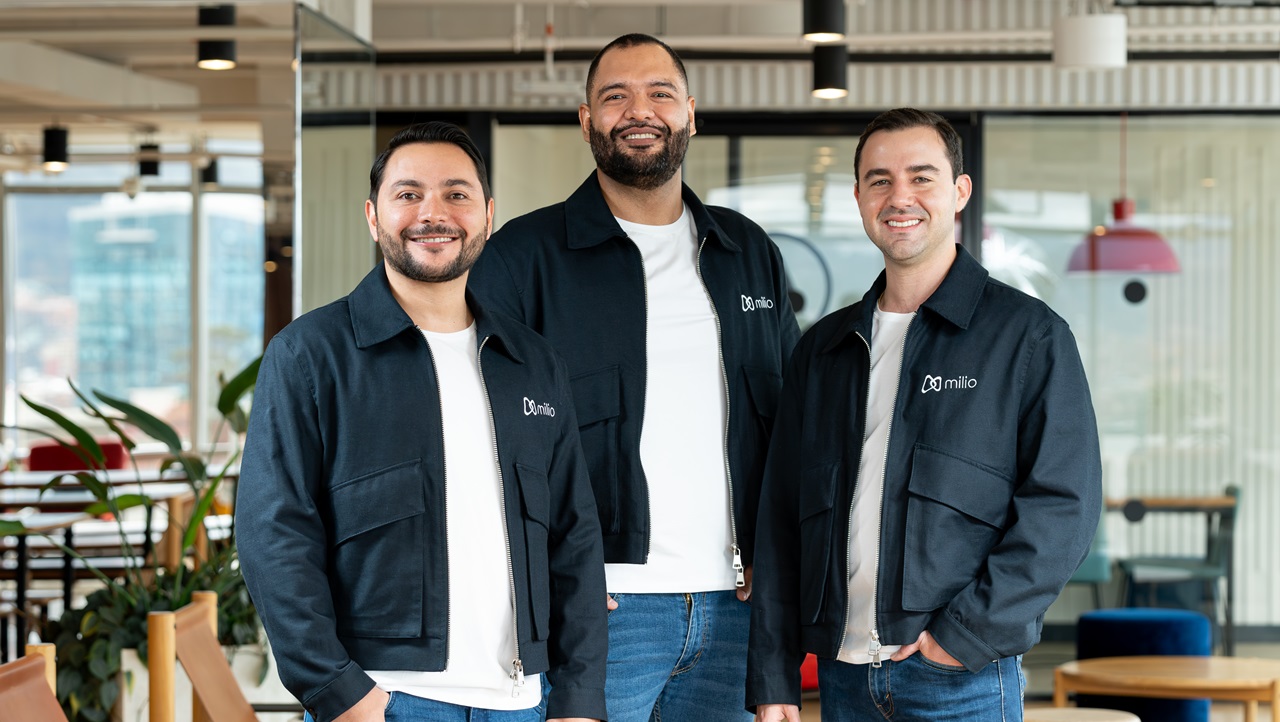
Under his leadership, Milio’s published product range addressed banks, wallets, fintech companies and corporations. Its corporate proposition included paying employees and suppliers, collecting money and reconciling operations. For developers, it offered documentation for initiating and monitoring transfers, alongside predefined interfaces. These were the components being offered to other teams building financial products. The CEO’s audience therefore included both the institution choosing a service and the engineers responsible for connecting it.
His public activity also took him to industry gatherings. He announced participation in Finnosummit in Mexico City in September 2024 to present Milio’s immediate-transfer solutions. More recently, he represented the team at Visa Day Ecuador, discussing local payments and remittances. The company’s connections were becoming a visible part of the CEO’s work.
In November 2023, he also appeared among Caribbean Colombian founders at a venture-capital and startup event in Barranquilla. The panel brought together entrepreneurs from several cities and industries. Montería’s place in that conversation was represented by the lawyer who had helped start Milio.
The next border is an actual border
In 2026, Milio and Payments Way joined forces to create Dagurpay, an infrastructure business focused on payments between the United States and Latin America. Pérez Escobar was identified as its CEO and co-founder. The offer combined dollar accounts for companies, foreign exchange, regulatory processes, collections and payouts, with support for traditional currencies and stablecoins.
The initial corridors announced included Colombia, Mexico, Ecuador and Venezuela. The company said settlements would ordinarily be completed in less than 24 hours. That is a stated service proposition, with a different scope from the instant domestic transfers Milio had previously discussed. International commerce brings another collection of systems to connect.
Pérez Escobar has described the goal through a practical example: a Colombian company buying supplies from a United States provider. Dagurpay aims to give the financial institutions serving such companies the infrastructure to move the money. His own announcement thanked Milio’s team, Payments Way and their customers and partners. The language remained about building connections.
The distance from a distributor’s telephone call to a cross-border payments platform is considerable. The people in the story remain recognizably connected: the lawyer, his school friend, the businesses trying to pay and get paid. Pérez Escobar’s work has changed its instruments and expanded its geography. The transaction still needs to reach the other side.