The ugliest part of a payment is often the part nobody photographs. A finance employee makes a transfer, saves a screenshot, sends it through WhatsApp, opens an accounting system, and tries to prove that the money that left one place arrived in another. The amount may move in seconds. Certainty takes the afternoon. Juan Luis Pérez Escobar has spent the past few years trying to close that gap.
His route to the problem began far from the usual mythology of the coder-founder. Pérez Escobar is a lawyer from Montería, the capital of Colombia’s Córdoba department. He studied at Pontificia Universidad Javeriana in Bogotá, earned his law degree in 2012, specialized in commercial law, and later studied competition law and consumer protection at Universidad Sergio Arboleda. He worked at a law firm and in-house at BODYTECH, then started LÖIS Consulting Group in 2015. Before payment APIs, there were contracts, clients, rules, and the more sobering education of running a business.
That education turns out to be useful in fintech. Money is code only after it is permission. Someone must be allowed to initiate a transfer, identify the recipient, hold the data, carry the risk, and explain the result. A payment product lives inside a mesh of consumer rights, bank connections, accounting habits, compliance duties, and human suspicion. Pérez Escobar learned to read that mesh before he tried to redesign it.
A company hiding in a phone call
The origin of Milio was not a brainstorm about financial technology. It was an observation about commerce. Pérez Escobar and his future co-founders interviewed distributors and found processes that had barely changed in decades. Invoices were collected by phone or WhatsApp. Cash remained common. Small retailers received credit only after years of personal trust with a supplier. Even when payment went digital, the administrative choreography remained stubbornly manual.
The founding team made sense because its skills did not match. Daniel Gómez, an economist and user-experience designer with software knowledge, had been Pérez Escobar’s close friend since they attended school together at the Británico in Montería. Toni Riera brought experience from technology and financial services. Pérez Escobar brought law and operations. Friendship supplied trust; different professional instincts supplied coverage.
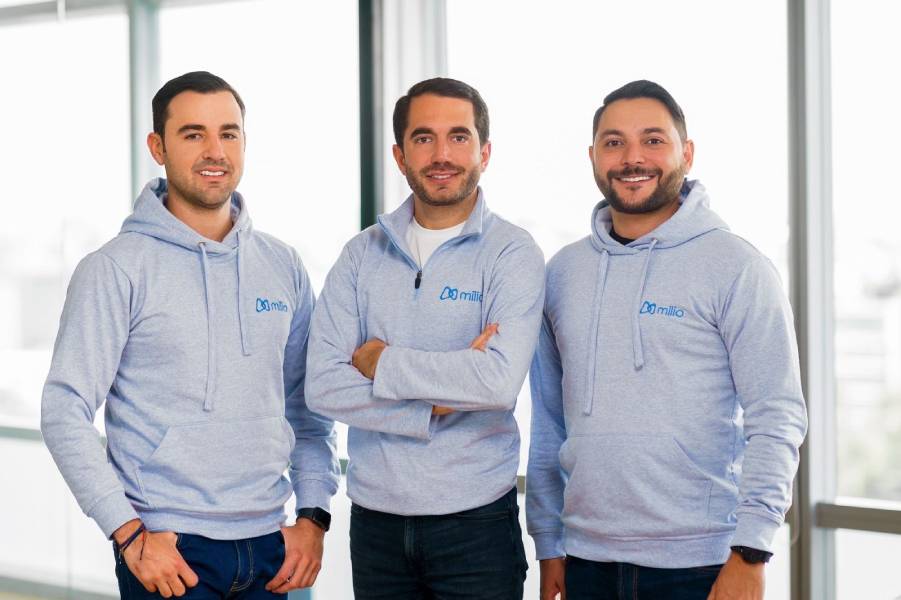
A team of developers in Montería worked for nine months before the minimum viable product existed. Pérez Escobar has described the difficulty plainly: when results are not immediate, keeping a team motivated becomes part of the product work. The counterweight was conviction that the problem mattered. It is a less cinematic version of starting up, mostly persistence in a room while the promised thing remains invisible.
“Lo importante es volver tangible que estás resolviendo una necesidad. Luego de esto, los recursos vendrán.”Juan Luis Pérez Escobar on early-stage building
His advice from that period is precise: develop the idea, test it in the market quickly, and do not wait for a crowd. A few customers can make a problem tangible. Resources should follow evidence, not substitute for it. The rule sounds almost too tidy. Its power is that it aims attention at a real operator doing an awkward task rather than an abstract market waiting to be conquered.
The useful lawyer in the machine
Milio began with financing and payments between businesses. Its early pitch helped distributors extend short-term credit to small retailers and digitize the surrounding process. The product evolved as the team looked deeper into treasury work: automated collections and payouts, real-time reconciliation, fraud controls, and connections between bank accounts and enterprise systems. The recurring enemy was not simply delay. It was opacity.
In 2023, Pérez Escobar summarized the irritation with a memorable inventory: blind transfers, screenshots used as proof, and repeated bank logins to reconcile a payment. Milio wanted the transfer and its information to travel together. For a finance team, that distinction is the distance between moving money and understanding what happened.
or ERP
+ data
or wallet
The company joined Y Combinator’s Winter 2023 batch. Pérez Escobar, then Milio’s COO, traveled with the founders to San Francisco and later became CEO in September. The title change fitted the work he was already doing: translating between product, institutions, partnerships, and the daily mechanics of execution. His legal background remained visible. He published detailed commentary on Colombia’s emerging open-finance rules, including questions about data commercialization, consent, competition, and which services should remain free because of their public character.
This is where the apparent career pivot becomes coherent. Law trained him to notice where rights and obligations sit. Operations trained him to notice what people actually do. Product building required both views at once. In regulated technology, the person who can translate among a regulator, a bank, an engineer, and a customer is not standing outside the machine. That person may be holding its most important map.
From faster islands to working bridges
Milio’s ambitions widened with the payment landscape. Colombia advanced toward interoperable instant payments. Brazil had Pix. Mexico had SPEI. Other countries developed their own real-time systems. These rails make local movement quicker, but national success creates a fresh inconvenience: each rail has different rules, technical connections, and borders.
Pérez Escobar’s current thesis is that instant is only the first adjective. The next one is interconnected. A payment can be beautifully fast inside Colombia and still meet friction on the way to Mexico, Brazil, or the United States. Integrating country by country turns speed into a patchwork. Milio now frames its job as building connective infrastructure for payment providers, wallets, financial institutions, and businesses that do not want to assemble every local layer themselves.
“The future of payments is not just about instant payments. It’s about connecting instant payment systems to the world.”Juan Luis Pérez Escobar, 2026
The company’s public milestones trace that shift. It worked with Visa and Banco Coopcentral on card-to-card transfers designed to run around the clock. It presented remittance infrastructure reaching more than 40 countries. In 2026, Milio and Payments Way Solutions announced DagurPay, a product connecting a United States banking account, dollars and stablecoins, on- and off-ramp functions, and onward movement into Latin America. The components vary, but the design instinct remains consistent: take a fragmented set of actions and make them feel like one legible flow.
Starts LÖIS Consulting Group after training and working as a business lawyer.
Co-founds Milio; a Montería-based development team builds the first MVP.
Milio enters YC W23. Pérez Escobar moves from COO to CEO.
Card-to-card, real-time transfer infrastructure is announced with Visa and Banco Coopcentral.
DagurPay and a broader thesis emerge: connect instant-payment systems across borders.
The Córdoba thread
There is a regional story under the payment story. Montería was not merely Pérez Escobar’s birthplace or a recruiting footnote. It supplied a co-founder friendship, the first development team, and a recurring concern with how technology creates opportunity away from the usual capitals. He has written about startups and local economic development, arguing that investment in technology companies circulates into talent, services, and employment.
He also co-founded Atarraya, a Córdoba civic foundation formed during the pandemic by professionals concerned with the department’s future. The organization convenes discussions about regional development and public policy. It is a different kind of infrastructure, built from conversation and institutional memory rather than APIs, but the impulse rhymes: connect people who operate in separate systems and give them a shared layer.
His public style is more enthusiastic than austere. He writes about innovation as a bet worth taking, praises collaborators freely, and returns often to the people surrounding the work. Advisors, co-founders, engineers, partners, and regional institutions appear in his account of progress. Even his founder advice begins with belief, expertise, and perseverance rather than a trick for outrunning competitors.
The most revealing detail may be Milio’s claim that Milio was its own first customer. Founders who have felt a problem possess an intolerance that market research cannot manufacture. They know which extra click is insulting, which delay ruins the day, and which workaround is so normal that nobody remembers choosing it. Pérez Escobar’s career has made him unusually attentive to workarounds: the legal workaround, the operational workaround, the screenshot sent because two systems refuse to speak.
What remains to be connected
The payment industry likes nouns that sound finished: rail, network, platform, system. Pérez Escobar’s work is about the verbs between them. Initiate. Verify. Reconcile. Convert. Distribute. Connect. Each verb is a place where speed can disappear and trust can leak.
His journey from a young lawyer starting a firm to the CEO of a payment-infrastructure company is therefore less a reinvention than a widening circle. The first work organized agreements among people. The current work organizes agreements among institutions and machines. Both require an answer to the same quiet question: when value moves, how does everyone know what happened?
Latin America does not lack fast payment systems. It has many of them, arriving at different speeds and speaking in different technical dialects. The opportunity Pérez Escobar sees is in the translation layer. If Milio succeeds, the cleverness should recede from view. A business will ask money to move, the systems will agree, and nobody will need to send a screenshot afterward. Good infrastructure has the manners of a discreet host. It introduces everyone, resolves the awkwardness, and leaves the room before taking credit.