A biography of Conrad Hilton was waiting in a hotel bedside drawer. Omar Onsi picked it up. Years later, he still remembered the hotel founder’s persistence through the Great Depression, and the uncomfortable familiarity of a business life with its ups and downs. It is a pleasingly modest origin for an entrepreneurial influence: a book left within arm’s reach, rather than an invitation to a private club.
Onsi’s own work has travelled from international telephone calls to the systems that move money. The Lebanese entrepreneur is the founder and CEO of NymCard, established in 2018. His subject is the machinery behind financial products, the part a customer rarely sees unless something goes wrong. There is little glamour in reconciliation. There is considerable inconvenience in getting it wrong.
A cheaper way to call home
In 2008, Onsi founded Nymgo, an internet-calling business aimed at people making international calls. Its audience included expatriate workers who wanted an affordable connection to families elsewhere. By 2013, the business had customers in 190 countries, around 150,000 monthly active users and a team of 50, including 40 in Lebanon. It was an international operation with a substantial Lebanese workforce.
That business gave Onsi a particular kind of problem to solve. A customer wanted a conversation. The company had to make the connection affordable enough to repeat. Price was part of the experience, as surely as the quality of the line. For someone paying to call home, a cheaper minute was a useful minute.
His explanation of Splendor Telecom’s approach in 2011 was deliberately narrow. While competing internet-call services offered a broad assortment of features, his company concentrated on inexpensive international voice calls, without video. He described growing the business organically before approaching investors, eventually securing backing from Intel Capital and Abraaj Capital. The product’s focus, alongside its track record, was central to his account of why investors were interested.
There is an attractive lack of ornament in that proposition. A call should cost less. The customer should be able to understand the benefit without a demonstration of twelve unrelated features. Looking across his career, the recurring commercial question is where a useful service becomes too expensive or cumbersome to reach people. That is an interpretation of the two businesses, rather than a claim that he planned the entire journey in advance.
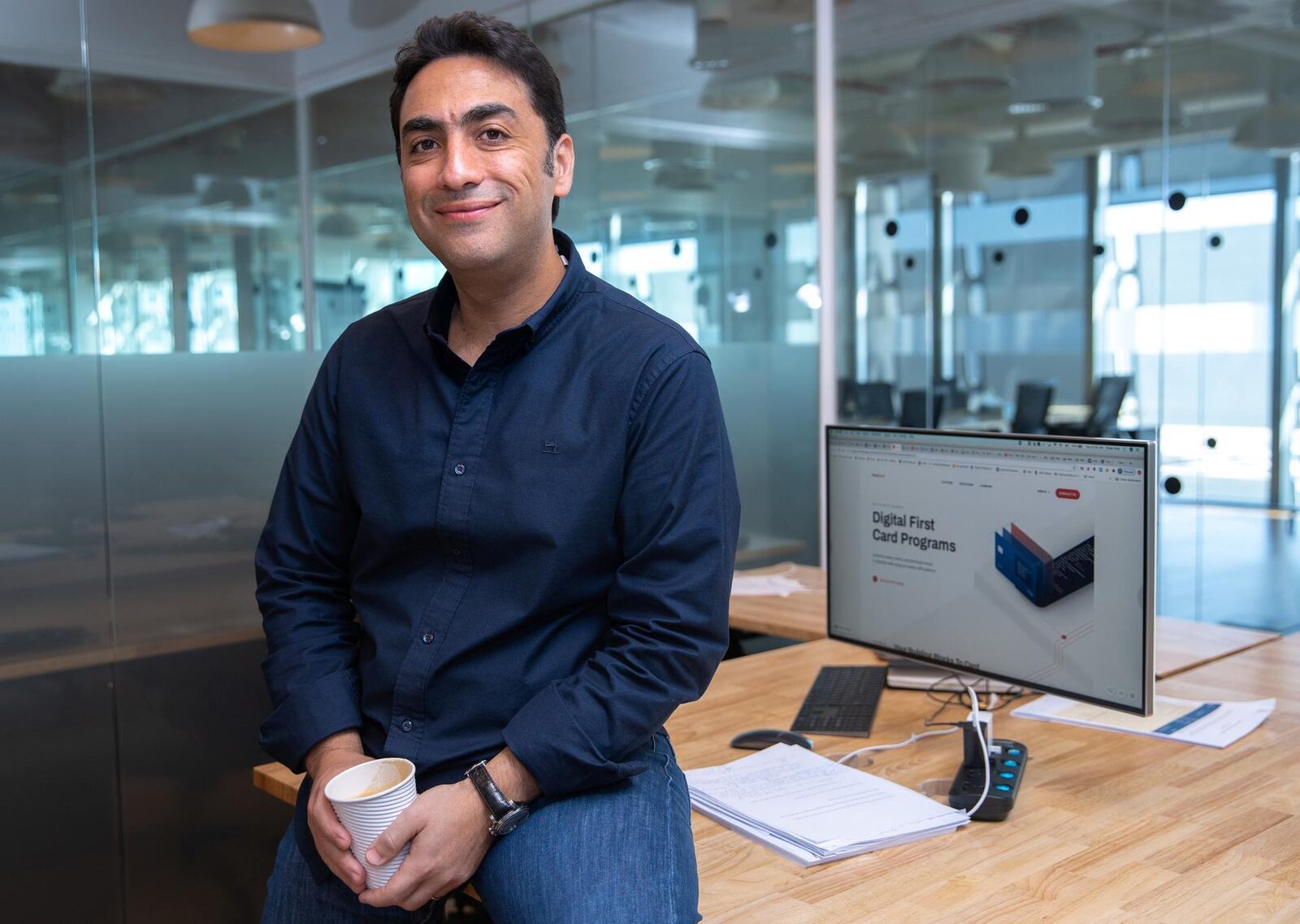
From a call to a card
The move into payments put Onsi in a different relationship with the customer. NymCard supplies infrastructure to the businesses creating financial products. A bank, fintech or enterprise can build a service using its technology. Onsi’s company works beneath the product that carries the partner’s name. The visible experience belongs to someone else; the underlying system still has to perform.
His April 2021 video conversation with Mark Walker ranged across banking as a service, consumer and business models, regulatory change and the region’s fintech ecosystem. By then, he had spent more than two decades as a technology entrepreneur. The questions had become broader than the price of a telephone call: who could launch a payment product, what they needed underneath it, and how they could expand.
NymCard’s geography mattered. The company moved its headquarters from Beirut to Abu Dhabi’s Hub71 in September 2020, seeking closer work with the local regulatory environment. That placed the business within an Emirati technology hub while its ambition remained regional. Building a financial service for several countries means encountering several sets of institutional arrangements. A map may make the journey look simpler than the paperwork does.
Onsi described that difficulty in 2021: a fintech needed both a suitable issuer processor and a bank to sponsor its card programme, then faced the problem again in another market. NymCard’s proposed answer was to build bank relationships across the region and give clients one relationship through which to expand. The company had developed its own processing technology and offered a sandbox where developers could begin testing.
Owning what sits underneath
At the centre of the business is nCore. NymCard owns the processor beneath its platform and describes a system spanning card issuing, money movement, settlement, reconciliation, lending and financial crime controls. Customers can take the layers they need through one integration. For Onsi, this makes the underlying architecture part of the commercial proposition. Selling access to a system also means accepting responsibility for how its parts fit together.
Embedded finance is the practical setting for that work. A company can place cards, payments or lending within a journey its customers already use, under its own brand. NymCard’s model lets the partner configure the financial capabilities beneath that journey. The attraction is continuity: adding another service should not require starting the infrastructure assembly all over again. It is a promise about the work that follows the first launch.
In June 2026, the company launched nCore FullStack, combining issuing processing, lending, money movement, settlement, financial crime and reconciliation. Onsi’s explanation centred on the cost of accumulating connections to an ageing system. Each addition creates something else to maintain. His stated aim was for a bank to integrate once, select the capabilities it needed and customise them over time. The ambition is easy to state. Delivering it requires the unglamorous consistency that infrastructure customers buy.
“Building a regulated financial institution takes time, discipline and a significant investment behind the scenes.”Omar Onsi, September 2026
The money, and the permissions
In June 2022, NymCard raised $22.5 million in a round led by DisruptAD, Reciprocal Ventures and Shorooq Partners. The company planned to grow its teams and strengthen its services in core markets. Its offering included card issuing, programme management, compliance, foreign exchange and treasury. These are the surrounding tasks that make a payment product possible, and help explain why a founder might buy infrastructure rather than assemble every piece independently.
Another round followed in March 2025: $33 million, led by QED Investors. Existing backers participated alongside Oraseya Capital. NymCard said it had partnered with more than 50 banks, fintechs and enterprises, and would deepen its presence across more than ten MENA markets. The announced priorities covered card issuing and processing, embedded lending and money movement. Funding was being directed towards a broader set of financial functions, with regional expansion continuing alongside it.
Capital and regulatory permissions follow different calendars. In May 2025, NymCard announced its licence to provide Open Finance services under the Central Bank of the UAE’s framework. That enabled regulated payment functionality within its broader infrastructure. The company described secure, consent-driven account-to-account flows as one use case, giving consumers a way to authorise payments and merchants another route to receive them.
In September 2026 came in-principle approval for a Stored Value Facility licence. That status matters: an in-principle approval is a step towards a licence, and should be described precisely. NymCard already held Retail Payment Services and Card Schemes Category II and Open Finance licences. Onsi’s accompanying comments stressed time, discipline and investment in the work behind the scenes. The announcement put governance and operational frameworks alongside the technology.
A busy year beneath the checkout
The 2026 developments show how many separate moments a payment contains. In February, NymCard took USDC settlement with Visa live in the GCC. The capability lets it settle card transactions with Visa using the stablecoin, supporting settlement around the clock. A purchase can appear complete to a shopper while institutions still have obligations to settle between themselves. Onsi’s business increasingly addresses that less visible part of the transaction as well.
Also in February, a partnership with Apaya brought NymCard’s licensed Open Finance infrastructure into merchant payment orchestration through Al Tareq. Apaya supplied the merchant-facing deployment tools; NymCard supplied the infrastructure for consent-driven, real-time account-to-account payments. The arrangement follows the same division of labour that runs through the company’s model: a partner manages a particular experience, while the financial machinery works underneath.
On 6 October 2026, NymCard and Visa announced Nym4Business, a commercial payments platform exclusively for Visa clients across Central and Eastern Europe, the Middle East and Africa. Its functions include commercial cards with spending controls, expense and invoice workflows, supplier and merchant payouts, and domestic and cross-border money movement. Onsi said feedback from the SMEs the company served had informed its construction. The next customer problem was already on the desk.
Room to improve
By October 2026, NymCard’s reported footprint included more than two million issued cards and 60 clients across eight markets. Those measures describe different things: cards issued, institutional customers and active markets. They give scale to a career that began with another cross-border service, without turning company funding into a measure of Onsi’s personal wealth. The useful test remains whether the service works for the people and businesses depending on it.
There are quieter details, too. Onsi has said he enjoys outdoor sports and cycling, and reads business books and biographies. In October 2021, he was finishing Getting to Yes. He joined the Endeavor entrepreneur network in 2013, years before NymCard. His public career has included both building companies and participating in the networks around them.
Asked what entrepreneurship had taught him, he chose communication, a skill with room for improvement. His advice paired persistence with a willingness to listen. It fits a business built through partners: conviction gets the project started, but the next conversation may change how it works. The hotel biography remains a small, memorable detail in that larger story. Onsi read about a founder enduring the difficult stretches. He has since found plenty of machinery of his own to keep running.