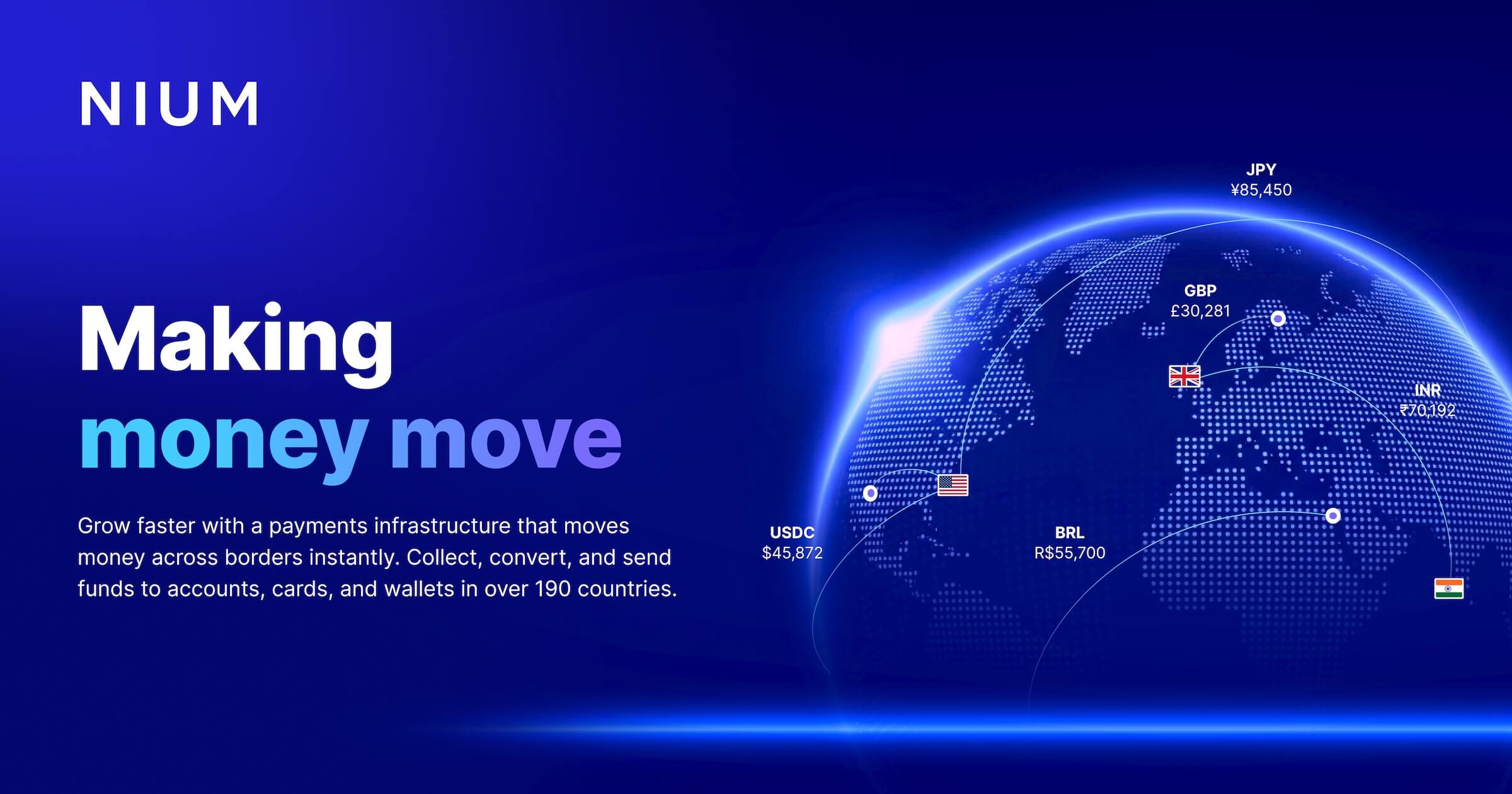
A freelance designer in Manila just got paid by a software company in Berlin. The money cleared in under a minute. Neither side noticed there was a payment company between them. That company was Nium.
Spend a week tracing how money actually moves between countries and you start noticing something unsettling. Banks talk about correspondent networks the way airlines talk about hub-and-spoke routing - except the connections take three days, fees disappear into invisible margins, and nobody can tell you exactly where your money is on a Tuesday afternoon. Nium does not love this system. Nium has spent eleven years quietly replacing the parts of it that businesses care about.
It is the kind of company you only meet by accident. A travel platform pays out to hotels in forty currencies and the rails are Nium. A spend-management startup hands you a corporate card in Sydney and the issuance is Nium. A bank in the UAE settles a cross-border transfer in seconds and, again, Nium. The brand stays politely off-screen, which is appropriate - infrastructure works best when you forget it is there.
The thing Prajit Nanu could not get over
In 2013, Prajit Nanu, then a sales executive at an outsourcing firm, tried to send a wedding gift to a friend getting married in Thailand. The bank's quote was a small comedy: aggressive fees, a vague exchange rate, and a four-day wait. He paid it because there was no alternative. He also stopped sleeping.
"I kept thinking, this is 2013, and we still send money like it is 1973," he told an audience years later. That insight is unglamorous and obvious, which is why it usually goes nowhere. Most people complain about wire transfers. A small number of them rebuild the rails underneath.
Nanu teamed up with Michael Bermingham, a former colleague, and started Instarem from his Mumbai apartment. The name was a portmanteau - instant remittance - and the bet was small at first: cheaper, faster consumer transfers across a handful of Asia-Pacific corridors. By 2015 they had a license in Singapore. By 2016 they had a B2B platform. By 2019 they had a new name: Nium.
Boring on purpose
Plenty of fintechs in the 2010s chose to be loud. They launched neobanks, fought for consumer attention, and burned investor money on subway ads. Nium did something almost contrarian for the era: it pointed itself at other businesses and went quiet. The bet was that the next decade of payments would not be won by the prettiest app, but by whoever held the most licenses, the most direct bank integrations, and the most reliable API.
It is not a glamorous thesis. Compliance lawyers and infrastructure engineers do not photograph well. But the math is unforgiving. Cross-border B2B payments are projected to reach roughly $175 trillion by 2030. The winners will not be the ones with the best onboarding flow. They will be the ones who, in any given country, are actually allowed to move the money.
Global Payouts
100+ currencies, 220+ markets, real-time in 100+ of them.
Card Issuance
Virtual and physical cards across 35+ markets on Visa & Mastercard.
Multi-Currency Accounts
Local virtual accounts so businesses collect like a local.
FX & Treasury
Real-time rate locking and multi-currency wallets.
Four product lines, one underlying network. The trick is making them feel like one API call to the customer and forty regulatory filings to nobody.
How Nium got here
A reasonably honest milestone log
Receipts, ledgers, and a 99.99% uptime number
The least interesting metric in fintech is "total addressable market." The most interesting one is "have you actually moved money for anyone." On that front Nium has receipts. Emirates NBD, one of the UAE's largest banks, runs cross-border flows through them. Australian spend-management leader Weel is on the platform. So is Aspire, a fast-growing Southeast Asian business banking startup. Travel firms route hotel payouts; payroll providers route salaries; spend platforms issue cards.
Pick any single number on this strip and a competitor can probably match it. Stacking all four is the moat.
What Nium covers, in human numbers
Coverage relative to a typical global bank's correspondent network
Source: Nium press materials, AWS case study, company filings. Bar widths are illustrative.
What they actually want
Ask Prajit Nanu what Nium is building and you do not get a Silicon Valley monologue. You get something close to an engineering brief: a network where any business in any country can move funds in real time, regardless of its banking partner. No correspondent chain, no three-day wait, no five-step manual reconciliation at the end of the quarter.
It is a tidy ambition, which is also a slightly impolite one. To make global money movement boring, Nium has to convince banks - the people who have run this system for several centuries - that boring is fine, actually, as long as they keep getting a cut. The pitch works because Nium is not trying to disintermediate banks so much as quietly upgrade the cable between them.
There is a quieter customer story here too. Freelancers in emerging markets, families wiring money home, immigrants paying tuition abroad: the Instarem app, still alive and still owned by Nium, serves a couple of million of them. The B2B platform sells the infrastructure to banks; the consumer app uses the same rails to do the thing the banks did badly in the first place. It is an unusually honest feedback loop.
The next ten years of money
The world is sliding, slowly and unevenly, toward real-time payments. India did it. Brazil did it. The EU is in the middle of it. The US is, in its way, getting there. As each domestic system goes instant, the cross-border seams between them become more visible and more annoying. That is the gap Nium is built for: not a domestic payment rail, but the connective tissue that makes all of them talk.
It is fashionable to assume crypto will solve this. Nium is hedged but not romantic about it. The company has built crypto-as-a-service capabilities for partners and supports digital asset flows, but its center of gravity is regulated, licensed, real-currency rails. The bet is that in any country with a central bank, the future of money still runs through that central bank's rules - and the company that owns the most permissions wins.
Back to the freelancer in Manila and the company in Berlin. They never met. They never will. The transaction took less time than it took the designer to refresh her banking app, and the company never had to think about Filipino payout rails. Both sides got the experience they wanted: the absence of friction.
That, in the end, is Nium's product. Not an app, not a card, not a clever consumer brand. The product is the part you do not notice. And every year there is more of it.
Where to find Nium
Official and worth-knowing