BREAKING — Cattle farmer's daughter turns USDA paperwork into a 15-minute app 20,000+ farmers now run their books on FarmRaise FROM DC TO DIRT — She left climate lobbying to build tools farmers actually use 4.9★ app rating — and a dad who hates phone screens still opens it $7.2M raised to rewire farm finance from the soil up USDA now hosts an education hub built by her company BREAKING — Cattle farmer's daughter turns USDA paperwork into a 15-minute app 20,000+ farmers now run their books on FarmRaise FROM DC TO DIRT — She left climate lobbying to build tools farmers actually use 4.9★ app rating — and a dad who hates phone screens still opens it $7.2M raised to rewire farm finance from the soil up USDA now hosts an education hub built by her company
FarmRaise · Co-Founder & CEO

Jayce
Hafner

She spent years lobbying Congress on climate. Then she decided farmers didn't need another speech - they needed better software.

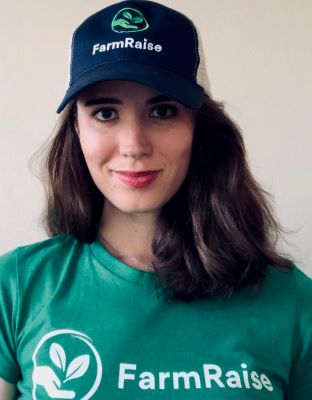
Jayce Hafner, CEO of FarmRaise
Jayce Hafner — the farmer's daughter running the farm-finance startup
The Dispatch

A dad who hates screens keeps opening her app

Jayce Hafner's father does not like phone screens. He is an Angus beef cattle farmer in Virginia's Shenandoah Valley, the kind of man who measures a day by fences and forage, not by notifications. Yet there is one app he opens on purpose - to draw the boundaries of his fields and plan how he'll graze them. When your product survives that customer, you have found something real.

That is the whole thesis of FarmRaise, the company Jayce co-founded and runs as CEO. It takes the parts of farming that involve paperwork, cash flow, and government funding - the parts that make a farmer's shoulders drop - and turns them into a few taps. More than 20,000 farmers now use it. The average rating is 4.9 out of 5. And the person behind it grew up on the same kind of farm she is now trying to save time and money for.

Here is the strange part. Before any of this, Jayce was in Washington, DC, organizing delegations to United Nations climate negotiations and rallying a hundred thousand citizens to defend the Arctic Refuge. She had a Fulbright, a foot in Apple's sustainability team, and a resume built for a life of policy. She walked away from most of it. Her reason was blunt: she had seen "more talking, thinking, and posturing than meaningful traction."

20,000+
Farmers on the platform
4.9★
Average app rating
$7.2M
Total funding raised
~15 min
To finish a USDA conservation app
The Turn

From the Arctic Refuge to the ledger book

Jayce's path to farm software runs through some unlikely rooms. She advised on environmental policy in DC. She led coalitions at UN COP climate talks. She invested in organic farmland with SLM Partners, did a Fulbright Fellowship in Trinidad and Tobago, and worked on Apple's Environment, Policy & Social Initiatives team. Then she went to Stanford - twice at once, earning a master's in agriculture and an MBA - and in the agriculture program she met Sami, a former USDA project manager who had spent years arming Midwestern row-crop farmers with soil science. Two women, one shared conviction: farmers deserved financial tools built for them.

"You have to be comfortable taking one step forward at a time into the unknown, find positive, resilient people to share the journey with."
— Jayce Hafner, on founding FarmRaise
The Route
Washington, DC
Environmental policy advisor; organizes delegations to UN climate negotiations.
Coalitions
Leads policy blocs at UN COP talks; mobilizes 100,000 citizens for the Arctic Refuge.
Fellowship
Fulbright Fellow in Trinidad and Tobago; later invests in farmland with SLM Partners.
Apple
Joins the Environment, Policy & Social Initiatives team.
Stanford
MS in agriculture + MBA; meets co-founder Sami in the ag program.
2020
Co-founds FarmRaise with Sami and Albert; joins Pear VC.
2024
Launches the FSA Educational Hub with the USDA Farm Service Agency.
2026
Partners with Avalo on AI-driven cotton innovation.
The Backstory

Why a policy insider bet on farm invoices

Consider the gap she noticed. Millions of small and mid-sized farmers lack the financial management tools that any corner coffee shop takes for granted, and they lack the time to go find them. Money that could fund conservation, cover payroll, or smooth a bad season sits unclaimed because the process to reach it is exhausting. Jayce watched this from two angles most people never combine: the farm kitchen table, and the policy conference room. She knew the programs existed. She also knew farmers weren't using them, and she understood exactly why.

The years in Washington were not wasted - they were reconnaissance. Organizing UN climate delegations and running a coalition that moved a hundred thousand people taught her how large systems actually change, and how often they don't. When she describes the disappointment of that world, she is precise about it: too much posturing, not enough traction. That precision is the tell of someone who left not out of cynicism but out of impatience for results. She wanted to build the thing, not recommend it.

So she went back to school to get closer to the soil - and to the balance sheet. Stanford gave her the agronomy and the business fluency in a single stretch. It also gave her Sami, the co-founder whose USDA experience meant the two of them together could speak both languages a farm-finance company needs: the field and the federal form. They added an engineer with a heavyweight tech pedigree, and FarmRaise had its founding triangle. What started as a simplified funding application has grown toward a full-stack financial services platform - a word Jayce uses deliberately, because the ambition is not a single app but the plumbing of farm money itself.
The Break

The 15-minute form that spread by word of mouth

Ask a farmer about USDA conservation funding and watch the enthusiasm drain from the room. The money is real, but the applications are long, and the deadlines are unforgiving. FarmRaise's first breakout move was to compress that ordeal into a form a farmer could finish in about fifteen minutes.

It worked the way good products are supposed to work and rarely do. Within days of launch, hundreds of farmers had used it - and then told their neighbors. No ad budget did that. Trust did.

THE SCRAPPY BIT — Before there were engineers, there were Typeforms. Jayce built FarmRaise's earliest versions with off-the-shelf tools like Typeform and Formstack, proving farmers would show up before she wrote a line of production code.

In Her Words

Six lines that explain the founder

"My dad doesn't like spending time on a phone screen, but there is an app on his phone that he regularly uses to draw boundaries across his fields to plan his practices."

ON WHY THE PRODUCT HAS TO EARN ITS PLACE

"I saw more talking, thinking, and posturing than meaningful traction."

ON LEAVING WASHINGTON

"People - finding, motivating, and aligning people - are the most fun and also the hardest part of my job."

ON RUNNING A COMPANY

"We're building a full stack financial services platform that enables farmers to access and manage their funding."

ON THE MISSION

"It's hard to celebrate yourself as a founder. I think we rarely get appreciation from other sources."

ON THE LONELY MATH OF STARTING UP

"A big win-win for the land, the cattle, and our pocketbooks."

ON ROTATIONAL GRAZING ON THE FAMILY FARM
Field Notes

What makes Jayce Hafner different

Origin

Raised on 160 acres

She grew up on a small Angus beef cattle farm in the Shenandoah Valley. The customer she builds for is the household she was raised in.

Method

Ship, then theorize

She favors experimentation over theory - de-risking ideas one test at a time rather than perfecting them in a deck.

Credentials

Two Stanford degrees

An MS in agriculture from the School of Earth, Energy & Environmental Sciences and an MBA from the Graduate School of Business - earned in tandem.

Activist roots

100,000 citizens

She founded a conservation coalition that mobilized a hundred thousand people to defend the Arctic Refuge. Organizing farmers came naturally.

Partnership

Met her co-founder in class

She and Sami, a former USDA project manager, found each other inside Stanford's agriculture program - and recruited a third co-founder, an engineer from Microsoft and Amazon.

The vision

Finance first, banking next

Earn farmer trust with everyday money tools, then expand into full-stack farm banking. Soil up, not top down.

The Aim

Equitable. Resilient. Profitable. All three.

Jayce wants agriculture pushed toward "a more socially equitable, ecologically resilient, and profitable paradigm." Note the refusal to trade one for another. The lesson comes straight from her family's pasture: rotational grazing, with electric fencing moved daily, improved the soil and cut feed costs at the same time. Good for the land and the ledger. FarmRaise is that same win-win, turned into software.

The Next Field

When the outsider becomes the infrastructure

There is a quiet irony in where Jayce has landed. She left the halls of government frustrated by their pace, and in December 2024 the USDA Farm Service Agency began hosting an educational hub built by her company. The founder who once felt like an outsider to the system is now part of the scaffolding farmers use to navigate it. That is a rare arc: not storming the institution, not ignoring it, but building the connective tissue it was missing.

The company keeps widening its reach. In 2026 FarmRaise announced a partnership with Avalo to push AI-driven cotton innovation at scale - a sign that the platform's ambitions extend past bookkeeping toward the frontier of how crops themselves get improved. The through-line stays constant: meet farmers where they are, earn their trust with tools that respect their time, and then keep expanding the definition of what a farm-finance company can be.

Ask her what the hardest part is and she doesn't say fundraising or product or the market. She says people - finding them, motivating them, aligning them - which she calls both the most fun and the most difficult part of the job. It is a fitting answer from someone who spent a career learning that the technology is rarely the bottleneck. The bottleneck is trust, and trust is built one farmer, one field, one fifteen-minute form at a time.

Odds & Ends

Things worth knowing