Before Jay Buys could run a company, he had to look up how to start one. He has described beginning with a Google search, a pleasingly ordinary first step for someone whose working life would come to include public talks about the purpose of business. There was an idea, a willingness to leave, and a search box. The business plan apparently did not arrive engraved on a tablet.
Buys and designer Matthew Billingsley met while working at a large public relations agency in Washington, DC. The job offered challenging work, but also late nights, weekends, and assignments that sat awkwardly with their values. Complaining together eventually became a more consequential conversation: could they run an agency themselves? In May 2006, they started Visceral. They wanted interesting work and a company they would actually enjoy working for.
The distinction mattered. Independence can change the name on an invoice without changing much else. A founder can reproduce an old employer's habits with impressive efficiency, especially while trying to make rent. For Buys, leaving the agency was the opening move. Choosing how to use that independence would take longer.
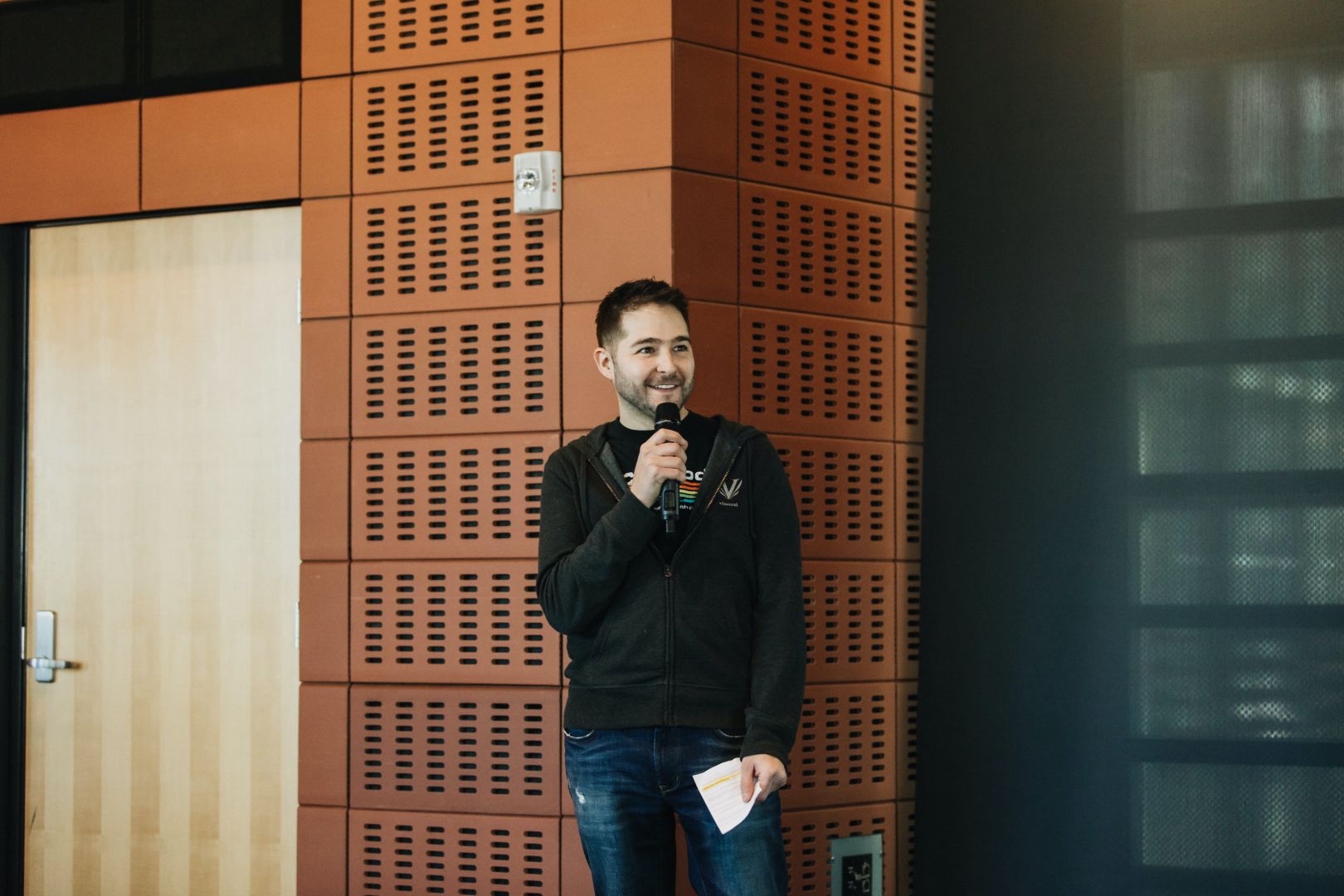
A programmer learns to ask questions
Computers had caught his attention much earlier. As a child, Buys played Oregon Trail on an Apple IIe. He began writing code in 1986, and an early website was for a friend's band. His introduction to technology came through making things and playing with them, long before running a creative business required a view on the latest artificial intelligence product. He still introduces himself as a computer nerd.
His public WordPress profile calls him a developer turned CEO. It also lists interests that stretch from code and business to advocacy, music, books, and games. He joined the WordPress community in December 2011 and describes more than a decade working with the platform. The technical craft remains part of how he presents himself, even when the job title puts him in charge of the whole operation.
Yet when asked in 2020 what contributed most to his success, Buys chose listening. His complaint was specific: people in his industry sometimes offer a solution before understanding the assignment. His preferred approach starts with questions about a client's goals and difficulties. The point is to reach a shared understanding of what the work should accomplish. A beautifully built answer is of limited use if everyone has quietly agreed to different questions.
That answer makes the move from developer to executive easier to follow. Writing code requires attention to what a system actually does. Listening to a client requires attention to what an organization actually needs. Buys's work brings the two into the same room. The temptation to show off the solution has to wait its turn.
His answer to what drives success“Listening.”Jay Buys, 2020
The expensive part of having principles
Visceral did not begin with a perfectly defined specialty. Early on, the founders accepted a broad range of paying work. A former colleague then brought nonprofit website projects. Repeated assignments helped the team understand those organizations, and the work felt useful. Eventually, the founders made mission-driven clients their rule. Their company had found a direction through doing the work.
The decision came with consequences. Visceral walked away from commercial engagements, including work with Google. Revenue became harder to stabilize, people left, and pitches were lost. The founders cut their salaries by 40% and 50%. Their twentieth-anniversary account does not assign either percentage to a particular founder. The lesson is clear enough without doing so: the people making the choice helped absorb its cost.
The response included expanding the operations group from two people to four and holding a 90-minute Monday meeting. Questions about money, responsibilities, and which assignments to accept had a regular place to go. The agency also developed annual profit sharing. It allocates 55% of profits to a distribution pool and retains 45% in the business; distributions follow tenure and seniority.
It is a revealingly administrative turn in a story about ideals. A calendar invitation and a distribution formula are less photogenic than a declaration of purpose. They also give the declaration somewhere to live.
Distribution pool
Allocated by tenure and seniority
Retained in the business
Operating reserves
The badge and the people behind it
Visceral became a Certified B Corporation in April 2016. The certification gave Buys's ambitions a framework outside his own judgment. It also placed the agency among businesses willing to have their social and environmental practices examined. The date matters in his career: the company was ten years old, with enough experience to know that wanting to run a decent business and documenting one are separate jobs.
By March 2024, he was writing frankly about the effort. His essay on being a B Corp mixed frustration with affection. Rising costs, environmental responsibilities, and the work of maintaining standards all occupied space that a celebratory badge might otherwise conceal. He described the weariness of trying to operate carefully while watching other businesses behave with considerably fewer inhibitions.
Then the essay turned toward the people. Buys had found lawyers, accountants, an insurance broker, and carbon-accounting help within the B Corp community. Shared principles were becoming practical business relationships. An abstract movement had acquired names, conversations, and people who could help with a difficult part of the job. His reason for staying involved was closely tied to those connections.
That candor suits someone who credits punk rock with teaching him to question the status quo. He is a longtime Electronic Frontier Foundation member and has served on the board of Business For Good San Diego. The through-line is a willingness to challenge established arrangements, followed by the much slower business of participating in alternatives.
The same question, printed on a shirt
Fervor & Zeal takes the argument into a different kind of business. Buys co-founded the apparel company with Billingsley and lawyer Sam Mazzeo. Its model pairs artists with nonprofit organizations, commissions artwork, and sells the resulting designs on clothing and other merchandise. Buys is listed as treasurer and chief financial officer on its board.
The split is explicit: the artist receives 25% of profits, and the nonprofit receives another 25%. That means half the profits go to the two partners whose creative work and cause give the product its character. The percentages refer to profits, an essential distinction when printing, shipping, and running a store all cost money.
A shirt can carry an image and help finance the people behind it. The venture gives Buys another way to test his belief that business can support useful work through ordinary transactions. Someone gets something they want to wear; an artist and a nonprofit share in the proceeds. The mechanism is easy to explain, which is an advantage when the product is supposed to leave the house.
Talking about the venture on Entrepreneurs on Fire in November 2025, Buys also discussed the unglamorous learning involved: supply chains, ecommerce marketing, and social media. He stressed asking other people for help, something he had previously found difficult. The programmer who once searched for company-formation instructions was still willing to be a beginner.
A living, and something to live by
Buys and Billingsley put their first decade into a book, Repurpose: Be Good At What You Do & Do Something Good, published in 2016. Its subject was the experience of building a small business through missteps as well as successes. The title joins competence to usefulness. You need a craft worth paying for before the promise of doing good has much commercial weight.
That same pairing appears in his teaching and speaking. During 2024, Buys and colleague Dana spoke to a University of San Diego marketing class, and he led a Websites 101 workshop for Business For Good. Visceral's review of that year also recorded more than $80,000 distributed in bonuses and profit pooling. The work of explaining the model sat alongside the work of paying people through it.
In April 2026, he joined Grant Oliphant on the Prebys Foundation's Stop & Talk podcast. Their conversation considered how employers respond to younger workers, how San Diego might develop as a center for socially minded business, and how to distinguish a stated purpose from actual practice. Buys's position leaves room for making money. The question is what the company does with its resources and who gets to benefit.
He has returned to that distinction in conversations with the local business community. “Money is not the problem. The problem is greed,” he says. It is a compact expression of a career spent trying to keep commercial survival and personal conviction in the same account. Clients still need good work. Employees still need a reason to stay. The arithmetic has to function.
There is room in his convictions for less weighty matters, too. Buys is quite firm that chicken wings should arrive with bleu cheese. Ranch enthusiasts are permitted their preference, but he sees no reason to surrender the default. The detail is useful company for the larger beliefs: a person can have principles, make room for other people, and still care how lunch is served.
Twenty years after founding Visceral, Buys remains occupied by choices that repeat. Which client fits? What should the team share? Who can help with the unfamiliar part? A company keeps presenting these questions long after the thrill of starting it has passed. He has built a career around answering them, then returning to the work they create.
Keep the conversation going
Meet Jay on LinkedIn, explore Visceral, or visit Fervor & Zeal.