An airport can sell you a flight to the other side of the planet and still make finding somewhere to sit feel like a minor expedition. There are doors you may enter, doors you may enter with the right card, and doors whose rules appear to have been written by a committee with a connecting flight. Jane Zhu has spent two decades building a business around making those arrangements easier to navigate.
Zhu co-founded Dragonpass in Guangzhou in 2005 with Kehui Cai. Its starting territory was airport lounge access and benefits for credit card customers. Today she leads a company that reports more than 40 million members. Her work sits between the traveller, the company promising a benefit and the business supplying it. The traveller wants the door to open. Zhu has made a career of connecting the people who can arrange that.
Her story crosses software, a Canadian business school, Chinese entrepreneurship and an international network of travel services. It also contains a useful puzzle: how does a founder build a recognisable business whose customers may encounter it through somebody else's brand? For Zhu, the answer increasingly involves a service that appears at the moment a person needs it. A lounge is one possible answer. It is no longer the whole question.
A software degree, then a different kind of connection
Before Dragonpass, Zhu studied computer software at Huazhong University of Science and Technology. She went on to earn an MBA at the University of Victoria. These are two quite different ways of examining a problem: what must the system do, and how will an organisation persuade people to use it? Her eventual business would have plenty of work for both.
Dragonpass brought together services that already existed in separate places. Airport lounges, restaurant programmes, transfers and meet-and-greet services could become part of a connected offering. In a 2019 description of the business, Zhu included high-speed railway stations alongside airports. The underlying idea travelled more widely than the lounge: take services scattered across physical locations and make them accessible through a shared digital platform.
Think of the difference between knowing an airport has a restaurant and knowing that your particular membership gives you a benefit there. The second requires several pieces of information to agree. Location, eligibility and the service itself must meet. That coordination is the work behind the pleasant part of the transaction. Nobody wants to study a benefits programme while their departure gate is changing.
The University of Victoria recognised Zhu with a faculty Distinguished Alumni Award in 2010. In 2015, its business school included her among 25 Alumni to Watch. These acknowledgements trace an ongoing connection with the university across the company's early development. Zhu also served on the business school's International Advisory Board, bringing her experience back into the institution where she had studied.
The business behind the lounge door
Building internationally meant connecting more than an app to a chair. The original Longteng business combined with I-DEAL Digital, founded by Manchester entrepreneur Mark Koch, in 2015. Zhu and Cai's venture gained another strand of digital expertise. The history helps explain a company with roots in Guangzhou and a substantial British operation.
By 2019, Zhu was describing a network spanning airports and railway stations across more than 130 countries. In 2025, Dragonpass marked its twentieth anniversary. Its celebration returned to Guangzhou for the International Airport Expo. Zhu's own anniversary post placed the company's international expansion beside its starting city. There is something appealingly practical about that choice of venue: a birthday party in the middle of the industry's working day.
In a separate anniversary post, she remarked on how quickly twenty years had passed. The surrounding company celebration described more than 500 employees and over 1,300 lounges. Those are business milestones, but the small personal response gives the occasion a different scale. A founder can spend years measuring progress and still find the anniversary arriving rather abruptly.
Dragonpass now advertises access to more than 1,400 lounges, regardless of airline or ticket class. It also offers airport Fast Track and dining benefits. These are company-reported network figures, rather than a measure of Zhu's personal wealth or an account of every traveller's entitlement. What someone can actually use depends on the programme they hold. The commercial achievement is assembling the options and making them distributable.
From a lounge-access starting point to a platform connecting travel services and partner benefits.
The phone company joins the journey
In Tokyo in October 2025, Zhu discussed another route to the traveller: telecommunications companies. Dragonpass became a strategic partner of WanderJoy, a cross-border rewards programme unveiled at KDDI Summit. The arrangement put travel benefits inside channels people already used through mobile operators. A service that began with credit card customers was reaching people through a different everyday relationship.
Zhu described a customer base for Dragonpass's business services that had expanded to digital banks, insurers, online travel agencies, airlines and telecommunications companies. WanderJoy brought together eight operators across Asia-Pacific. The attraction of this distribution is easy to understand. Travellers need connectivity as they cross borders. A mobile relationship can accompany them into the same places where they might want a transfer, a lounge or a meal.
“User engagement is the core of loyalty,” Zhu said. It is a concise sentence with a demanding implication. Issuing a benefit is only the opening move. A customer must discover it, understand it and find a reason to use it. A generous-looking list can remain untouched if the useful item is buried halfway down the screen.
“User engagement is the core of loyalty.”
Jane Zhu, Tokyo, 2025
The partnership also makes Zhu's role more interesting than the familiar picture of a founder selling directly to consumers. She is working across several relationships at once. A mobile operator wants a more useful rewards proposition. A travel service wants customers. The person carrying the phone wants the arrangement to be simple. Each side has its own priorities, and the product has to make sense to all three.
From looking up a benefit to describing a trip
By September 2026, Zhu was discussing the next change at the Apsara Conference in Hangzhou. Her subject was the membership economy and the move towards services organised around what travellers want to do. Instead of starting with a catalogue, a person could describe an interest or a journey. Conversational AI could then help match plans with available airport benefits, transfers and local services.
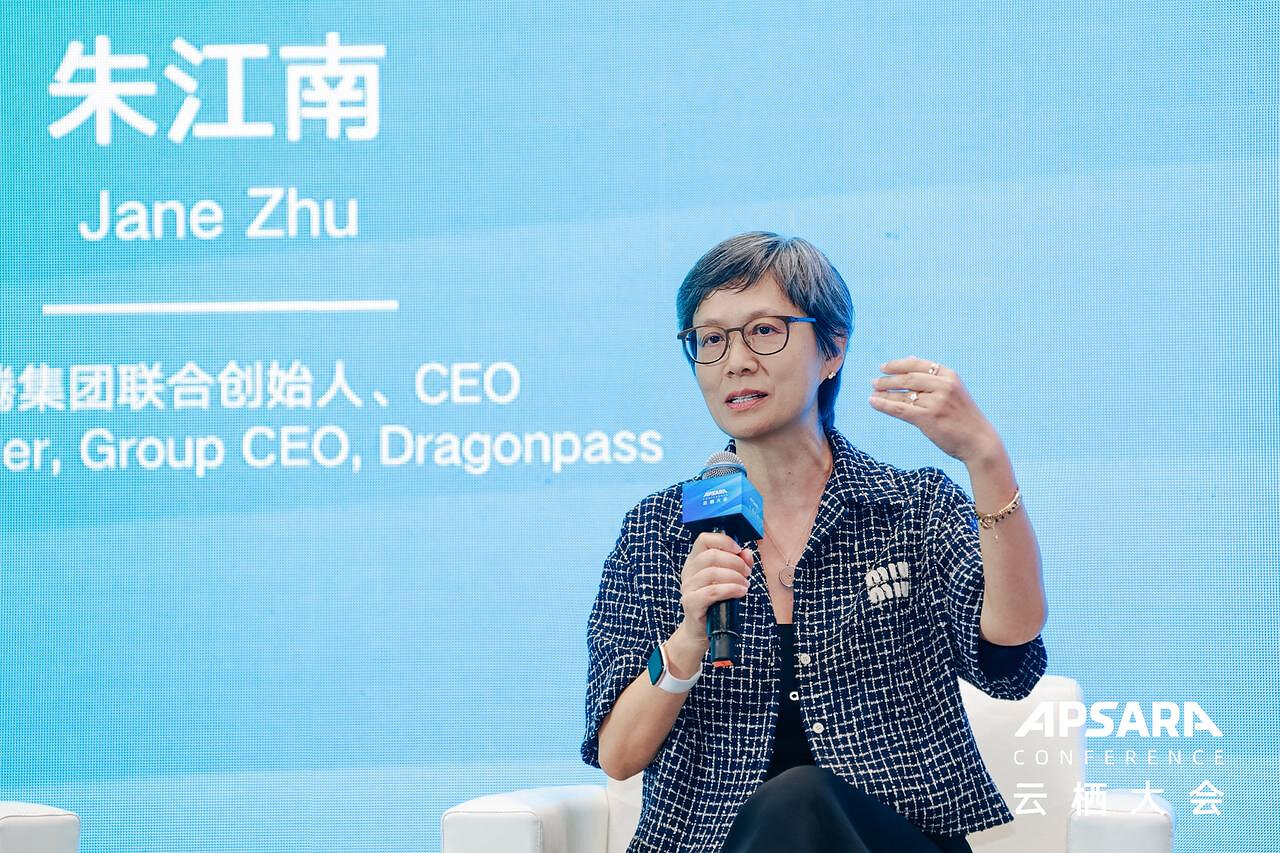
Dragonpass had partnered with Alibaba Cloud on an AI Airport Concierge using Qwen models and the company's existing airport service network. A September 2026 company announcement said the concierge had served more than 100,000 travellers in its first eight months. The figure describes use of that particular service. It offers an early indication of adoption, while leaving the longer-term results of Zhu's approach to be established.
Her argument gives human expertise a continuing place alongside AI. Better recommendations still have to connect to an actual service, in an actual airport, with somebody available when a journey becomes complicated. A conversation can be fluent and a transfer can still be late. The quality of the entire arrangement matters more than the charm of its opening exchange.
A conceptual view of the personalised travel approach she outlined in Hangzhou.
Staying herself, across borders
There is another account of Zhu's leadership in a staff conversation in Manchester ahead of International Women's Day. She spoke about remaining true to herself and her strengths when facing pressure to conform. She also recognised male allies, including Cai. The advice has a particular weight coming from someone whose working life has crossed countries, disciplines and partner organisations.
The University of Victoria's portrait of Zhu describes an analytical leader who combines discipline with flexibility and an empathetic approach. It also records her interests in music and the arts. These details give some texture to a career otherwise easily reduced to membership numbers. A person can spend her professional day arranging access and still have interests that require no commercial explanation.
Her university connection now includes two named initiatives: the Jane Zhu Cross-Cultural Integration Award and the Jane Zhu Entrepreneurship Scholarship. Their titles bring together subjects that recur in her own career. Studying abroad, building across markets and starting a company all involve entering unfamiliar settings. The awards attach her name to those experiences for other students.
At a company built around travel, distance is a commercial opportunity. In a personal career, it also means learning how to work with people whose assumptions differ from your own. Zhu's education in China and Canada, her continuing university ties and her international business offer concrete instances of that crossing. The interesting part is how often connection appears as both the product and the method.
Her current ambition extends beyond admitting someone to a lounge. She wants travel benefits to become more relevant to the journey a person is actually taking. That is an appealing promise with an everyday test: can the traveller find and use the thing that helps? After two decades, the question still ends somewhere wonderfully ordinary. A door opens. A service is ready. Someone has one less arrangement to make.