At 5:38 each evening, the owl left. That was the detail Jim Peterson wanted to show off on his phone in early 2019. A white owl had taken up residence at his San Juan Capistrano property, and its punctual departures had become a small domestic mystery. Peterson gave his grandchildren books about owls. After eighteen years running a chip company, he still enjoyed something he could not quite explain.
By then, Microsemi had been sold. The executive known around Orange County as Jimmy P had exchanged the daily machinery of a public-company chief executive’s job for investing, family and philanthropy. “I built a wonderful company and handed it off,” he said. The sentence sounds like an ending. His subsequent calendar suggests he treated it as an intermission.
There is a useful way to follow James J. Peterson’s career: watch what he puts together. A business acquired his company, then put him in charge. He assembled a broader semiconductor supplier through acquisitions. Later, he helped another chip business grow and joined his wife, Sheila, in asking a community to finance a university’s ambitions. The scale changed; the appetite for assembling things survived.
The company that bought his company
Peterson came to the chief executive’s office through sales and marketing. His earlier employers included General Instruments Microelectronics and Rockwell. At Silicon Systems, he worked in worldwide sales and marketing around mixed-signal products for storage and communications. Those are revealing markets for someone who would later spend years buying businesses: the customer buys a component because it has a particular job inside a much larger machine.
In February 1997, he became president and chief operating officer of Linfinity Microelectronics in Garden Grove, California. Linfinity made analog and mixed-signal integrated circuits. Microsemi acquired the business in April 1999. Peterson stayed with the acquired operation, then became Microsemi’s president and chief executive in November 2000. The acquired executive had become the buyer’s boss.
Microsemi already had a history stretching back to 1960. Peterson was taking responsibility for an established company, with existing customers, factories and habits. His task was to make that inheritance larger and more useful. Selling chips to another business rewards familiarity with the customer’s engineering problems. A component can be small enough to disappear from view and still be difficult to replace.
That customer-centered way of thinking was audible in a 2006 business presentation. Peterson described the need to understand the building blocks and architecture of a customer’s product. He also offered a dry qualification about intellectual property: “most of the patents, I bought.” There was no ceremony about the distinction. Buying capability was part of the work.
“Most of the patents, I bought.”
James Peterson, 2006 business presentation
Buying a broader set of answers
Two transactions show how far that approach could take him. In 2010, Microsemi agreed to acquire Actel in a deal with a net transaction value of approximately $430 million. Actel supplied field-programmable gate arrays, or FPGAs: chips whose logic can be configured for particular tasks. Its portfolio included low-power, mixed-signal and system-critical devices for markets including aerospace, communications and industrial equipment.
The attraction was concrete. Microsemi could add programmable logic to the components and circuits it already offered. An acquisition changes more than the revenue line when it changes the set of engineering problems a supplier can address. It also brings the people who know how to solve those problems. The transaction completed in November 2010.
PMC-Sierra was a larger step. Microsemi announced the approximately $2.5 billion agreement in November 2015 and completed the acquisition on January 15, 2016. PMC brought storage and communications technology, including products for optical and mobile networks. Peterson’s stated rationale emphasized scalable storage, complementary communications products and a broader spread of markets.
These deals give substance to a phrase that can otherwise become financial wallpaper: diversification. Actel and PMC added different technologies and different customer requirements. By fiscal 2017, Microsemi’s four principal markets were aerospace and defense, communications, data center and industrial. Its identity had become a collection of specialized capabilities, held inside one supplier.
Three years on the revenue line
The limits of the dealmaker’s method
Peterson’s record also includes an acquisition that had to be undone. Microsemi bought assets from Semicoa in July 2008. The following year, a settlement with the U.S. Department of Justice required the divestiture of those assets. The government said the combination would leave little or no competition in certain semiconductor devices used in military and space programs.
The issue was particularly sharp because these were qualified components for demanding applications. A limited field of suppliers can make a niche attractive to an acquirer while making the loss of a competitor consequential for customers. Microsemi announced the asset sale in August 2009. Consolidation had met a boundary that a spreadsheet of expected savings could not remove.
There was a separate, personal reckoning in January 2009. An independent inquiry commissioned by Microsemi’s board established that Peterson had neither the bachelor’s degree nor the MBA previously attributed to him. It confirmed an associate degree from Ricks College, earned in December 1978, and substantial undergraduate credits at Brigham Young University in 1979 and 1980.
The board retained him. It required a $100,000 payment to the company, the forfeiture of his potential bonus for the current fiscal year and delays to restricted-stock vesting. It also introduced company-wide credential checks and other remedial measures. Those decisions belong in the same account as the growth: the board chose continuity in leadership while imposing penalties for the credential misrepresentations.
A closing bell, then another boardroom
Peterson added Microsemi’s chairmanship in November 2013, having served as president and CEO since 2000. By fiscal 2017, annual net sales reached $1.812 billion. The scale was measurable, and another semiconductor company wanted the resulting portfolio. On March 1, 2018, Microchip Technology announced its agreement to acquire Microsemi for $68.78 a share in cash.
The announcement put equity value at about $8.35 billion and enterprise value at approximately $10.15 billion, using the balance-sheet figures specified in the agreement announcement. Keeping those numbers distinct matters: the value of the shares and the value of the whole business are different measurements. Neither number is a measure of Peterson’s personal wealth.
The acquisition closed on May 29, 2018. Of the Microsemi shares voted, 99.5 percent supported the merger. Trading in Microsemi stock ceased that day. A public company Peterson had led for nearly eighteen years became part of another supplier. For shareholders, the transaction converted their holdings into cash; for Peterson, it ended the Microsemi chief executive chapter.
He subsequently co-founded Peterson Capital Group, an Irvine investment firm. Another operating business soon provided a familiar setting. He joined Mobix Labs’ board in February 2021 and became executive chairman that November. The appointment expanded a role that already included fundraising, partnerships and expansion. A retirement diary, apparently, could still accommodate an acquisition discussion.
Mobix’s purchase of Cosemi Technologies in 2021 brought active optical cables, transceivers and optical engines. The combination connected wired and wireless capabilities. Mobix later entered the public markets, with its shares beginning Nasdaq trading in December 2023. Peterson was again involved in a company building a wider offering through transactions, although this was a new business with its own execution demands.
By August 2026, he was discussing a further change in direction as Mobix’s chairman. The company announced a definitive agreement to acquire Special Project Delivery, a platform focused on domestic supply chains for rare earth elements, critical minerals and energy storage. It was an announced agreement, with future work attached. The vocabulary had moved beyond chips; assembling industrial capabilities remained part of the proposition.
The other kind of capital campaign
Alongside that work, Jimmy and Sheila Peterson took on a different assignment. As UC Irvine Foundation trustees, they co-chaired the university’s Brilliant Future campaign. Its public launch came in October 2019. The effort asked donors to support students, research and the institution’s future, while also drawing alumni back into university life.
In April 2021, the campaign passed $1 billion. By January 2025, it had exceeded its $2 billion goal, months before its scheduled conclusion. The final 2025 total was more than $2.4 billion. The Petersons helped lead the campaign; the money came from a community of more than 122,000 donors. That distinction gives the achievement its proper dimensions.
raised for UC Irvine
The smaller gifts deserve attention. Seventy-three percent were $100 or less, and 84 percent of donors were giving for the first time. Nearly 85,000 gifts supported students, helping establish 269 scholarship, fellowship and award funds. A large fundraising total can be hard to picture. A student-support fund is easier: it is a continuing resource attached to someone’s chance to study.
In September 2025, the couple received the UC Irvine Medal, joining five other recipients that year. They had also been recognized together as Orange County’s Outstanding Philanthropists in 2011. Their university work was a shared undertaking, with Sheila’s own history in the semiconductor industry and a family of seven grown children behind it.
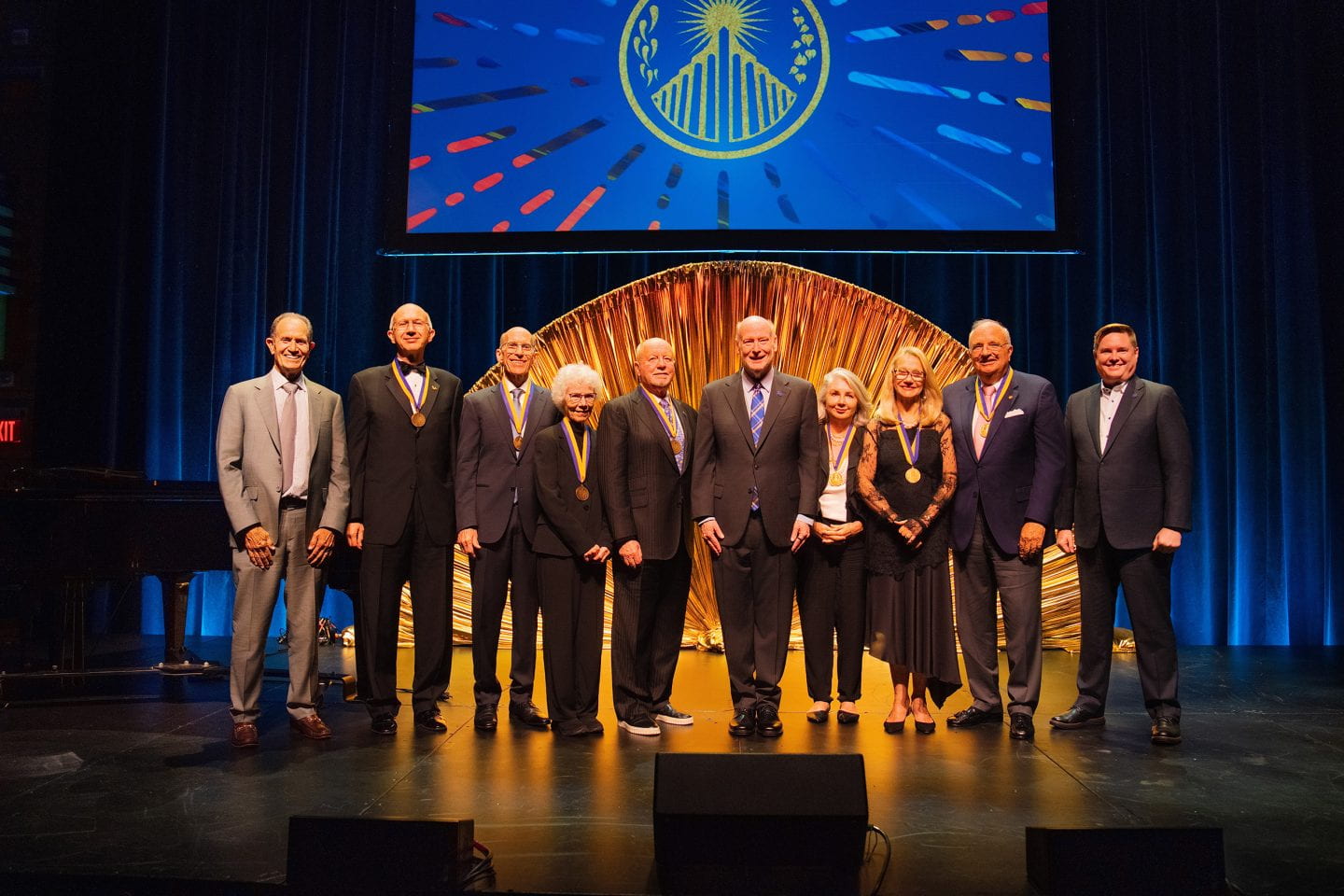
Peterson has advocated directing 1 percent of business operating cash flow toward nonprofits and education. In his later university reflections, he emphasized welcoming alumni back and finding a need they could help fill. These are specific requests for participation, consistent with a career spent persuading other people to commit resources to a larger undertaking.
The Microsemi years have a definite closing date. The work that followed has several open calendars: a board, an investment firm, a university community. For James Peterson, the interesting question after a transaction appears to have been what could be assembled next. The owl, at least, had the discipline to leave on time.