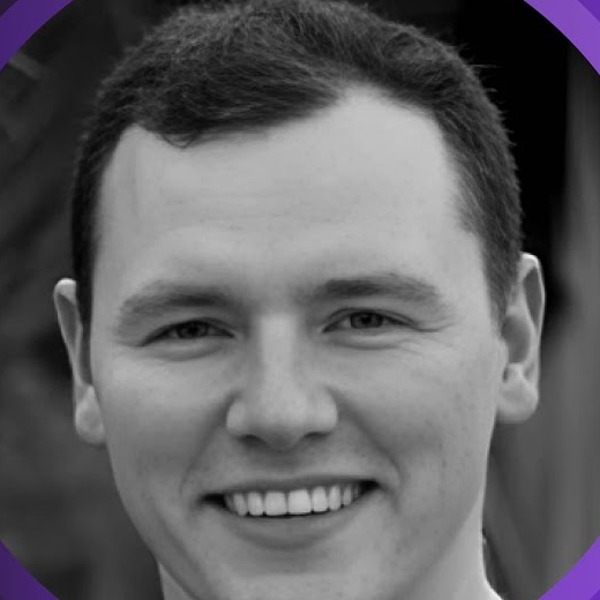
 Calm face, hard problem.
Co-founder / Chief Executive / Somewear Labs
James
Kubik
He builds the radio you reach for when the cell bars vanish and the situation gets loud.
Satellite + mesh comms for frontline teams
Calm face, hard problem.
He builds the radio you reach for when the cell bars vanish and the situation gets loud.
Somewear Labs sells a small gray box and a piece of software, and the pitch is almost boring until you understand where the box goes. It goes to the helicopter paramedic hovering over a canyon. It goes to the wildland fire crew on the second ridge past the last cell tower. It goes into the ruck of an operator inside a building with no signal, underground, off the grid, past the edge of every network anyone thought to build. James Kubik runs the company that makes it, and he did not arrive at satellite communications by way of a defense career or a telecom pedigree.
He arrived by way of a design studio at Northwestern and a memory he could not put down.
Today Somewear's platform is used by all services of the U.S. Department of Defense, a stack of federal agencies, and a long tail of state, local and commercial teams. The products have names that sound like verbs - Relay, Node - and they do one stubborn thing well: they keep a team talking when the infrastructure everyone relies on isn't there. Kubik's title is CEO. His actual job is making sure the button works.
"It turns any smart phone into a satellite communicator."
- JAMES KUBIK ON RELAY
It's never about the business. It's about who you're serving.- James Kubik
Long before there was a company, there was a sailing trip on Lake Michigan. A childhood friend of Kubik's went out with her father and younger sister. Somehow they were separated from the boat. They had no way to call for help. She drowned. When the boat later washed ashore, it was still carrying the safety equipment that might have changed everything - useless the moment it drifted out of reach.
That detail is the whole company. Not the tragedy in the abstract, but the specific, maddening fact that help was aboard and unreachable. Kubik carried it into an industrial design class at Northwestern's Segal Design Institute, taught by Professor Greg Holderfield, who challenged students to design something they believed would make a difference. Kubik's answer was an early sketch of what became Somewear. When the quarter ended, Holderfield offered to keep going with him as an independent study.
The lesson he took wasn't "build a gadget." It was: put the lifeline on the person, not on the vehicle, not on the tower, not on the assumption that the network will be there. Everything Somewear ships still obeys that rule.
Keep it stupid-simple, because people don't use complicated things when they're scared.
"We wanted to keep the hardware as simple as possible."
He launched North America's fastest-growing new product at Intuit, then walked toward a problem with no obvious market and a very personal reason.
Before Somewear, Kubik was a product leader at Intuit in Silicon Valley, where he launched the fastest-growing new product in North America and took it international, to Europe and Australia. It was the kind of resume line that opens doors. He used it to close one and open a harder one.
He teamed up with Alan Besquin - a fellow Northwestern design engineer who'd done time at both Apple and Tesla - and for roughly a year the two built prototypes on nights and weekends in coffee shops. In January 2017 they went all in. The first product, Relay, was marketed as the smallest satellite hotspot ever built: pair it with your phone and you had global messaging, location sharing and an SOS anywhere on Earth.
Then the customers told them something. The adventurers were nice. The people who needed this most wore uniforms.
The pocket satellite hotspot that turns any smartphone into an off-grid communicator. Messaging, tracking, SOS - anywhere the sky is open.
A pocket-sized device that fuses mesh radio and satcom. No fixed infrastructure required - every person carrying one becomes a moving relay.
Routes data across the mesh to whichever Node has the best satellite or cellular link, so the team stays connected indoors, underground, on the move.
Illustrative comparison of connectivity reach, based on Somewear's stated capabilities.
Somewear's $13.7M Series A didn't come from the usual growth fund alone. It was chaired by David Dorman, former CEO of AT&T and former chairman of Motorola, and joined by a bench of operators who don't need the money and don't lend their names lightly.
90+ rescues. Ten months. One Air Force squadron in Alaska, running Somewear as its primary comms.
"You always have more to learn and you're never fully prepared."
"There is no business without distribution."
"We realized that no one really wants to think about emergencies."
"Stay neutral but believe."
Kubik is an outdoorsman in the least performative sense - he fly fishes, snowboards and shoots archery, which is a tidy way of saying he is his own customer. The products are for people who go where the signal doesn't, and he goes there too.
He keeps a letter from his grandfather that tells him to do the right thing and do no harm. For a company selling into defense and public safety, that's not a poster in the break room; it's a filter for decisions. When he talks about leadership, he doesn't reach for swagger. He reaches for humility - the founder who ran the company in his twenties and says out loud that he was never fully prepared, and that this was fine.
His mantra for the mission is odd and memorable: stay neutral but believe. Hold the conviction, drop the ego. Serve the person on the other end of the SOS button, not the story you'd like to tell about yourself.
Put the lifeline on the person. Not the vehicle. Not the tower. Not the hope that the network shows up.- The Somewear thesis, in plain terms