Before James Donald Armstrong had a software company, he needed somewhere to sleep. He was hitchhiking across Canada in the 1970s when winter caught up with him in Winnipeg. The Salvation Army offered a meal and a bed. No business plan was required. Years later, after JDA Software had made him successful, Armstrong would remember the people who let him through the door.
He called his younger self a hippie. The future software executive was, for that night, one of hundreds receiving help. He remembered that he could have returned the following evening. The generosity had no closing ceremony, no demand that its recipient first become an uplifting example. It was available when he needed it.
That memory offers a useful way into a career usually introduced through corporate initials. JDA began in Canada, expanded into the United States, went public and eventually became part of the business now called Blue Yonder. Armstrong’s interests expanded too: investing, education, a Mexican border community, and the Canadian town where he and his wife grew up. The company changed hands. Those attachments endured.
The town before the ticker symbol
Armstrong and Jo-Ann grew up in Elliot Lake, Ontario, a mining town that figures prominently in his memoir, Going Down the Road. He describes a journey from unskilled labor to running a publicly traded American company. There is quite a distance between those occupations, even before allowing for the border.
His education took him to Toronto’s Ryerson Polytechnic Institute. He graduated from its Mechanical and Industrial Engineering program in 1972. That detail places his beginnings in the world of systems and practical work, before retail software became his business. Programming, operations and management jobs preceded his American company.
Jo-Ann belongs in this early history. Alongside raising their four children, she helped develop JDA in its first years. The later philanthropic partnership had a business partnership behind it, and a shared hometown behind both. A founder’s biography can become a solitary expedition surprisingly quickly. The Armstrong story comes with company.
A retailer’s problem becomes a business
In 1978, Armstrong founded JDA Software Services in Canada. Its early work involved IBM’s midrange computers. These were business machines, and the opportunity lay in making them useful to people with stock to track, accounts to reconcile and stores to run.
One early retail project captures the appeal. Armstrong and Doug Marlin’s programming business developed an integrated system for a Canadian Tire retailer. It brought together financial management, merchandising, checkout and warehouse control. Canadian Tire Corporation subsequently bought the system and installed it in 250 outlets. A problem solved in one store could travel.
The attraction of that work is easy to miss from the shopping aisle. A customer sees a product on a shelf. Behind it sit purchasing decisions, stock records, prices and replenishment. Every extra store multiplies the opportunities for those things to disagree. Software gave a growing chain a way to coordinate them.
One connected system. Many opportunities for a misplaced number.
Armstrong later described a decisive move away from generic accounting applications toward helping specialty retail chains expand. He also acknowledged arriving late with newer products and losing market share to a competitor. Recovery took time. It is a useful admission from someone whose career could otherwise be edited into an uninterrupted sequence of good decisions.
Eight employees, one move
In 1985, Armstrong sold the Canadian business and co-founded the American JDA with Frederick M. Pakis in Cleveland, Ohio. A contract with a Phoenix automotive retailer helped pull the business west. In 1987, all eight employees relocated to Arizona. Headquarters followed a customer rather than a grand theory about the ideal address.
On March 15, 1996, JDA went public. That year, it also repurchased the Canadian business Armstrong had sold. Expansion had produced an unusual homecoming: the company crossed back into its own earlier history. Selling an operation need not be the final sentence in its story.
- 1978Canadian software business begins
- 1985American JDA co-founded with Frederick Pakis
- 1987Eight employees relocate to Arizona
- 1996IPO and Canadian business repurchased
- 2012JDA sold; Armstrong’s chairmanship ends
His time as chief executive came in two stretches: 1985 to 1997, then a return in 1999 that lasted until 2003, including a period as co-CEO. He remained chairman through 2012. Founding, managing and governing were successive jobs, with different demands, rather than one permanent title.
Leaving the CEO role still left work to do. As chairman, he helped with strategy, potential acquisitions, major product decisions and relationships with customers and employees. These responsibilities are less visible than an IPO, but they show what a founder can keep contributing after handing over daily management. A company carries knowledge in people as well as products. Armstrong’s continued involvement put his experience of the business within reach of the people responsible for its next decisions.
During his second period as CEO, JDA entered a strategic relationship with Microsoft around the .NET platform. By then, the business served retailers, wholesalers and consumer goods manufacturers. The work had grown beyond its Canadian beginnings, while retaining the practical problem of getting organizations and their information to cooperate.
The Blue Yonder name arrived in February 2020, well after Armstrong’s executive tenure. His connection is through JDA’s founding and development. The distinction matters: a company can have a long life after its founder stops running it, accumulating new owners, products and names along the way.
The investor still picks up the phone
From 2008 to 2019, Armstrong was a managing partner at Canal Partners. His responsibilities covered finding investments, examining the numbers and making investment decisions. Today, he is director and president of JDA Investments (US), Inc. The move from operator to investor kept him close to software businesses, with a different seat at the table.
At ClickDimensions, he joined the board in 2015 and increased his investment. At Allbound, his involvement included helping bring in leadership. Daniel Graff-Radford recalled Armstrong calling to ask him to lead the company; Allbound announced the appointment in March 2019. Capital arrived with introductions, judgment and somebody willing to make the call.
Another connection brings the geography back toward his beginnings. Calgary-based positioning technology company 4D1 lists Armstrong as an adviser. Its work concerns precise indoor positioning. Decades after helping retailers organize information, he remains involved with people trying to make complicated operations more manageable.
A scholarship with people attached
In 1999, Jim and Jo-Ann established the Armstrong Family Foundation Scholarship Program at Arizona State University. Their daughter-in-law’s experience pursuing college without parental support had helped reveal a gap. The program was designed for students facing similar circumstances, including young people in foster care, wards of the court and independent students.
They committed $4 million in 2007 to endow the program. By June 2012, it had supported 72 students. Those are dated milestones, a glimpse of the program at a particular moment. The more personal detail is that the Armstrongs met regularly with scholars and helped them work through obstacles beyond coursework.
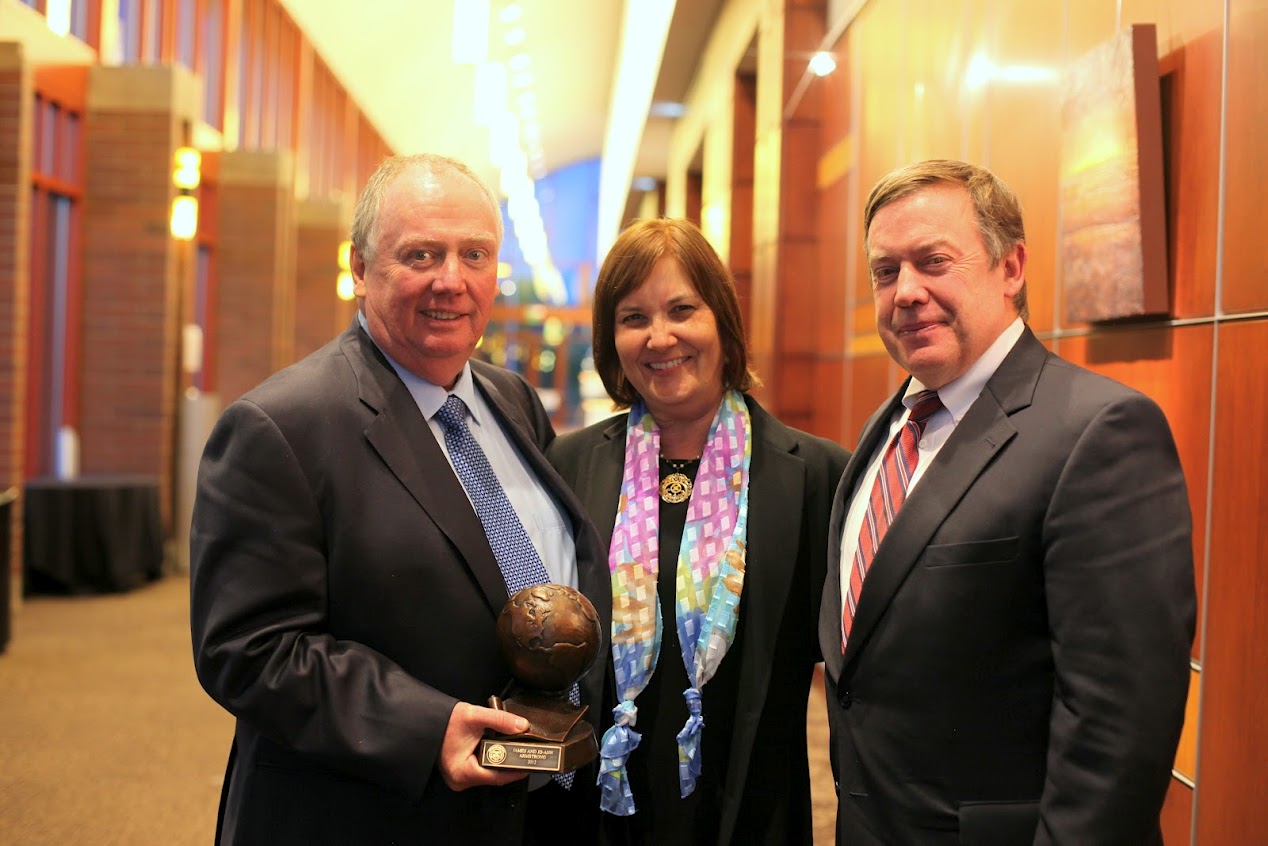
In 2025, the scholarship’s service component was still central to its story. Scholars volunteered in Agua Prieta, Mexico, helping build homes and distribute food alongside residents. Receiving support and offering it to someone else became part of the same education. There was room in the curriculum for a shovel.
“We are honored to provide a family atmosphere”
Jim Armstrong, 2012
Armstrong’s own university also benefited from his software career. In 2003, he donated retail applications to Ryerson. JDA continued the relationship, contributing software and licence agreements valued at more than $7 million in 2017. Students could learn with tools used in the businesses they hoped to join.
Keeping the doors open
Armstrong began volunteering with his family at Rancho Feliz in 1998. The organization works in Agua Prieta, across the border from Arizona. His commitment eventually included arguing for its future: when founder Gil Gillenwater considered selling its property and directing the proceeds into scholarships, Armstrong urged that its programs continue.
Back in Elliot Lake, another set of doors needed opening. Jim and Jo-Ann contributed C$300,000 to launch a 2024 arena repair fundraising challenge. He had played hockey throughout his school years and remembered the excitement of finally having an indoor arena. The building’s closure gave those memories an immediate use.
Jim and Jo-Ann’s opening gift to the arena repair challenge.
The challenge began with a C$500,000 goal. Together with other community giving and Kraft Hockeyville support, the effort ultimately raised just over C$1 million. An old hometown attachment had become a practical contribution to the next generation’s winter afternoons.
Armstrong has left a written account too. His 2019 memoir runs to 426 pages, covering work, travel, family and the company’s growth. Away from business, his interests include photography, fly-fishing, woodworking and piloting aircraft. A life spent organizing other people’s operations has left room for activities that demand attention of their own.
Recognition followed both sides of his work. Arizona’s technology community honored him with a lifetime achievement award in 2018. Yet he had already described the legacy he wanted in more everyday terms: well-paid jobs and a personal commitment to education. It is a revealing choice of measures. Jobs give other people a livelihood. Education gives them a way to choose what comes next. Neither requires a founder to remain in the chief executive’s office forever.
The road in his book’s title runs through several countries and several kinds of work. Its recurring destinations are surprisingly ordinary: a place to sleep, a chance to study, a home, an ice rink. Armstrong helped build software for businesses that needed to keep things moving. He has spent much of the time since helping people find somewhere to begin.