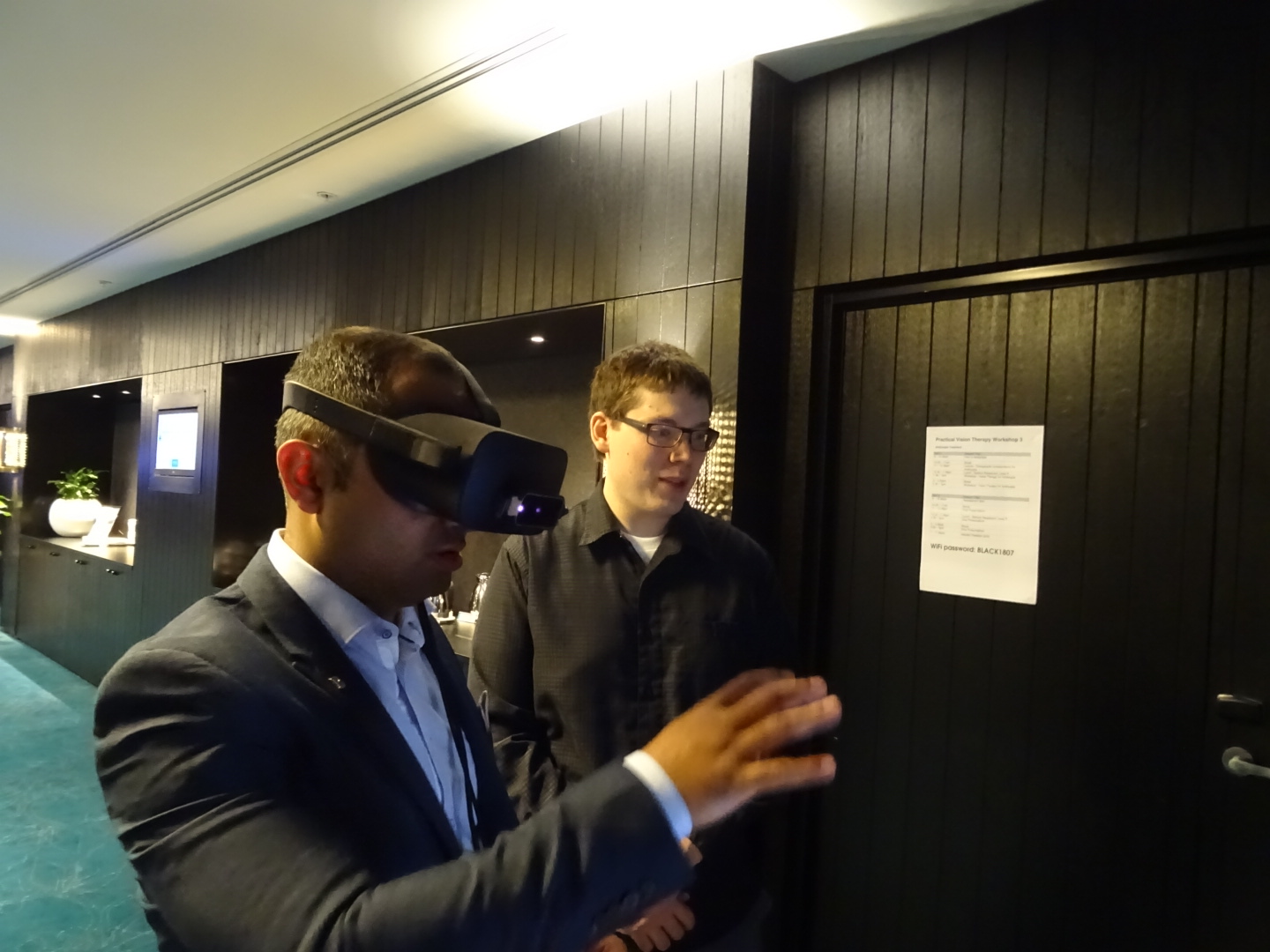
In a conference hallway in Sydney, James Blaha stands half a step behind a man wearing a virtual-reality headset. Blaha is not posing. He is watching. The user's right hand floats in front of him, fingers spread, while Blaha studies whatever the headset has made possible in the room. It is a small scene from the Vivid Vision archive, and a useful picture of the founder's career: build a world, hand it to someone else, then pay attention.
Blaha began as a programmer, not an industry lifer. By the end of 2013, he had founded Vivid Vision in San Francisco. In March 2014, he and eventual co-founder Manish Gupta presented an IEEE Virtual Reality paper under the product's early name, Diplopia. The name would change. The hardware would change. The company's job would widen. What survived was the useful trick at the center of any good interactive system: software can create a controlled experience, observe what happens inside it, and adjust.
Silicon Valley tends to frame virtual reality as transport. Put on a headset and go somewhere else: a battlefield, a concert, a cartoon kitchen. Blaha treated it as an instrument. A headset could be more than a portal. It could deliver carefully designed tasks, record responses, and give professionals a new way to work with people. That moved the company out of pure entertainment and into a slower, more demanding neighborhood where a clever demo is merely an opening sentence.
The customer edits the code
The most revealing chapter came after the prototype. Vivid Vision placed systems in a handful of clinics at prices Blaha later described as roughly three for the price of one. The clinics received a bargain and the startup received something harder to finance: unvarnished observation. Over six to eight months, the team learned that professionals used the system very differently from the way its programmers had imagined.
This is the small tragedy of software: a clean mental model meets a Tuesday afternoon. A button that seems obvious in the studio becomes mysterious between appointments. A workflow that looks elegant on a whiteboard acquires three people, two interruptions, and a printer with opinions. Blaha's response was to admit the gap. The team substantially changed the interface after hearing what clinicians actually did day to day.
“We really had to hear the doctor perspective and how they work with their patients day-to-day ... to redesign it.”James Blaha, 2018
The sentence contains an entire operating philosophy. Technical conviction got the company into the clinic. Product humility kept it there. Blaha did not confuse a founder's attachment to the problem with ownership of the workflow. Early users became editors. The code was revised by people who never opened the repository.
A company of translators
Blaha's title says founder and CEO, but the more descriptive occupation may be translator. He has spent years moving among software engineers, hardware makers, clinicians, vision scientists, university administrators, investors, and research sponsors. Each group has its own nouns, its own clocks, and its own definition of proof. A product can be impressive to one room and incomplete to the next.
The team around him reflects that translation work. Gupta, who left IBM to co-found the company in 2014, led development as CTO. Optometrist Tuan Tran brought the professional perspective. Scientist Benjamin Backus added research depth. In 2018, Vivid Vision signed an exclusive license agreement with the Research Foundation for the State University of New York for eye-tracking technology developed at SUNY College of Optometry. The startup was no longer simply borrowing the clothes of a clinical company. It was forming the institutional relationships one needs to become one.
The intellectual property record followed the same path. Blaha and Gupta were named on a 2017 patent for an interactive system for vision assessment and correction. Blaha, Gupta, and Backus were later named on an application for systems and methods for vision assessment. Patents are not products, and products are not companies, but together they show the widening cast: two programmers at the beginning, a vision scientist in the next act.
Follow the instrument
By 2019, Blaha was publicly discussing a new use for the underlying system: virtual-reality-based visual-field testing. The shift was subtle and consequential. Interactive software had begun as a guided experience. Now it could also become measurement infrastructure, collecting repeated observations in a consistent digital environment. The company was moving from an appointment-shaped product toward something closer to an endpoint-shaped product for research.
That year Vivid Vision won the “Show Me the Money” pitch session at the Glaucoma 360 New Horizons Forum. In 2025, the company published feasibility work around at-home testing and became one of six finalists in the VSP Vision Innovation Challenge. In January 2026, Blaha presented again at New Horizons in San Francisco. The sequence has the tidy look of a strategy slide now. Living through it took seven years.
Startups are often advised to pivot as if the word means spin. Vivid Vision's movement looks more like opening a pocketknife. The same technical object revealed another tool. The company did not abandon interaction, VR, or professional oversight. It combined them differently and addressed a new buyer with a new standard of evidence.
The distance problem
Blaha's management idea, rendered as a conceptual diagram rather than a measured dataset.
The antidote is not staying small forever. It is designing ways for builders and leaders to remain close to the people spending time inside the product.
Count the human hours
In March 2020, Blaha joined the founders of three other startups for a conversation with 120 members of Zeiss leadership. Asked what a smaller company could teach a large one, he paused. Then he described a problem created by scale: the average distance between employees and customers grows. When a company's buyer and end user are different people, the distance can grow again.
His proposed metric was memorable. Count how many hours of human experience happen inside the device. Vivid Vision, he said, had accumulated several collective years of experience in a single month. He encouraged Zeiss to consider the many thousands of years people might spend with its products and to treat the quality of that time as a responsibility.
“Although our company is small, people have spent several collective years inside our experiences in just the last month.”James Blaha at the Zeiss leadership retreat, 2020
Most startup metrics turn people into units: acquisition cost, retention, frequency, conversion. Human hours reverses the gaze. It asks what the product does with the time it has acquired. A high number is not automatically good. It is a debt owed by the designer. Make the hour clear, useful, and as humane as the job permits.
The idea also explains Blaha's attention to game design. Games are unusually honest about time. If an experience is confusing or dull, the player's hand finds the exit. Professional tools sometimes survive bad design because the user has no exit. Blaha's argument was that necessity does not excuse indifference. A required interaction deserves craft precisely because it is required.
What builders can borrow
Blaha's public record does not offer the usual founder costume changes. There is no procession of unrelated companies every eighteen months. There is one technical idea, a sequence of collaborators, and a widening set of applications. The work is patient in a culture that often mistakes restlessness for range.
There is an amusing modesty in the conference photograph from Sydney. The user gets the futuristic object. Blaha gets the background. This is appropriate. Founders are frequently photographed speaking, but companies are more often built while watching: a customer moving through a workflow, a partner challenging a premise, a researcher asking for better data, a product revealing the next product.
The first prototype gave Blaha a beginning. The clinics gave him revision. Gupta, Tran, Backus, and research partners gave the company range. Investors gave it time. The later measurement work gave the core technology another job. Vivid Vision's story, twelve years after that IEEE paper, is still being written in the grammar of the original demo: create the environment, observe carefully, change what happens next.