The useful thing about a ruinous invoice is that it tends to explain itself. In 2023, Evan Conrad and Alex Gajewski were running a two-person AI audio project. To train their model, they signed for a GPU cluster for a year. The model needed about a month. The contract, having no interest in product schedules, continued for eleven more.
Their bank balance was headed toward zero. So the founders did what software people do when a system refuses to fit the problem: they made a layer around it. They found other companies that needed bursts of compute and subleased the idle months. A private rescue acquired the shape of public infrastructure. The audio project receded, and San Francisco Compute Company appeared.
Conrad now describes the company in a sentence sturdy enough to survive contact with an accountant: it sells time on large GPU clusters on contracts customers can exit. SF Compute operates the machines, offers virtual machines and bare metal, and keeps an order book where unused capacity can be listed for somebody else to buy. The escape hatch is the product.
A mistake with excellent product-market fit
Cloud computing trained a generation of developers to expect a tap. Open it, run a server, close it, pay for what passed through. Large GPU clusters obey a different economy. They are costly to buy, slow to build and attractive to lenders only when somebody has promised to keep paying. That promise is called offtake - the long-term purchase agreement that helps finance the cluster before it exists.
The agreement gives the builder certainty. It gives the customer a liability. An AI startup may charge its own customers month by month while owing a data center for years. If demand moves, a software roadmap can be rewritten over lunch. A warehouse of accelerators cannot pivot. Conrad's fascination sits in that mismatch between elastic ambition and stubborn assets.
His proposed fix is neither to abolish the long contract nor pretend the hardware is cheap. It is to make the commitment transferable. A company can reserve enough machines to get a better rate, use what it needs and list idle time on the SF Compute market. Another buyer gets a shorter window. The original buyer recovers part of the cost. SF Compute takes a fee and remains responsible for operating the cluster.
The contract gets an escape hatch
This is a financial idea wearing a cloud provider's overalls. It requires billing, compliance and a ledger alongside Kubernetes, InfiniBand and people who know what to do when hundreds of expensive computers disagree before breakfast. The order book matters only if the underlying hour is dependable enough to trade.
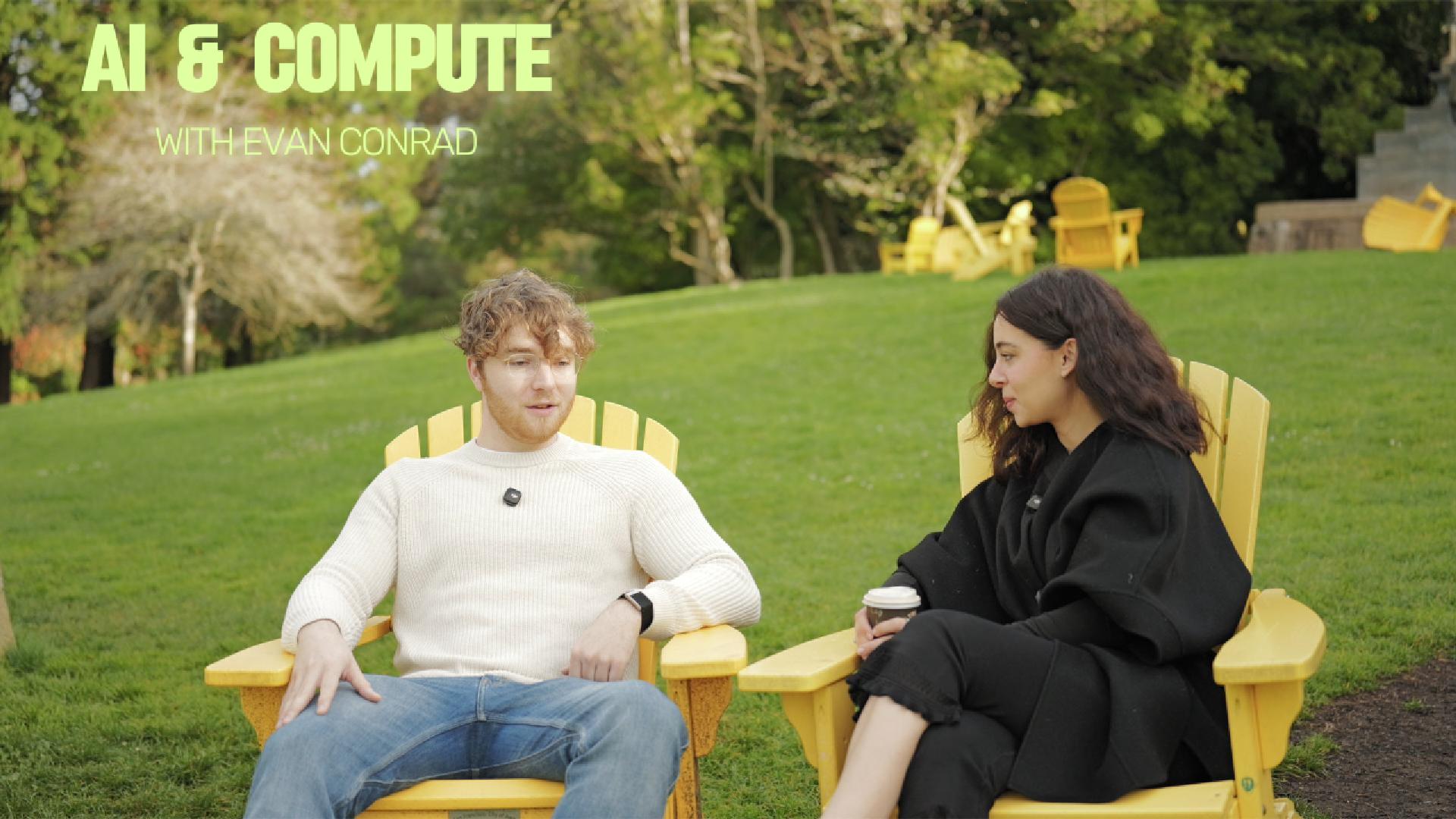
An engineer walks into the balance sheet
Conrad came to this market by way of code. At Gonzaga University, where he studied from 2015 to 2018, he built small products: a dining-hall app, a golf-course ordering app and a real-time HTML and CSS renderer for students. His public GitHub account, Flaque, now contains more than 200 repositories. The pinned projects range from a JavaScript framework for idle games to a temporary-file utility for Go tests and a tool that lets a language model review code.
The collection reveals a preference that his essays state more bluntly: make the mechanism legible. In a 2022 post aimed at founders who bury their products beneath grand abstractions, he offered a two-word instruction: “Be boring.” Tell people what the thing does. Give them a sentence they can repeat.
SF Compute's branding follows the rule. Its website pairs pictures of fog, bridges and California coastline with offers for H100, B300 and GB300 clusters. The language is low-temperature: reserve compute, resell what you do not use, run it from a command line. Even the company name sounds as though it might have been stenciled onto a municipal transformer in 1958.
The calm exterior is not an absence of ambition. Conrad has compared the scale of the AI data-center surge with national infrastructure programs. His response is to lower the rhetorical temperature and examine the invoice. In a business full of intelligence metaphors, he talks about lenders, margins, utilization and who owns the asset when a customer stops paying.
Why the cloud looks like a hotel
Conrad's favored analogy for SF Compute is Marriott. A hotel may carry the Marriott name and use its operating system while the real estate belongs to another owner. SF Compute similarly wants outside capital to own the GPU clusters while his company specifies, operates and sells the capacity. The distinction sounds administrative until one remembers that a rack full of chips is an investment as well as a product.
Venture investors usually hope a software company can grow without buying a matching pile of physical assets. Infrastructure funds and sovereign wealth funds are built for a different return profile and may have cheaper capital. Put the machines with the owners suited to machines, Conrad argues, and let the operating company concentrate on reliability and demand. A lower cost of capital can eventually become a lower hourly price.
He has been writing toward this thesis for years. In a 2024 essay on commodities, pricing and assets, Conrad observed that hardware purchases lock competitors into the strategy implied by the purchase. Code can change direction. Debt attached to depreciating equipment is less imaginative. His cheerful advice was to celebrate each large asset purchase by a rival, because it closes doors that remain open to you.
SF Compute's path has required its own commitments. The company says it builds data centers and the clusters inside them, supports virtual machines, bare metal, managed Slurm and Kubernetes, and can arrange contracts from one node for an hour to thousands of nodes for years. In late 2025 it raised a $40 million Series A co-led by DCVC and Wing Venture Capital. Public reports put total funding at $52 million.
Conrad studies at Gonzaga and builds student and consumer apps.
An AI audio project subleases excess capacity; SF Compute is founded.
Conrad writes about commodity pricing, asset risk and AI's physical costs.
SF Compute announces a $40 million Series A.
The company adds cluster options and product tooling while Conrad explains the model in public interviews.
Optimism with a refund policy
Conrad's GitHub biography is one word: “Optimist.” Below it, he publishes a compact list of beliefs. People are fundamentally good. Problems are solvable. The goal of life is to be a good ancestor. Bikes, trains and buses deserve more of the world. Tame Impala, he adds, is the Beatles with extra echo.
There is a consistent character in those lines: earnestness rescued from solemnity by a joke. His profile photograph features him grinning beneath enormous trumpet flowers, as if nature issued him a crown and he was too polite to decline. His personal site is equally unfussy, offering essays, links to art and photography, and a picture of Mount Tamalpais.
The civic optimism is practical, too. Conrad moved to San Francisco from rural Idaho and has publicly supported more apartment construction in the city. A 2026 newspaper profile found the founder sharing a rental house with four roommates and wondering what the city's housing costs feel like for everyone else. His software thesis and his civic one rhyme: scarce things become punishing when access is rigid.
What he wants compute to unlock reaches beyond chat boxes. In a 2024 conversation, Conrad pointed to robotics, self-driving systems, physics simulations and materials science as areas that might become more accessible when teams do not need to raise vast sums before they can run an experiment. The market is a means, not the spectacle. Its purpose is to let more builders approach expensive machines without betting the company on every attempt.
That makes SF Compute a curious kind of optimistic business. It begins with the assumption that plans will change. Models will disappoint. Demand will arrive late, then all at once. Hardware will age. A customer may need out. Conrad's answer is not a pep talk. It is a matching engine, an operating team and a contract with room for second thoughts.
The original year-long lease was nearly a disaster because it treated a forecast as destiny. SF Compute's wager is that ambition works better when destiny can be relisted by the hour.