At GoodData, Jakub Sedlacek encountered a problem with a certain professional irony. He was working at an analytics company, leading developers, yet the team needed a clearer understanding of what its customers wanted. More information about a product did not automatically provide a better sense of its users. The missing ingredient was their own account of the experience. Sedlacek built a small application that asked whether they would recommend the service. The answers were useful enough to suggest a business.
There is an appealing lack of ceremony in that beginning. A developer encounters a difficulty at work, writes something to address it, then discovers the difficulty has company. The resulting venture, SatisMeter, would put short surveys inside other businesses’ products. Years later, Productboard would buy it. Before the acquisition announcement and the customer list, though, there was the ordinary discomfort of making decisions without hearing enough from the people affected by them.
That discomfort gives Sedlacek’s career a thread worth following. It runs through software, the small team he built with his brother, and the colleagues he later credited with improving the company. A question on a screen is easy to overlook. The work required to make its answer useful is considerably more interesting.
Two brothers, different toolkits
SatisMeter came into being in early 2015. Jakub’s brother Ondrej joined him as co-founder, bringing experience in sales, marketing and fundraising to a partnership whose technical and product work fell to Jakub. Their professional paths had previously seemed unlikely to meet. The family connection supplied familiarity; their different skills supplied a reason to work together.
Jakub described the advantage in terms of being able to rely on each other through good and bad periods. “We share the same values,” he said. It is a less theatrical account of founding a company than the usual collision of ambitions. Brothers already have a history. In this case, they also had different jobs to do.
The early division is visible in the company’s public record. Ondrej explained the business to prospective users and spoke about its plans. Jakub built the software. An early founder listing identified him as CTO; by the 2022 acquisition announcement, he was identified as co-founder and CEO. The titles changed over the company’s life. The responsibility for making an idea usable remained central to his contribution.
SatisMeter begins with Jakub and Ondrej.
The brothers join the accelerator’s sixth cohort.
The feedback company joins a product management platform.
A survey with some manners
The original proposition was compact: ask people whether they would recommend a service, then ask what could improve. SatisMeter placed the questions inside the application. Its early features included surveys in a user’s language, visual customization, and connections to other customer data. These were practical details for a product that needed to fit into someone else’s software without looking like an uninvited guest.
In May 2015, Ondrej reported more than 400 registered users and more than twenty businesses using the service in production. The brothers were still the entire team. Their principal cost was their own time, and the service remained free during its trial period, with paid plans scheduled for June. That snapshot captures a familiar early business problem: people may use something before anyone knows whether they will pay for it.
A customer put SatisMeter on Product Hunt. The resulting attention brought forty registrations on the first day, according to Ondrej. Small numbers can have large consequences when there are only two people watching them. Every new account is another chance to learn whether a promise survives contact with an actual workplace.
The answer needs somewhere to go
Jakub’s early advice about surveys was unusually plain. Companies often asked customers for feedback, he observed, then failed to follow up. A dissatisfied person could explain a problem; a satisfied one could open another conversation. Either way, the survey was a beginning. Treating it as a completed task missed the opportunity that had made it worth sending.
The company’s work with Instapage offers a concrete example. In 2017, the landing-page business was using SatisMeter at several points after signup. Its research team reviewed scores and comments for emerging patterns, then used those patterns to start more detailed investigations. Customer feedback also flowed into a Slack channel that reached colleagues across departments.
A short response could therefore travel quite far: from a person using the product, to researchers, to support, to the people deciding what to build. That route matters. A comment sitting in a database has limited social prospects. Put it in front of a team and it can acquire a reply, an owner, or a place in the next discussion.
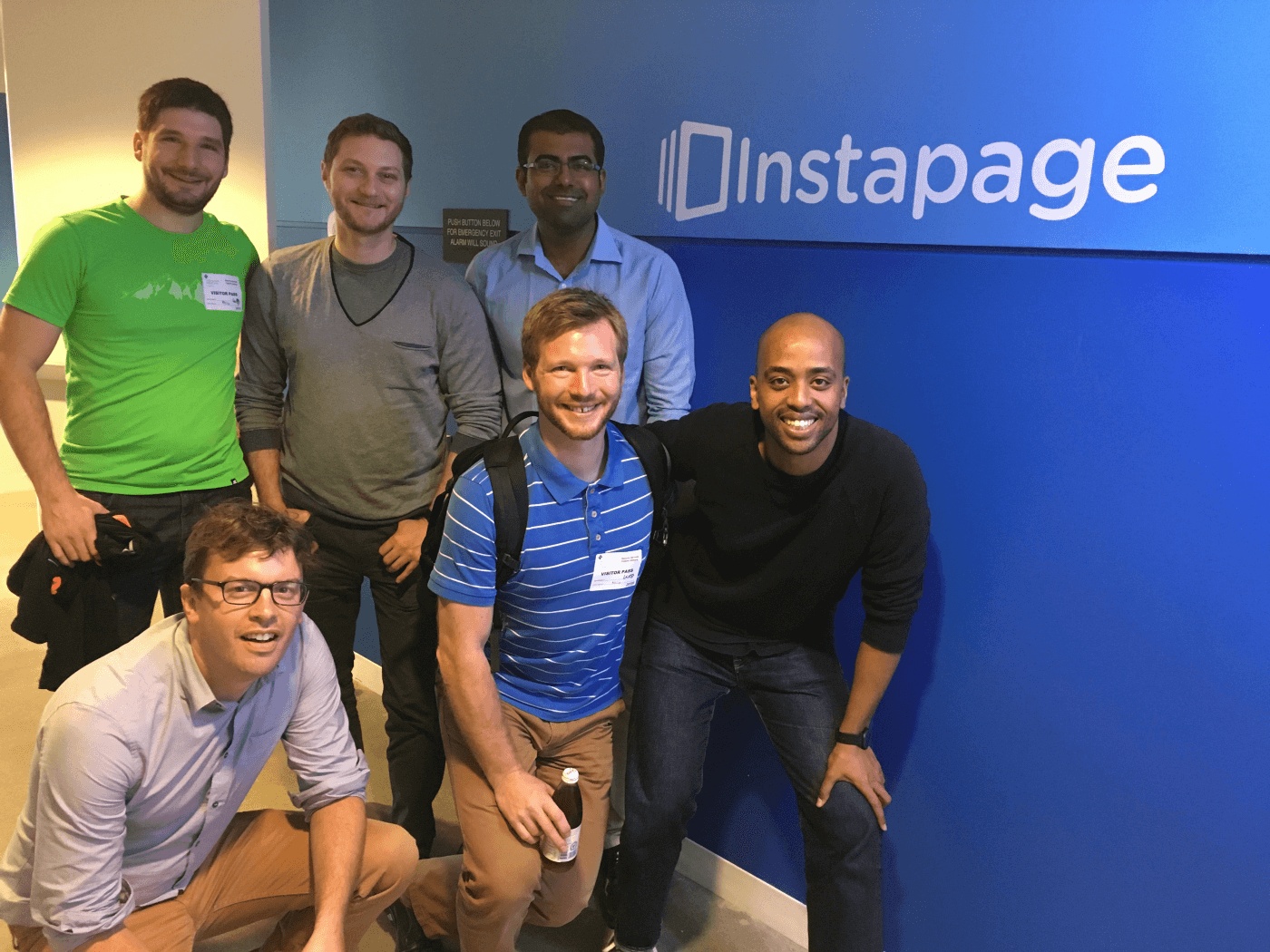
The photograph of the brothers visiting Instapage supplies a pleasant corrective to the abstraction of software. There are people at both ends of these integrations. Someone writes the questions; someone answers them; someone else has to decide what deserves attention. The customer relationship cannot be finished by installing a widget, however tidy the widget may be.
When the technical question lands on Jakub
SatisMeter applied that thinking to its own operation. In 2018, the team described a weekly rotation in which everyone handled live chat and email support. The arrangement began when the company was too small to hire a dedicated person. As it grew, the team kept the rotation because direct contact with users continued to teach them things.
Cally Tomlinson, who wrote about the practice, explained that technical questions frequently went to Jakub even outside his designated support week. The interruption was part of the cost. A small company can make a beautiful schedule, but a customer’s question has little interest in its beauty. Someone still needs to understand the problem well enough to help.
Keeping builders within reach of users also makes the consequences of a decision harder to abstract away. An unclear setting or an awkward workflow returns as a conversation. There is a useful humility in that arrangement. A feature can look entirely reasonable from the desk where it was designed, then require several minutes of explanation from the person who made it.
“Mutual trust and respect.”
Alexia Klie’s description of the SatisMeter team culture under Jakub
He gives the other builders their due
Sedlacek’s public recommendations for colleagues reveal what he noticed in their work. He hired Petr Hlubina as SatisMeter’s first product designer and praised his contribution to user research, the product’s appearance, and simplification. Hlubina’s own account describes a troubling activation problem: half of first-time users were not reaching the point of trying the product. He worked on the redesign and dashboards to address it.
That is an instructive problem for a customer-feedback company to have. Helping other businesses understand users does not confer immunity from misunderstanding your own. The remedy still requires research and design. Sedlacek’s praise is specific about that labor, giving the designer credit for understanding customer jobs and challenging existing choices.
He also credited head of growth Jan Kuzel with helping reposition SatisMeter from a simple NPS tool into a customer-feedback product for product managers. Kuzel’s responsibilities included research, positioning, website copy and pricing strategy. Sedlacek connected the change to the company becoming more valuable and better placed for an acquisition.
Read together, those recommendations show a founder comfortable naming contributions beyond the code. A business changes through many hands: the person who revises the interface, the person who finds the right audience, the person who asks a better interview question. Giving those contributions names makes the company’s progress easier to understand.
A place inside the product decision
On May 26, 2022, Productboard announced its acquisition of SatisMeter. It was Productboard’s first acquisition. SatisMeter then served more than 350 companies worldwide, including Calendly, Hunter and Meltwater. The deal brought a business built around gathering feedback into one built around helping product teams decide what to make.
The fit was straightforward. Productboard wanted contextual feedback throughout a product’s life, and SatisMeter collected it at points where users were actually engaging with the software. The announcement said the employees would join Productboard and SatisMeter would initially continue as a standalone product. The work was to bring the technologies together.
Sedlacek described the combination as an opportunity to improve the product management experience. In a separate account of the decision, he said joining Productboard was the path he preferred for the product and team. That places the acquisition within the story of how the work would continue. A transaction can mark an ending for ownership while creating another set of engineering responsibilities.
Still building things on the web
Sedlacek’s personal website now lists Productboard, SatisMeter, GoodData and Monster as previous workplaces. His current work is at Sustainova, helping businesses become more sustainable; his LinkedIn profile lists a business partner role beginning in May 2026. Sustainova combines technology and advisory work, including its Vicky compliance platform.
His public interests remain recognizably technical: web development, data visualization, Rust, SaaS and AI. His GitHub account includes a JavaScript client for the SatisMeter API alongside other development projects. For all the changes of company and title, the builder’s description survives.
“I build things on the web,” his site says. It is a small sentence to place beside a company sale. It also brings the story back to the useful scale of a person’s work: something that can be made, put in front of someone, and improved when they answer. SatisMeter began with a question its founder needed answered. The most revealing part of his career is the attention he paid to what happened next.
Keep the conversation going
Find Jakub’s work and read more about the people and projects in this story.