Every software developer knows the complaint. A button does not work. Somewhere. Under some circumstances. The person reporting it is certain about the failure and less certain about the address. In 2012, Josef Trauner was building applications as a subcontractor for a telecommunications company when versions of that complaint kept arriving. Before he could fix anything, he had to establish what anybody was talking about. The repair came with an unpaid detective story attached.
Trauner asked for the page, the browser and a screenshot. Sometimes the answer was another question: what was a screenshot? A perfectly reasonable question for a customer, and a rather expensive one for a developer. He and his collaborators built a prototype over a weekend to capture the picture automatically. In 2013, their product had the name Erroreporter. The name eventually improved. The underlying irritation proved durable.
Usersnap grew from that little act of translation into a business helping product teams collect feedback. Ten years later, Trauner helped sell it to saas.group. Then he went back to building. His current venture, OtterlyAI, looks at how brands appear in AI search answers. Read together, the two businesses suggest a recurring interest: finding a way to examine something that people otherwise have to describe, remember or guess.
Before the dashboard, a six-legged detour
Trauner’s route into software ran through Upper Austria. He studied computing and organisation at HTBLA Perg from 2001 to 2006, then computer science at Johannes Kepler University Linz, with a master’s course running from 2010 to 2013. Alongside that education, he worked in software development. His professional history lists JTec, his own technology business, from November 2006 until December 2016. Running a company and studying were overlapping activities, rather than neatly consecutive chapters.
There is a pleasingly specific detail in his early professional biography. A 2016 startup event brochure describes him as a national champion in hexapod programming. Six legs are an unusual addition to a SaaS founder’s résumé. The distinction belongs to his technical past; it supplies no automatic explanation for his later companies. Still, it is a welcome reminder that a product executive can have spent time persuading machines to move before persuading customers to subscribe.
A 2016 startup brochure lists Trauner as a national champion in hexapod programming.
Born in Perg, Trauner later built from Linz. Usersnap moved between the two places in 2016, settling in the Neue Werft technology hub in the city’s harbour district. By 2018, the business served more than 1,000 companies worldwide. Co-founder Florian Dorfbauer was working from Florida on overseas business. The geographical arrangement was practical: a software company in an Austrian harbour could have customers well beyond the next bend in the river.
A customer can be right about the wrong product
Usersnap’s original founding team included Trauner and the brothers Florian and Gregor Dorfbauer. Its early usefulness was concrete. A person could mark a problem where it appeared, and the people responsible for fixing it could receive visual context. An ambiguous report became something a developer could inspect. That reduced the burden on the person asking for help, who should hardly need to learn a new profession to explain that a page had failed.
Yet a tool built for errors can attract questions about things that are working exactly as designed. The colour is wrong. The process is cumbersome. A feature is missing. In 2019, Trauner described the importance of hearing customers rather than building only what product managers or the team themselves proposed. Listening complicated the product’s boundaries. It also gave the company a reason to cross them.
A dashboard arrived in 2015 after customers asked to work beyond email. In 2017, Usersnap joined Salesforce Accelerate. There, a challenge to collect qualitative customer feedback helped push it toward a broader platform. Trauner has described the team’s initial reluctance to make that jump. They tested customer-experience uses with Austrian retailers before bringing those uses together with visual bug tracking. Even a company selling feedback needed time to accept its own.
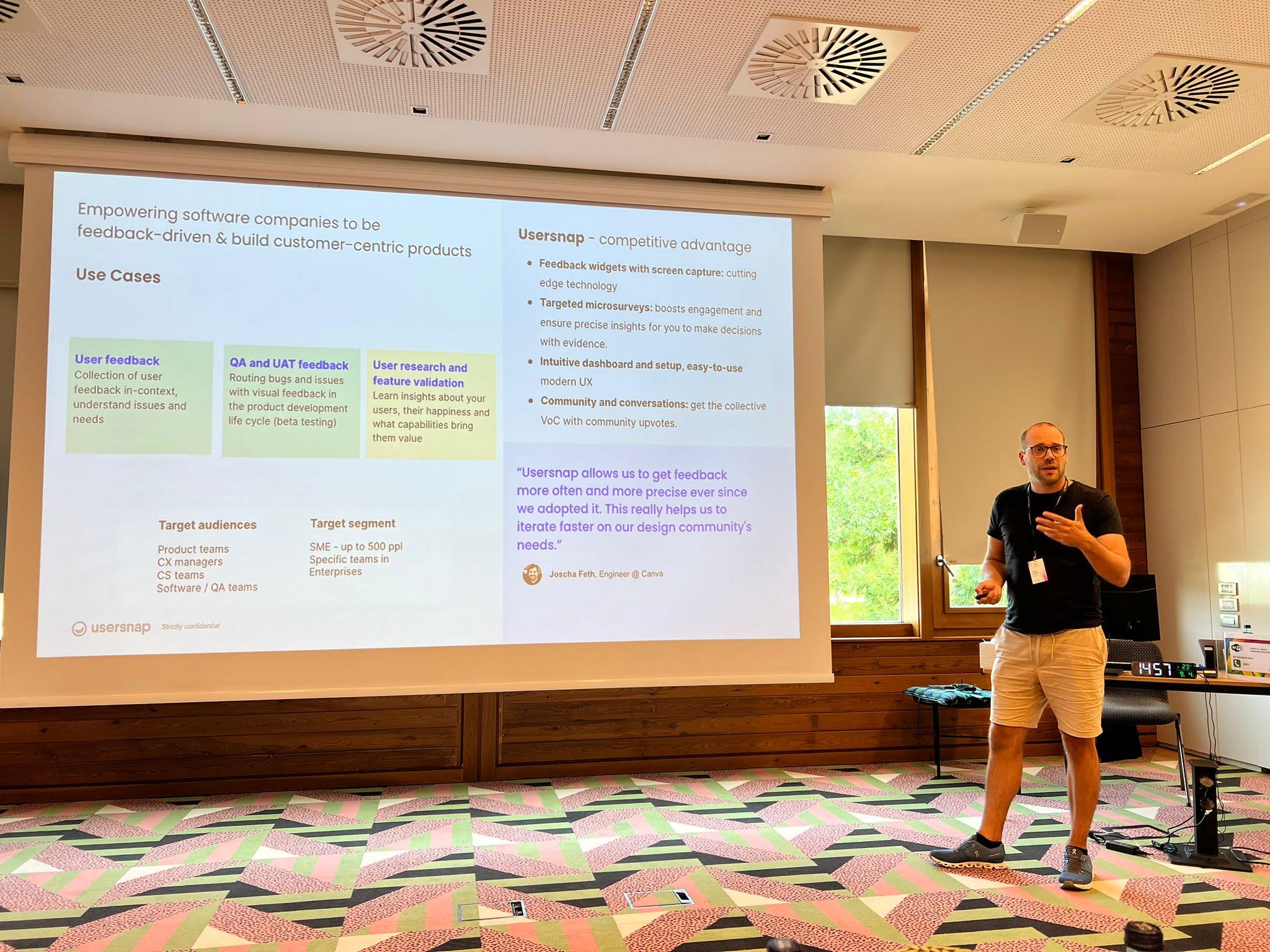
Inside the business, the listening had a less glamorous setting: the kitchen. Trauner, then CPO, led daily meetings where developers and designers shared tasks and difficulties. The international office team brought different backgrounds into the same conversation. A kitchen meeting does not make a product good by itself. It does offer a small, regular place for someone to say that something needs attention before the problem acquires a meeting of its own.
Ten years of code, then a different kind of decision
By September 2023, Usersnap had more than 1,300 customers worldwide, with an established base in the United States, Canada and Europe. Its customers included Lego, Red Hat, the BBC and Microsoft. The company had received limited funding from Speedinvest. Calling its entire history an exercise in bootstrapping would flatten that detail. The more useful picture is of a software business built over years, with customers paying for a problem to become easier to handle.
Klaus-M. Schremser had joined as a later co-founder and growth leader. When saas.group announced the acquisition on September 5, Trauner was CEO and Schremser was CRO. The buyer planned to keep both at the helm for the next phase. Usersnap said its identity would continue and customer agreements would remain unaffected. Behind the ownership change sat a deliberately ordinary promise: people already relying on the product should be able to keep relying on it.
Trauner’s own reaction was more personal. He called the announcement “exciting and somewhat bittersweet.” He remembered writing the first code and moving from a founder doing a bit of everything into the responsibilities of CEO and product lead. There is a considerable distance between getting a prototype to work and being responsible for the people, customers and commitments gathered around it. His account makes room for that distance without turning the sale into a victory lap.
“Usersnap will retain its identity as an individual brand, and our dedicated team will remain unchanged.”
Josef Trauner, at the 2023 acquisition
After an acquisition, he said, communication and openness to new ways of working matter. A founder has to say what is going well and what needs adjusting while accepting that the new organisation will do some things differently. That is an awkwardly practical lesson. Selling a company means negotiating a relationship with the future of something you once could change simply by opening your editor.
The spreadsheet returns
In his 2024 discussion of Usersnap, Trauner stressed the need to choose a specific audience. A feedback product could serve many industries; product managers in software and SaaS gave the business a clearer focus. He also argued that AI additions should provide useful value. Both ideas put a limit on the temptation to make a product capable of everything. A feature earns its place through the work it helps somebody finish.
Trauner and Schremser left Usersnap in mid-2024 to build again. They teamed up with Thomas Peham, who had worked with Trauner at Usersnap for four years before leading marketing at Storyblok. At OtterlyAI, Peham became CEO, Schremser CRO and Trauner CPO. The division gave Trauner a title close to the work from his earlier career: deciding what a product should do and helping turn that decision into software.
The new question concerned search. When an AI system writes an answer, where does a brand appear? Which website does it cite? What happens to visibility when the interface is a paragraph rather than a page of links? The founders began tracking visibility in a spreadsheet and asked marketers what they needed. Those conversations shifted their attention toward traffic, beyond the appeal of a simple brand ranking.
There is a family resemblance to the first Usersnap prototype. A spreadsheet is a modest instrument, but it gives a conversation something to point at. The value comes before the polish. For an engineer with a decade of product experience, returning to an elementary tool can look almost comical. It can also keep the cost of being wrong low enough to let customers change the plan.
Usersnap
What is the customer seeing?
Screen capture → feedback → product decisionOtterlyAI
What is AI search showing?
Prompt → answer & citation → visibility analysisForty thousand users, and a question in another language
OtterlyAI launched its initial monitoring product in October 2024. By December, more than 1,000 marketers had started using it. The founders had interviewed more than 50 marketing leaders while exploring the opportunity. Their company chose an otter for its name and identity, invoking the animal’s agility and eyesight. A creature good at looking around is a suitable mascot for software concerned with whether anyone can find you.
The company’s own milestones record a second product launch in June 2025 and recognition as a Gartner Cool Vendor for AI in Marketing that year. In 2026 it won Best AI Search Software Solution at the European Search Awards. Trauner credited the team in his public response. Those milestones concern a collective effort, not a solo invention. The product bearing his decisions also bears the work of the people who build, explain and support it.
As of August 2026, OtterlyAI reported 40,000 marketing professionals using the platform. That is a user figure, not a count of paying companies. Its scope had expanded to monitoring brand visibility and citations across ChatGPT, Google’s AI search experiences, Gemini, Perplexity and Copilot. The task had acquired more surfaces to watch, each of which could present a company differently.
On October 13, 2026, Vienna University of Economics and Business published an account of Trauner’s recent practitioner seminar. He discussed how AI search changes brand visibility, demonstrated prompt research and citation tracking, and addressed localisation. Language and local context can affect which material appears in an answer. Two questions that look equivalent to a marketing team may therefore yield different views of the same brand. The missing picture now depends partly on who is asking to see it.
A useful picture still needs someone to look
Alongside his product role, Trauner offers consulting in SaaS development, product strategy, growth and technical architecture through his personal website. The subjects span the choices he has had to make himself: what to build, how to test it, how to support adoption and how to keep the machinery running. They put his engineering background and executive experience in the same room, without requiring every client to repeat the whole ten-year journey.
The thread through his career is easiest to see at the point of friction. A customer cannot describe a broken page. A team needs to decide which request matters. A marketer cannot see how an AI answer represents a business. Each situation rewards better evidence, yet evidence still leaves a decision to be made. A screenshot can identify the button. Someone has to work out why the button failed.
Trauner’s companies have changed names, scope and ownership. His work keeps returning to that interval between an uncertain report and a useful next step. In the first chapter, a weekend prototype helped shorten it. In the latest, the answer is a moving target, written in different words for different people. There is plenty left to inspect. For a founder who has chosen to build again, that appears to be part of the attraction.
Keep following the questions
More from Trauner and the teams he has built with.
- Josef Trauner’s personal website
- Josef Trauner on LinkedIn
- Josef Trauner on XING
- Usersnap’s acquisition announcement
- Usersnap: the feedback platform’s origin
- Watch: preparing Usersnap for acquisition
- Listen: Trauner and Peham on OtterlyAI
- OtterlyAI: founders and milestones
- The AI search practitioner seminar in Vienna