Jackie Krick had a business with a rather demanding staffing arrangement. She found the clients. She did the work. Then she went looking for more clients. In the early graphic-design venture she started around 1990, the sales department and the production department were the same person. Both could be busy; neither could cover for the other.
The arrangement eventually became too difficult to sustain. She closed the business and went back to working for someone else. For a person who wanted to direct her own work, that was a hard decision. It also gave her something useful to take into the next attempt: a fairly precise understanding of what one capable person could not keep doing.
In 2004, she founded ECU Communications. Today she leads the Virginia agency while her interests extend to a youth nonprofit and a coworking venture. Read together, those activities suggest a preoccupation with the practical company people need while trying to become independent. Krick had learned something about the limits of a one-person operation.
An entire company, with one chair
There is a particular trap in being good at the work your business sells. Every assignment feels like something you ought to handle personally. Hiring can look like an expense before it looks like capacity. Meanwhile, the next customer still needs finding. Talent does little to increase the number of hours between breakfast and bedtime.
Krick’s account of the first venture is unusually concrete. She talks about the difficulty of bringing work in and then returning to produce it. She was trying to keep a business moving through the efforts of a single person. Eventually, the arrangement had to end.
Her later advice is equally direct: “you cannot do it alone.” That phrase has a useful lack of ceremony. It describes a working limit rather than a personal shortcoming. Someone must be available to bring in tomorrow’s assignment while somebody else takes care of today’s. The next company would have to be designed with that fact in mind.
“you cannot do it alone.”
Jackie Krick, on growing a business
English was only the beginning
Krick was born in Bogotá. At fifteen, she moved with her family to Bolivia; at twenty-one, she came to the United States. Her stepfather was an American diplomat, and she had attended American schools. English was familiar. The routines of living in a new country were another matter.
In Florida, she worked as a restaurant hostess and then entered tourism, where her English and Spanish could both be useful. She moved to the Washington metropolitan area in 1986 and took a marketing job with a computer company. These were working introductions to different customers, expectations and ways of getting things done.
It is easy to make a border crossing look like the decisive event in a career. The slower education happens afterward: discovering how people work, where your experience fits and which questions you still need to ask. For Krick, the path toward owning a marketing agency passed through jobs that gave her knowledge she could use later. A founding date captures very little of that preparation.
- 2004ECU Communications
- 2013IMPACTO Youth
- 2017CenterFuse opens
A second business, with other people in it
Before ECU, Krick held marketing roles connected to technology and government contracting. Her experience included channel marketing, directing marketing and serving as a marketing vice president. She came to the agency business with exposure to the commercial work behind a campaign: developing opportunities, understanding customers and turning a proposed assignment into a real contract.
ECU’s business reaches federal, state and local agencies, nonprofits and private companies. That range asks for different kinds of expertise. A designer, a strategist and a digital specialist bring different answers to the same problem. The founder’s task includes making their contributions work together.
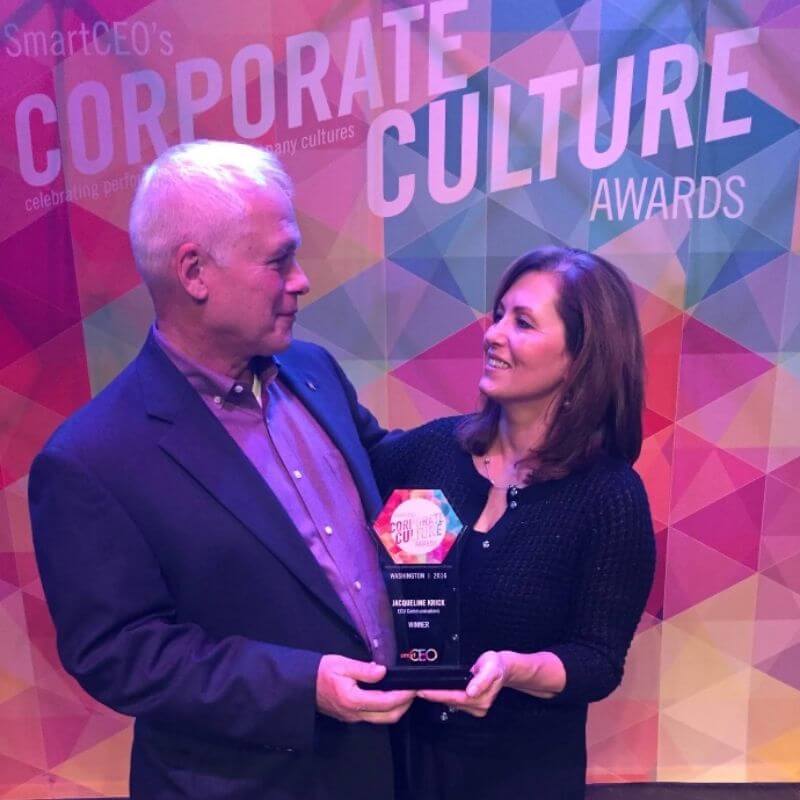
The agency’s public recognition includes AVA Gold awards in 2024 and MarCom Platinum awards in 2023 and 2020. Its award categories span digital advertising, informational video, recruitment and media strategy. Those are team outputs, a useful detail in a story that began with one person trying to do everything.
The old problem has a different shape once there are colleagues with their own specialties. A company can pursue an assignment without requiring its founder to become every department involved. For Krick, the second attempt allowed a wider distribution of the work.
The old bank gets a new line of work
In Historic Downtown Manassas, Krick helped create a place where other small businesses could find room. CenterFuse opened in 2017, jointly owned by Jackie and Ken Krick and Bennett and Gayle Whitlock, in partnership with the city.
The building had previously housed a department store and a bank. Its next occupants needed conference rooms, office space and somewhere to open a laptop. Manassas contributed $200,000 toward the venture’s build-out. An old place for handling money had become a place for people figuring out how to earn it.
There was more to the proposition than furniture. By its second anniversary in 2019, CenterFuse had graduated its first eight-week Launch a Business class and arranged small-business counseling with George Mason University. Networking groups brought entrepreneurs into the same rooms.
By 2020, the programming also included mentoring and Lunch and Learn events. Those details matter because a fledgling business can have questions before it has colleagues. A shared workplace offers opportunities for conversation as well as a place to leave the house. For someone whose first venture ran into the difficulty of working alone, that is a particularly legible investment.
Opportunity, with somewhere to practice
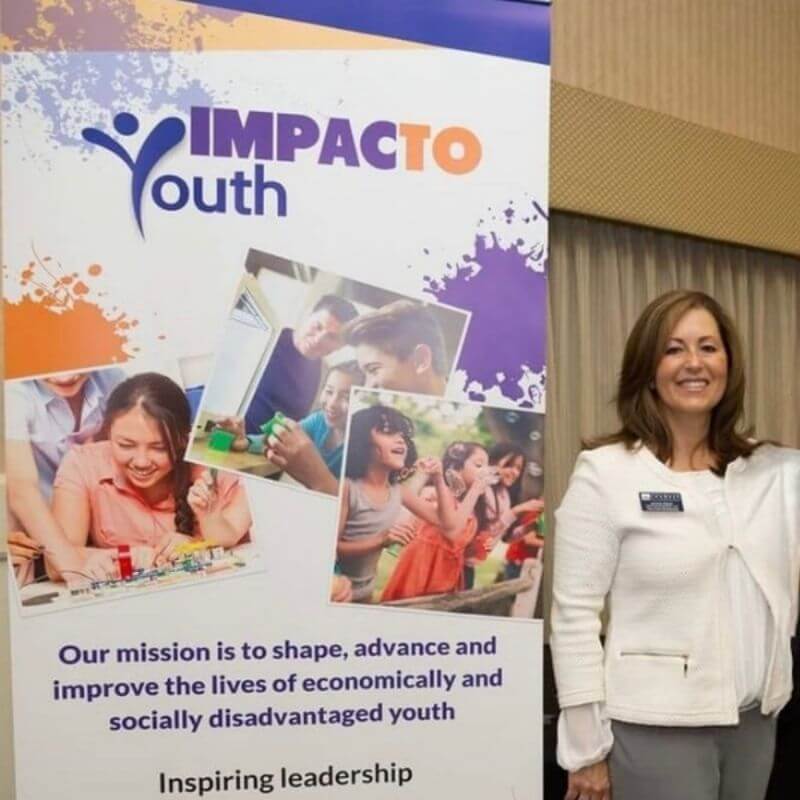
Krick founded IMPACTO Youth in 2013. The nonprofit’s educational mission gave another form to her interest in helping people begin. The intended beneficiaries were young people whose circumstances could limit their access to useful experiences and connections.
Its work has been tangible. By 2018, it had funded robotics floors for five Title I schools and a traveling robotics floor. It had sponsored students for leadership opportunities and supported a nine-week business academy at CenterFuse. The setting put young people inside a place used by working entrepreneurs.
A robotics floor is a modest object beside a grand statement about opportunity. It is also something students can actually use. Equipment makes practice possible; an academy gives a large question about the future a schedule and a room. That is how an abstract ambition acquires ordinary, useful parts.
In 2022, Krick reflected on reaching students earlier, including middle school, with career guidance. She also acknowledged that business ownership and a four-year degree would not be the right destinations for everyone. Helping a young person see options leaves room for that person to choose among them.
A Labrador makes the org chart
ECU describes a workplace built around different backgrounds, cultures, languages and viewpoints. Its account of company life emphasizes mutual respect, open doors and space for life beyond the office. Then it introduces a management appointment unlikely to require much explanation: the Director of Morale is a Labrador Retriever.
The dog earns its place in this story because the detail makes the workplace easier to picture. Government marketing comes with formal expectations. An office can take those seriously and still have room for a small joke about who keeps everybody cheerful.
The people in Krick’s professional circle extend beyond the agency. The Latino Coalition lists her on its board of directors, and the Virginia Serious Game Institute has profiled her on its executive advisory board. Her work touches entrepreneurship, education and the networks through which people meet collaborators.
An AURP agenda for April 2026 also listed her as host of a networking gathering at CenterFuse. The setting is consistent with the interests that recur across her career: local connections, working conversations and places where people with different experience can encounter one another.
That gives her business history a useful human scale. The organizations have names, dates and different purposes. Inside each are people trying to work out what to do next. A founder can spend a career answering that question for herself and still find reasons to help somebody else ask it.
The next person through the door
Krick’s public writing has also returned to an unglamorous subject: customer service. Among her LinkedIn article titles is “Good, Old-Fashioned Customer Service,” published in 2015. It is an apt interest for someone whose working life concerns communication. The experience of being understood can be as memorable as the message a company hoped to send.
Her career invites a similar attention to the ordinary mechanics. A colleague who can take responsibility. A room for a meeting. Equipment for a school. A person who can answer a question about running a business. These are small units of help, but they can change what becomes possible next.
The early graphic-design company closed. ECU followed. IMPACTO Youth and CenterFuse added other ways of putting people, work and opportunity together. The sequence leaves room for an ending to become part of a useful education.
There is something fitting about a founder learning to share the work, then helping create places where others can find company. At the start, Krick was responsible for bringing in the assignment and completing it. The later organizations make room for another person to pull up a chair.