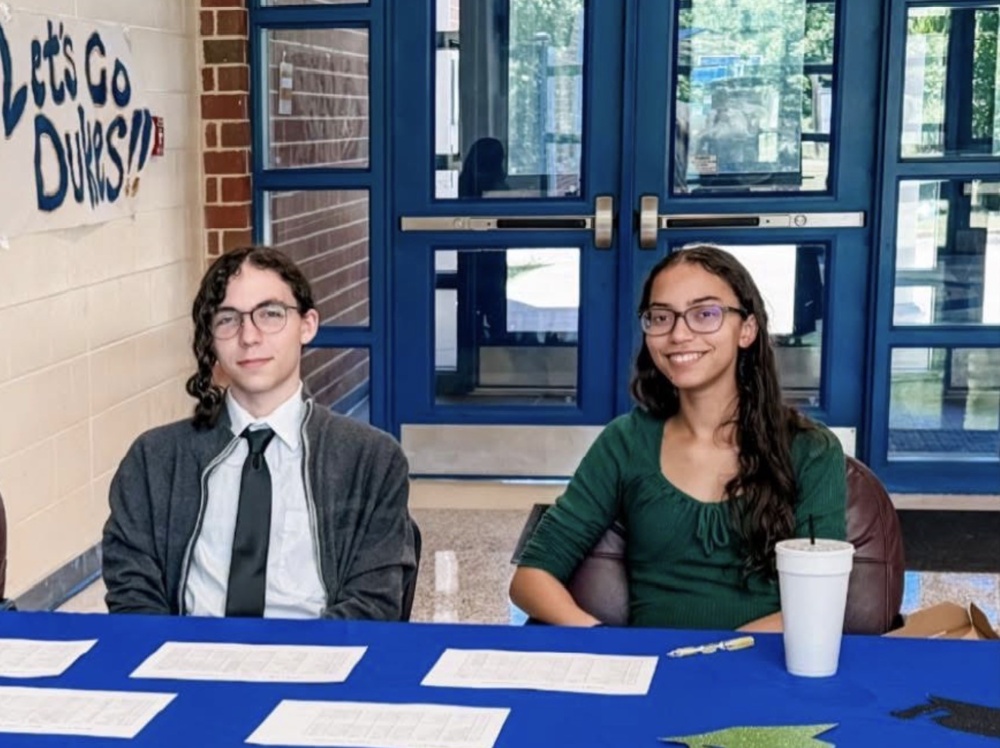
Before the new school year could begin, somebody had to get the laptops ready. In Cumberland County, Virginia, two of those people were still in high school. Joseph Haigh and Peyton Turner spent part of summer 2026 helping the district’s technology department. Each recorded more than 75 hours of community service. Their assignment had a particularly satisfying feature: the people who would benefit included their fellow students.
- Three public schools serving a rural Virginia county.
- College study and career preparation alongside the school curriculum.
- Local partners contribute money, materials and opportunities.
This is a useful place to begin understanding Cumberland County Public Schools VA. A school can explain a career. It can also give a young person a reason to try doing part of one. The second approach introduces something a worksheet cannot supply quite so easily: another person depending on the result.
Small is a starting point
Cumberland operates an elementary school, a middle school and a high school. Federal education data records 1,278 students in 2024-2025 and classifies the division as rural and remote. Those details describe the scale of its assignment. They do not describe the limits of a child’s interests.
The district provides public education from prekindergarten through twelfth grade. Its users are children and families; its responsibilities also include the support that lets instruction happen. For a parent considering the district, the practical question is whether that relatively small system can supply enough different ways to learn, participate and prepare for adult life.
Its answer includes college dual enrollment with Southside Virginia Community College. Cumberland reported 25 associate-degree earners in the Class of 2024. That is a tangible credential attached to a local school experience. A partnership gives a small district access to teaching and qualifications that would be difficult to reproduce entirely within its own walls.
The machinery behind a school day
Haigh and Turner’s internship involved preparing devices for incoming freshmen, repairing middle-school Chromebooks and organizing new equipment. They worked with Hayes Turner. Consider the modest but useful reversal involved: students who ordinarily receive a school service were helping deliver it. The district itself became a setting for practical learning.
“Thanks to their work, along with Mr. Turner, our devices are prepared and ready for student use.”Jeff Dingeldein, Director of Technology and Operations
That kind of assignment has an obvious attraction for other schools. Start with a supervised task that already needs doing. Make the work specific enough that a student can see completion. Give the student a beneficiary beyond the person grading it. The interpretation here is straightforward: responsibility becomes easier to understand when somebody will actually use what you have prepared.
Adults remain essential to the arrangement. In May 2026, Cumberland recognized three staff members for regional technology awards: Kathryn Burton Jefferson, Charles Motter and Hayes Turner. The honors covered classroom integration, instructional support and technical support. A working device, useful teaching and someone who can help when things go wrong are separate contributions. The district’s recognition made all three visible.
A check with a destination
Community support can sound pleasantly vague. Cumberland’s recent examples have addresses and purposes. In March 2026, Gemini, the architectural-signage manufacturer with a Farmville presence, awarded $10,000 to support technology instruction at Cumberland Middle School. The company’s interest in STEM found a local classroom destination.
Other contributions arrive in boxes. Sharon Baptist Church delivered bookbags, pencils, markers and other supplies in August 2026, continuing an annual practice. A donation of notebook paper is easy to overlook in a discussion of educational opportunity. For the family buying it, the expense is perfectly concrete.
There is also an alumni connection. The district recognized NAPA Auto Parts - Cumberland Farm and Auto for its school support in May 2026. Its three owners, brothers Paul, Kevin and Mark Ingle, all graduated from Cumberland. The relationship offers a particularly local version of a familiar idea: people who passed through an institution can later help sustain it.
Give ambition somewhere to go
Career preparation also needs occasions when students can test themselves beyond the classroom. In March 2026, 37 Cumberland High students entered the regional Future Business Leaders of America competition at Longwood University. Twenty-two qualified for the state conference, across 21 events. The district’s published results include cybersecurity, mobile application development, public speaking and event planning.
These are examples of access and participation. They do not establish that one program caused a districtwide academic improvement. What they show is more immediate: students had a venue, categories to enter and a next stage to pursue. For a rural school, making the connection to that outside venue is part of the educational work.
Opportunity has running costs
Cumberland’s financial model is public education: local, state and federal funding, supplemented by particular grants and donations. Its annual report lists actual per-pupil expenditure of $19,327.42 for 2023-2024. That historical spending figure describes the cost of provision. It is not a tuition bill or a price for the internship.
Expansion still has conditions. A 2026 county meeting packet describes regional discussions about a possible masonry program and potential forestry, auto-mechanics and teacher-academy pathways, dependent on funding. The distinction matters. An idea under discussion has not yet become a course a family can choose. Partners need resources, qualified adults and enough continuity to turn interest into instruction.
Families can already use the district’s free app for events, menus, notifications and staff contacts. They can explore employment through its jobs portal and college options through the schools. Cumberland’s most transferable idea is equally practical: look at the useful work and willing people close by. Then build a real assignment, a college route or a classroom contribution around that connection.