A festival poster has limited space. Kenneth S. Johnson has spent years deciding who gets some of it. The familiar name sells a ticket; the unfamiliar one gives somebody a reason to come back. In Richmond, where Johnson founded the marketing and communications firm JMI in the early 1990s, arranging that encounter has become a substantial part of his working life. He deals in campaigns and clients, certainly. He also deals in the possibility that people might enjoy, understand or help somebody they have yet to meet.
His Richmond Jazz and Music Festival offers a particularly agreeable way to test the idea. There is music, there is a crowd, and there is the small gamble of putting an artist before listeners who came for someone else. Johnson's business extends well beyond the festival. Yet a running order is a useful place to begin understanding him: somebody must choose the company everyone else will keep.
JMI’s client work supplies the commercial foundation. The firm has worked with organizations including Verizon, Dominion, Virginia Tourism Corporation and AECOM, across research, public relations and brand communications. Those assignments require attention to institutions as well as audiences. Johnson’s cultural projects add another dimension: he can help create the occasion at which people gather. The founder occupies both sides of that relationship, advising organizations on reaching people while also taking responsibility for events people choose to attend in their own time.
A city worth staying in
The first Richmond Jazz Festival was announced for August 14 and 15, 2010, at Maymont. Its advertised performers included Chaka Khan, Stanley Clarke, Lalah Hathaway and Terence Blanchard. Local musicians were part of the bill alongside visiting names. That opening combination established an event with several points of entry, rather than requiring every ticket buyer to arrive with the same record collection.
Maymont gave the project an outdoor setting in Richmond itself. A city can have plenty of talented residents and still send its audiences elsewhere for a weekend. Building a festival at home changes that transaction. The trip becomes shorter; the occasion becomes part of the city's own calendar. Johnson's subsequent work in television and live events would keep returning to the question of what Richmond could put before its own residents.
The headliner and the happy discovery
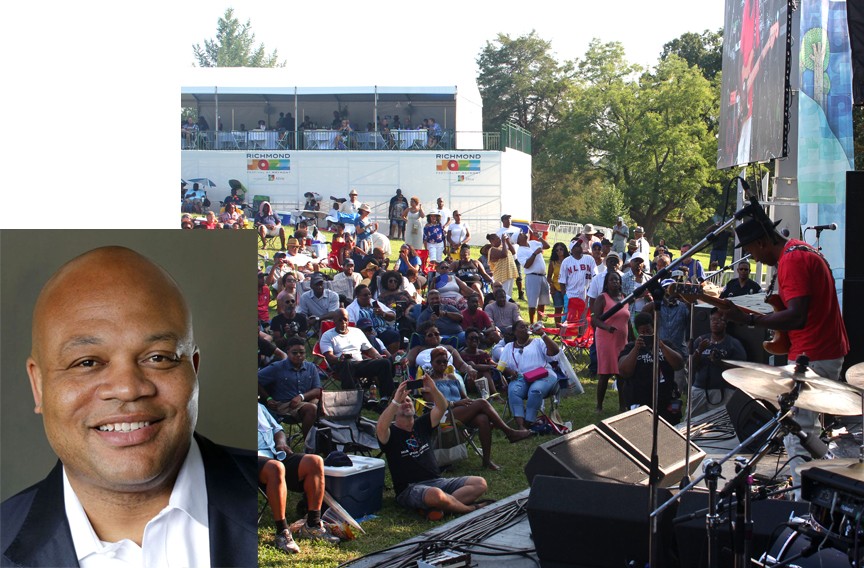
By 2019, the festival had added “and Music” to its name. Jill Scott, Maze featuring Frankie Beverly and Big Boi were among the announced headliners. Further down the bill were Anderson East and Cautious Clay, whose Tiny Desk appearances had helped bring them to the organizers' attention. Johnson oversaw the booking. The widened name made room for the musical variety the programming already embraced.
There is a particular pleasure in a lineup that allows recognition and curiosity to sit beside one another. Someone can arrive with a favorite song in mind and leave with a new artist to investigate. In 2025, Johnson was still leading a small team that searched for performers throughout the year. JMI's Frances Burruss described a continuing effort to balance returning favorites with discoveries, including Hot Like Mars and Masego. The weekend on the calendar rests on listening that happens long before it.
A television guide to the neighbors
Johnson also created RVA Grooves: All Things Arts and Culture, a television project hosted by Kelli Lemon. Announced in 2013, it brought musical artists, visual artists and local businesses into the same program. Its remit extended through food, fashion, dance and theater. Live gatherings at the Hippodrome Theatre in Jackson Ward accompanied the screen work.
The format made an interesting editorial choice. A local business belonged beside an artist, rather than in a separate commercial universe. A viewer could encounter several parts of the same city without being asked to pick one cultural lane. For a communications executive, the show was a way to give Richmond's creative work an introduction. For its subjects, it offered something less abstract than a city's reputation for creativity: time on screen, a host, an audience and a name people might remember.
Someone else's idea needs a place to grow
James Warren's account of building Share More Stories gives another view of Johnson's role. Warren had launched a storytelling venture, tried crowdfunding without success and reached a difficult point in developing the business. An adviser, Greg Cummings, urged him to meet Johnson. A partnership with JMI followed, giving the company room to change direction and develop.
Warren describes JMI as a place where both the venture and his own understanding of business could grow. Members of JMI's team joined the effort. Storytelling workshops and analytical tools developed into SEEQ, the platform associated with Share More Stories. Johnson appears in this account through the consequences of a meeting: another founder acquired a working relationship and somewhere to keep going. It is a quieter kind of production than booking a festival, though it also involves seeing what another person might bring to the room.
Back to Williamsburg, with questions
That partnership later became part of work in Williamsburg, Johnson's hometown. JMI and Share More Stories helped develop the narrative for the city's African American Heritage Trail, working with residents, an advisory committee and city officials. Johnson described the commitment as honoring the community's voice. The assignment brought his firm's communications work into the public account of a place with an unusually visible historical identity.
The distinction mattered to residents who had not recognized their own lives in that account. At the project's 2024 kickoff, advisory committee member Johnette Weaver described learning about her local heritage as an adult after missing it in school history. JMI executive James Warren explained that the team would gather people's experiences, find shared themes and connect the resulting narrative to places along the route. Residents supplied the lived knowledge. The agency's task was to help organize it without losing the people inside it.
Williamsburg City Council approved the trail narrative on December 12, 2024. The planned two-mile route includes interpretation at significant locations, with digital elements alongside the physical experience. The city later announced a June 19, 2026, groundbreaking. For Johnson, a business built in Richmond had become part of telling the history of his hometown. For a visitor, the intended result is practical: a walk through the city with more of its people present in the story.
The meeting before the message
Johnson studied public administration at Virginia State University. His work has repeatedly brought him into the affairs of Virginia beyond his own company: consulting on diversity and inclusion for governors Tim Kaine and Bob McDonnell, serving on gubernatorial transition teams and working with the state's information technology board. JMI has supported more than half a billion dollars in minority business engagement across Virginia.
Johnson brings a question to internal and external meetings: “How are we defining success?” The wording is plain enough to survive a room full of specialists. Its value lies in asking people to name an outcome before they become attached to a proposed activity. In his career, that activity might be a campaign, a public conversation or an event. The question gives each assignment a place to start, while leaving the answer open to the people who have to make it work.
“How are we defining success?”
Kenneth S. Johnson
Big Dipper brings the conversation indoors
In January 2023, Johnson worked with his alma mater on the Big Dipper Summit. The event accompanied the Freedom Classic basketball game between Virginia State and Virginia Union. University president Makola Abdullah described Johnson's involvement as helping create an environment for discussing community issues. Sport supplied an existing occasion for gathering; the summit added a reason to spend time talking while people were there.
By April 2025, the Big Dipper Innovation Summit's announced program stretched across three days and multiple downtown Richmond venues. Its subjects moved between business, sport, investment and culture. Tony Bennett and Scott Van Pelt were among the advertised speakers; evening programming included local musicians. Johnson was identified as the summit's founder. An event with a business agenda still made space for the kinds of cultural encounters familiar from his other projects.
The 2026 gathering took place at Main Street Station. Its speakers included Governor Abigail Spanberger, Issa Rae, ESPN analyst Dan Orlovsky and Kickstarter chief executive Everette Taylor. University leaders and HBCU presidents also participated. The range says something about the company Johnson wants people to keep. These are professions that can occupy separate conferences, separate calendars and separate conversations. Bringing them into one event gives attendees a chance to hear how somebody outside their own working world approaches a problem.
- 2023Virginia State collaboration alongside Freedom Classic
- 2025Three days across downtown Richmond venues
- 2026Business, education and culture at Main Street Station
A longer guest list for Virginia
In August 2026, Johnson was appointed to the Virginia Economic Development Partnership Authority. The announcement identified him as JMI's chief executive in Richmond. His continuing involvement in the state's economic life adds another setting to a career already spent moving between commercial work and public gatherings. An agency founder's calendar can become rather crowded when the client meeting, the civic meeting and the concert all count as work.
The different projects make sense together without requiring them to do the same job. A festival offers discovery. A television show gives local talent an introduction. A history trail helps residents tell a fuller account of where they live. A summit puts unfamiliar perspectives within conversational distance. Johnson has kept finding occasions for those encounters, and building organizations or events around them. The invitation is only the beginning. Someone still has to make the gathering worth people's time.