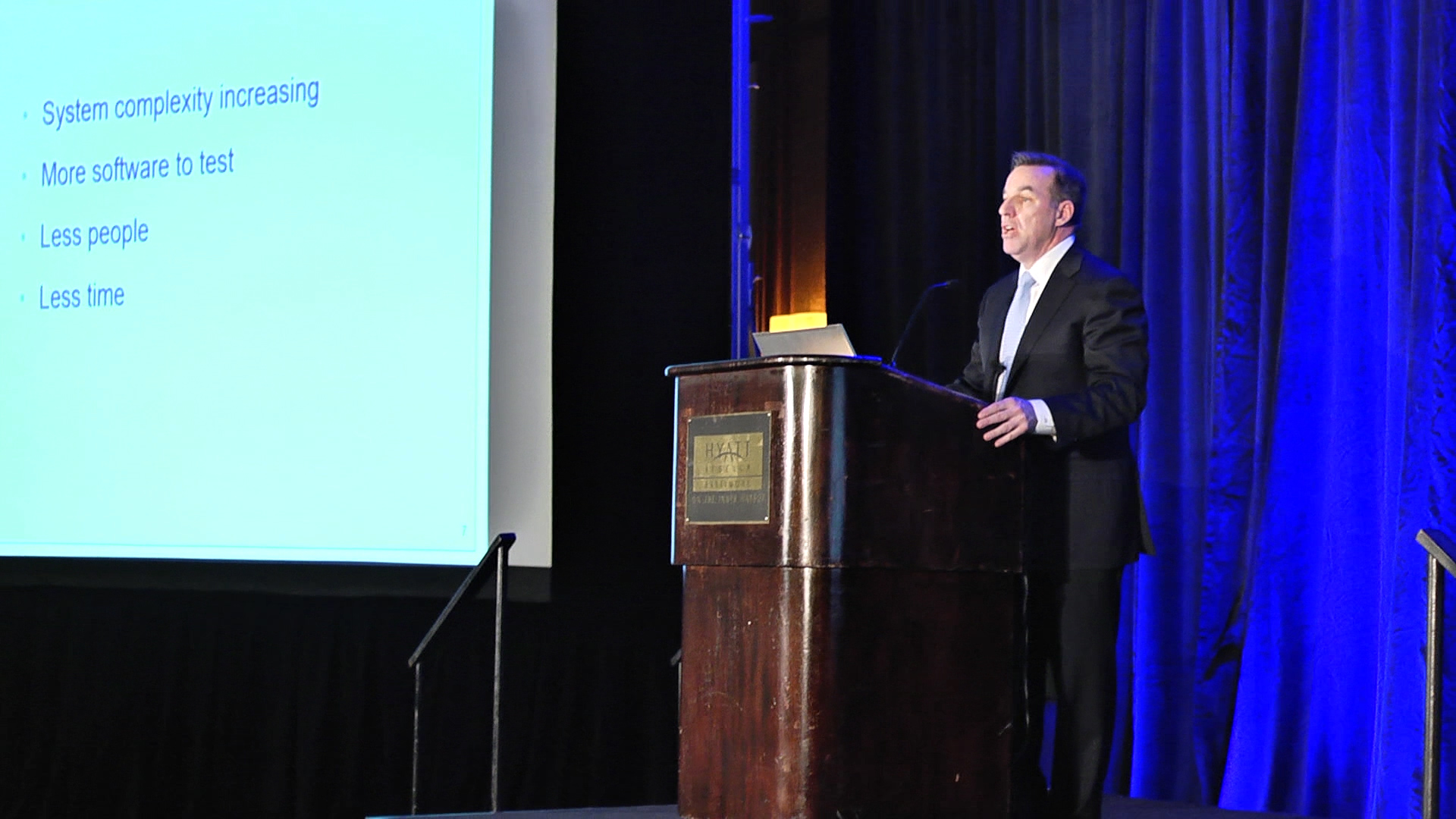
In April 2014, Bernie Gauf stood at a lectern in Baltimore beside a slide with an unpromising inventory. System complexity was increasing. There was more software to test. There were fewer people and less time. Four bullet points, and scarcely a cheerful one among them. For Gauf, though, this was familiar territory: the place where a difficult delivery schedule becomes a reason to build something.
He was addressing the Quality Engineered Software & Testing Conference, known as QUEST. His subject was testing under reduced budgets. Software development had acquired new languages, tools and working environments; much testing still depended on people following written procedures. The contrast gave his audience a problem to recognize before he offered an answer.
Gauf had helped found Innovative Defense Technologies in 2006. By the time of that talk, automated testing was already the basis of its business. His proposition was straightforward enough to sound almost impolite: improving the speed of writing software would accomplish only so much if proving it ready continued to take so long.
A second company, a familiar problem
His route into that argument ran through an earlier defense business. Gauf had served as president of Digital System Resources, a systems integration and software company acquired by General Dynamics in 2003. That background mattered at IDT. He and his founding colleagues arrived with experience of Navy systems, their operating constraints and the Small Business Innovation Research program.
This was an opportunity that required knowing the customer’s machinery as well as its ambitions. A new capability had to function inside a collection of existing systems. Software could be improved in one place and upset a relationship somewhere else. The work of checking those relationships would recur with the next update, and the one after that.
IDT’s early technology grew from Navy SBIR work. Automated Test and ReTest, or ATRT, applied automation to the verification process. The name is pleasingly candid about the job. Testing has a sequel, and the sequel is rarely optional. Changes demand another examination of what previously worked.
The early business also had to make the journey from research into actual programs. By 2010, its record included a $15.4 million NAVSEA contract awarded in 2007 and a $45 million Naval Underwater Warfare Center contract awarded in 2009. Those were contract values, rather than a tally of money already earned. Their significance was the route they opened into surface and submarine systems.
A book with a warning label
In March 2009, Gauf, Elfriede Dustin and Thom Garrett published Implementing Automated Software Testing: How to Save Time and Lower Costs While Raising Quality. Its title carried the business case on the cover. Inside, the authors made room for the less photogenic obligations that determine whether such a promise survives contact with a project.
The book’s contents move through requirements, strategy, measurement, processes and staffing. A chapter examines why automated testing fails. Another asks whether the testing framework itself meets its requirements. Even the mechanism for checking the software needs checking. The bureaucracy of doubt can be tiresome, but it has its uses.
That structure makes the book a useful companion to Gauf’s executive biography. It gives substance to the word implementation. Someone must define what success means, choose suitable tools and maintain the resulting system. Automation brings its own engineering work; the table of contents never lets the reader forget the bill.
His collaborators also locate him within a working technical community. Dustin brought extensive experience writing about and implementing software testing. Garrett’s background included testing and deployment of complex systems. Their joint authorship put the company’s argument into a form other practitioners could inspect, challenge and apply to their own circumstances.
The slide with less of everything
Five years later, at QUEST, Gauf addressed more than 350 attendees. Budget pressure gave the subject urgency. He described resistance to automation that included concerns about system complexity, unusual requirements and the effect on people’s jobs. A proposal to change how work gets done will eventually encounter the people doing it.
“The future of testing really is automation.”
Bernie Gauf · QUEST keynote, 2014
His recommended starting point was a test strategy. That choice put planning ahead of enthusiasm for a particular tool. In his account, teams needed to consider where automation would fit and what they expected it to achieve. A difficult system was a reason to think carefully about the approach.
That insistence also appears in his discussion of customer work. Before recommending an automated approach, IDT assessed a program’s objectives, priorities and existing testing arrangements. The process acknowledged that customers could arrive at quite different stages. A team trying to reduce labor on a recurring test might need a different first step from one reorganizing its testing program.
Gauf continued taking the argument to technical audiences. In 2017, he was announced as a speaker at AFCEA’s Technology Day at Tinker Air Force Base, with a presentation on automated test and analysis. The advertised subjects included software quality, testing efficiency and faster delivery. The audience had changed; the delivery problem remained recognizable.
Tests that leave a trail
To understand the attraction of ATRT, consider what a useful test must leave behind. The result needs a relationship to the requirement being checked. A failure needs enough detail to be reproduced. Another team should be able to understand what happened. Speed helps, but an unexplained result still leaves someone with a puzzle.
By 2013, ATRT connected requirements, test cases and individual test steps, then reported outcomes. It had applications across more than 25 projects, including AEGIS, the Littoral Combat Ship and the Virginia-class submarine program. These were different settings for the same recurring obligation: assemble evidence that a complicated system behaves as intended.
- 01 / DefineDescribe the required behavior.
- 02 / ExerciseRun the test against the system.
- 03 / ExamineCompare results with requirements.
- 04 / RepeatReproduce, adjust and test again.
Conceptual illustration of the workflow, rather than a product interface.
Gauf’s connection to the technology extended to a patent. He was named with Scott Bindas, Shawn Kline, Matthew Oehler and Dave Ponticello on a test-and-retest invention granted in September 2014. The described system included building test cases, generating test flows, executing them and collecting output. The list of inventors is a reminder of how much collaborative work can sit behind a chief executive’s public role.
In 2015, he and Burt LeJune wrote about mission-based testing for submarine combat systems. Their subject widened the frame from individual components to interacting systems and the conditions crews might encounter at sea. A component could satisfy its own requirements while the larger arrangement still presented questions. Integration supplies a software project with plenty of opportunities for surprise.
By 2020, ATRT had been used across more than 125 projects. In 2019, an AEGIS virtual-twin demonstration was linked to a live-fire event aboard an Arleigh Burke-class destroyer. Testing work had expanded into virtual representations and continuous integration, while preserving the earlier aim of making updates easier to assess and deliver.
The people inside the process
Gauf’s public business advice has tended toward practical obligations. In a 2013 interview, he emphasized understanding customers’ strategic objectives and delivering quality work on time and within budget. He also endorsed surrounding oneself with capable people. There is little theatrical glamour in those prescriptions. A customer waiting for working software may find that rather appealing.
The same year, IDT won SECAF’s Government Contractor of the Year award in the $12 million to $25 million revenue category. The category belongs in the telling: it was recognition among businesses of a particular scale. It marked a stage in the company’s development, seven years after its founding.
His own appearance on iHeart’s CEOs You Should Know in November 2024 supplied another dated marker. Introduced as chairman and CEO, he was still leading the company he had helped start. By then, his defense technology experience extended across more than three decades.
Across these milestones, the interesting continuity is the choice of problem. Testing asks a team to revisit its own work and look for reasons to withhold approval. That can be an awkward service to sell to people eager to deliver. Gauf’s approach makes the case through the delivery process itself: make the checking more repeatable, preserve what the team learns and reduce the effort of doing it again. The next change will bring another round of questions. A business devoted to testing has to plan for that recurrence.
Another start line
In May 2026, IDT announced a larger next step in Arlington: a planned $19 million expansion expected to create 210 jobs. Gauf linked the investment to technical talent and proximity to customers. These were future commitments, with the work of hiring and expansion still ahead of them.
$19Mplanned investment
210expected new jobs
Announced expansion commitments, not completed investment or confirmed hires.
The announcement gives his story a substantial new chapter without changing its central question. A larger team still has to help a customer move from a proposed improvement to a capability ready for operational use. The testing schedule, the integration work and the evidence remain part of that journey.
There is a smaller, more personal image to set beside the expansion figures. In 2013, Gauf said he had recently run a half-marathon with one of his daughters. “I am an avid recreational athlete,” he explained. Once an event was finished, he would look for the next challenge.
It would be easy to ask that anecdote to explain his entire career. It is better allowed to remain a shared run and a glimpse of someone outside the office. Still, it provides a fitting final picture: an event completed, another ahead, and Gauf already considering what comes next.