Stephen O’Keefe helped start a technology company with a rule short enough to remember during a bad meeting: “No Jerks.” It has the welcome economy of an instruction that could fit in the margin of an employee handbook. Virtual Service Operations would go on to develop seven first principles, but its account of the beginning preserves those two words. Before the elaborate language of organizational culture, there was a fairly direct request about how people ought to behave.
There is another, more demanding idea in O’Keefe’s working life: people need preparation before an employer needs their output. At VSO, the company he co-founded with John Birch in 2017, that idea takes the form of recruiting and developing military veterans for technology careers. Cloud services are the business. Building a workforce able to deliver them is part of the business, too.
O’Keefe’s career offers several ways into that argument. There is an earlier company acquired by IBM, a shared patent concerned with the complexity of computer systems, and a return to his college as chairman of its board. There is also an oyster farm in the Chesapeake Bay. Executive biographies rarely improve when they become longer. This one improves considerably when the oysters arrive.
Two interests, one company
VSO began where two professional interests met. Birch wanted to create a company that invested in military men and women. O’Keefe wanted to move further into cloud computing. Together, they made a business in which the technical offering and the employment approach developed alongside each other.
The company works in hybrid and multi-cloud managed services, helping organizations operate across their technology environments. Its founding ambition was international, while its workforce was based in the United States. That combination puts a practical obligation behind the founding story: people have to acquire the skills to do the work customers are buying.
For O’Keefe, this was another chapter in entrepreneurship. He had co-founded NovusCG, the storage consulting and technology company acquired by IBM in 2007. His background also includes working as an IBM executive and serving as a partner at Strategic Business Systems. By the time VSO began, he had experience on both sides of a familiar boundary: building a business and working inside a much larger one.
The complication behind the computer
Years before VSO, O’Keefe and Birch had already appeared together on a technical project. Both are named among the inventors of a patent for determining a management complexity factor in a service environment. The application was filed in 2007; the patent was granted on July 12, 2011.
The title sounds like something that might require its own administrator. The underlying question is easier to recognize. How do you identify the needless complication that makes an information system expensive and difficult to run? The proposed method evaluates several aspects of an environment, weights their importance, and compares its current condition with a potential improved condition.
It considers matters such as automation, available information, process maturity, and the alignment of skills. Read together, those measures make the human arrangements around the equipment part of the technical problem. A system has people, habits, and coordination inside its operating costs. The machinery alone cannot explain everything that happens.
That is a useful piece of background for a founder whose later company would put training and service delivery in the same conversation. The patent documents one earlier attempt to make a complicated environment more understandable, and to identify where improvement might be possible.
A résumé with room to grow
O’Keefe has publicly argued that veteran hiring requires planning beyond the immediate vacancy. In a LinkedIn post, he described the limits of recruiting only for today’s needs and the highest existing experience levels. He called for development with clear direction and outcomes, supported by leaders and a deliberate talent plan.
His complaint also reaches the customer relationship. He has described the difficulty of persuading contract owners and federal prime contractors to let VSO invest in developing people. That makes the question larger than whether an employer likes the idea of hiring veterans. Someone also has to permit the preparation, make space for it, and accept that readiness can be developed over time.
The point has an unglamorous administrative consequence. A company needs a way to connect promising candidates with work they can learn to do. It needs people responsible for that learning. In O’Keefe’s account, the hiring decision belongs inside a longer sequence of decisions about capability.
By 2021, VSO’s veteran employment practices included assigning each veteran a mentor for guidance on an IT career path. The company worked with private and government veteran organizations to find candidates at different skill levels. DAV selected it as Small Employer of the Year, an award for which businesses with fewer than 250 employees competed.
Accepting the recognition, O’Keefe put his explanation into a short sentence: “VSO is successful because it hires veterans.” He repeated it. The emphasis matters. He was identifying the workforce as a reason for the company’s performance, while accepting an award for its approach to that workforce.
“VSO is successful because it hires veterans.”
Stephen O’Keefe, 2021
The details behind an award can be more revealing than the ceremony. Mentorship creates someone to ask about the next step. Career guidance makes that next step a subject the company is expected to discuss. Neither comes automatically with an offer letter. Both were part of the employment practices recognized at VSO.
The veteran employment work also brought O’Keefe into conversation with Kyndryl. On November 9, 2021, he and VSO account lead Ethan Watts joined Jim Batterton, Kyndryl’s general manager for US public and federal business, at its New York headquarters. Their Veterans Day discussion included O’Keefe talking about VSO’s veteran mission and Watts describing his own experience as a Navy veteran entering the IT workforce. The conversation brought a company leader and an employee’s career story into the same interview. It gave the employment argument another setting beyond the award ceremony and the recruitment process.
April to August
One employee’s experience gives the approach a human scale. Trenton Keen had served in the Army National Guard for eleven years and spent four years looking for a civilian career path. He had an interest in technology, but no formal training in it.
In April 2021, Keen applied through VSO for an Amazon Web Services apprenticeship. By August, he had gained multiple certifications and started full-time work as a system administrator serving the company’s public-sector clients. The sequence is specific: an application, training, certifications, then a new role.
VSO’s support at the time included in-house mentoring, quarterly reviews modeled on military practice, career planning, and leadership training. There was also a company chat room for veterans. That small detail deserves its place alongside the formal programs. A new career has a daily texture as well as an official starting date.
Keen’s experience illustrates the kind of development O’Keefe has advocated. It also keeps the discussion attached to an actual person and an actual job. An apprenticeship becomes easier to understand when the next line in the story says system administrator.
Another kind of stewardship
O’Keefe’s connection to education also has an institutional form. A 1993 graduate of Christendom College, he serves as chairman of its Board of Directors. In 2023, he was among the board members on the committee searching for a successor to longtime president Timothy O’Donnell. The committee’s job was to recommend candidates to the board, which would elect the next president.
On August 25, 2024, O’Keefe delivered the formal charge at George Harne’s installation as the college’s fourth president. Standing before the college community, he recalled founder Warren Carroll’s beginning with twenty-six students and the subsequent expansion under O’Donnell. He placed Harne’s appointment inside that longer history.
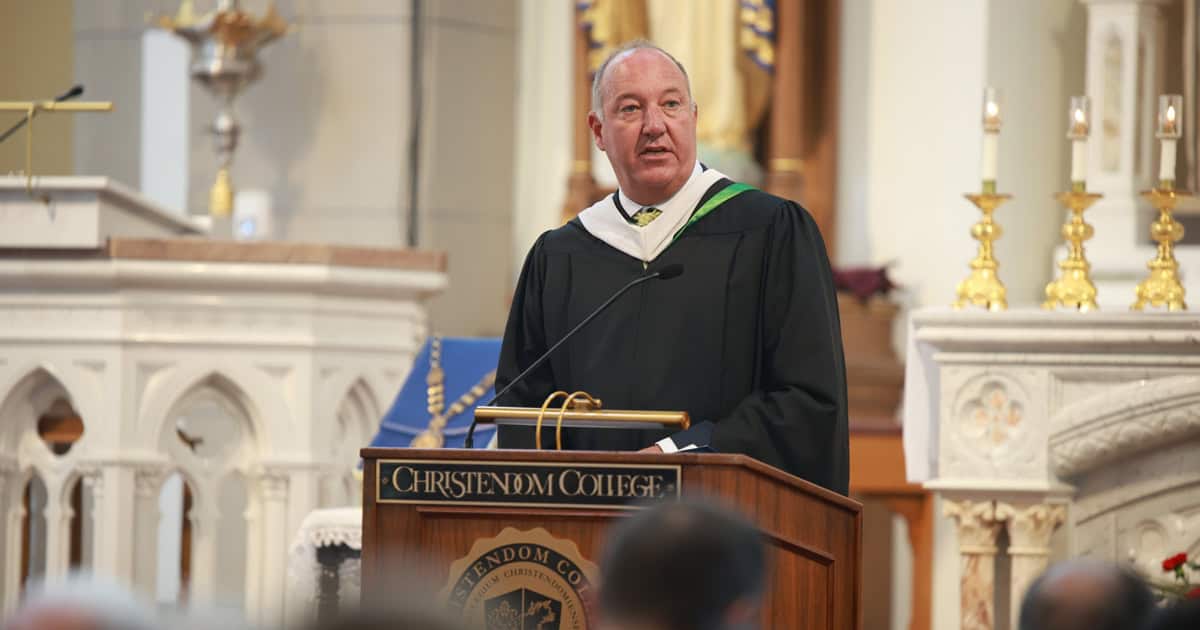
The setting gives his biography a different scale. A company founder can begin with a new organization. A college board chair inherits an institution with predecessors, commitments, and a community already in place. At the installation, O’Keefe’s role was to articulate that inheritance as a new president took responsibility for it.
His public biography extends that involvement to a seat on the board of Seton School in Manassas. It also identifies a master’s degree from George Mason University. Education appears in his story as study, governance, and the practical development of people at work.
Room for the oysters
Beyond those roles, O’Keefe and his wife, Paula, have seven children. He has coached his children in sports. A VSO leadership spotlight describes time spent traveling with his family, playing sports, and tending his oyster farm in Virginia’s Chesapeake Bay.
It is a pleasingly concrete set of interests. The oyster farm needs no managerial metaphor to earn its place here. It supplies an activity, a location, and a glimpse of a life away from cloud services. Seven children and years of coaching supply another.
The public work continues. In February 2026, VSO announced its Gold Medallion recognition at the Department of Labor’s 2025 HIRE Vets awards ceremony, held that January. An April 2026 Artifex Pitch Night in Front Royal listed O’Keefe among its investor judges, bringing his company-building background into a room for other founders.
Across those settings, his argument about employment remains practical. A company that wants people ready for difficult work has decisions to make before the vacancy appears. It can recruit, teach, assign mentors, and discuss where a career goes next. At VSO, O’Keefe has put those decisions inside the business he and Birch founded. The work begins early.