Jim Reagan has a trip in mind that will be difficult to put on a corporate calendar. He wants to sail his own boat across the Atlantic. There is something pleasing about a finance executive choosing an ambition with so little respect for a forecast. The ocean does not attend earnings calls. In 2026, though, the crossing on his immediate agenda was professional: from the board of SAIC to the chief executive’s chair.
He had already retired as chief financial officer of Leidos in July 2021. He had joined boards. Then, on October 23, 2025, SAIC appointed him interim CEO, succeeding Toni Townes-Whitley. The word “interim” suggested a temporary assignment. By February 17, 2026, the board had unanimously chosen him for the permanent job. A career spent helping businesses make consequential decisions had brought him to a decision about his own.
He later offered an unusually plain explanation of how the assignment had felt: “I didn’t expect to enjoy the role as much as I have.” Working with the team and serving customers had proved rewarding. Accepting the permanent role had not been his original intention. That small admission gives the appointment a human scale. Even after decades in business, a person can discover that a job suits him by actually doing it.
The accountant before the captain
Reagan’s route began in accounting. He earned a business administration degree in accounting and finance at William & Mary and an MBA at Loyola University Maryland. His early career included PricewaterhouseCoopers. He became a certified public accountant, then accumulated senior finance experience across businesses whose work ranged from telecommunications to software. MCI, Nextel and American Management Systems all appear on that route.
These were different settings for the same stubborn questions: what does a business earn, what does it cost to deliver, and what happens when its plans meet its customers? An accounting qualification supplies a language for those questions. Moving through operating companies gives the language consequences. Reagan’s eventual résumé would contain a succession of CFO appointments, but the organizations themselves were far from interchangeable.
At Deltek, where he became executive vice president and CFO in March 2005, there was a particularly measurable assignment. He led an initial public offering that raised $162 million. He also helped turn the business into an organization compliant with Sarbanes-Oxley requirements. Going public meant both obtaining capital and building the machinery of accountability around it. The money made a headline; the controls had to work after the headline disappeared.
Raised in Deltek’s IPO, which Reagan led as CFO.
In September 2008, Vangent appointed him senior vice president and CFO, with responsibility for finance, contracting, pricing and compliance. The pairing matters. Pricing and contracting sit close to the work a company promises to perform, and to the risks it agrees to carry. At Vangent, finance reached into the terms of the business itself. Later came CFO roles at PAE and Vencore, placing him further inside the government services industry.
What happens after the deal
He joined Leidos as CFO in July 2015. The following year, Leidos agreed to combine with Lockheed Martin’s Information Systems & Global Solutions business in a transaction valued at approximately $5 billion. Reagan would continue as CFO. It was the kind of corporate event that invites enormous numbers and elaborate diagrams, with a decidedly practical question underneath: how do the combined operations become a functioning business?
An April 2016 employee town hall supplied a less glamorous picture of that work. There would be one finance leader in Reagan, while separate finance organizations initially continued to operate beneath him. Combining systems would take longer than combining leadership. A transaction has a closing date. Getting people, processes and software to cooperate has a calendar of its own. Anyone who has tried to reconcile two spreadsheets may appreciate the distinction, if not the scale.
Reagan was also explaining the economics to investors. In an August 2016 presentation, he outlined an increased estimate of $350 million in cost synergies, supported by $235 million of investment. Those were expectations at the time, rather than a retrospective tally of savings. Still, they show the nature of his work: making explicit what a transformation was supposed to deliver, and what the company would have to spend to get there.
Leidos announced his retirement in May 2021, with Christopher Cage succeeding him on July 5. Reagan remained an adviser through the end of that year. The arrangement gave the handover time beyond the change in title. His six years as CFO had put him at the center of a business undergoing substantial change; the final assignment was to help another finance leader take over the work. It also makes the later SAIC appointment more interesting. The end of an executive position had created space for board responsibilities, and those responsibilities eventually led him back into a company’s daily operations. Retirement from one job became part of the route to another.
- 2005Deltek CFO
IPO leadership - 2015Leidos CFO
Six-year tenure - 2023SAIC director
Board oversight - 2026SAIC CEO
Permanent appointment
A temporary job acquires a future
Board work followed. Unanet announced Reagan’s appointment as a director in December 2022, alongside new investment from Onex. The company makes enterprise resource planning and customer relationship management software for project-based businesses, including government contractors. It placed him near a familiar intersection: the people doing complicated contract work and the systems that help them keep track of it.
In January 2023, he joined SAIC’s board. By the time he became interim CEO in October 2025, he had spent more than two years viewing the company from the directors’ side of the table. Donna Morea, SAIC’s board chair, emphasized his industry experience and familiarity with the business. The appointment moved him from reviewing management’s execution to taking responsibility for it.
His first months were occupied by an unromantic problem: connecting innovation more closely to bids the company could win. In December 2025, he described matching research and development spending to customer opportunities in the next 24 months. SAIC had identified $100 million in indirect spending to redirect. Account management and business development would receive a substantial portion. The practical ambition was to make technical capability travel all the way into a successful proposal.
That is a useful place to see the former CFO inside the new CEO. The question was where existing money could do more useful work. He also stressed listening for what customers would need tomorrow. For a contractor, a clever idea must eventually survive a procurement process. A laboratory demonstration and a contract award can be separated by a great deal of paperwork, patience and competition.
“Steady hand at the tiller”
Donna Morea on Reagan’s appointment as permanent CEO, February 2026
Getting closer to the work
Once confirmed as CEO, Reagan put more weight on mission IT and engineering, where technology is tied closely to a customer’s particular operational problem. He described moving away from some less differentiated enterprise IT work. The distinction was about where SAIC could compete effectively. Networks, software and engineering acquire a different commercial character when they must solve a specific problem for someone carrying out a mission.
He also described an internal review in which employees could identify processes that helped or hindered their day. Direct messages from staff brought issues to his attention that he otherwise might have missed. His expression for the exercise was pleasantly free of consultant polish: “get some gunk out of the system.” A company can commission an enterprise transformation and still discover that part of the assignment is removing a nuisance familiar to everyone on the floor.
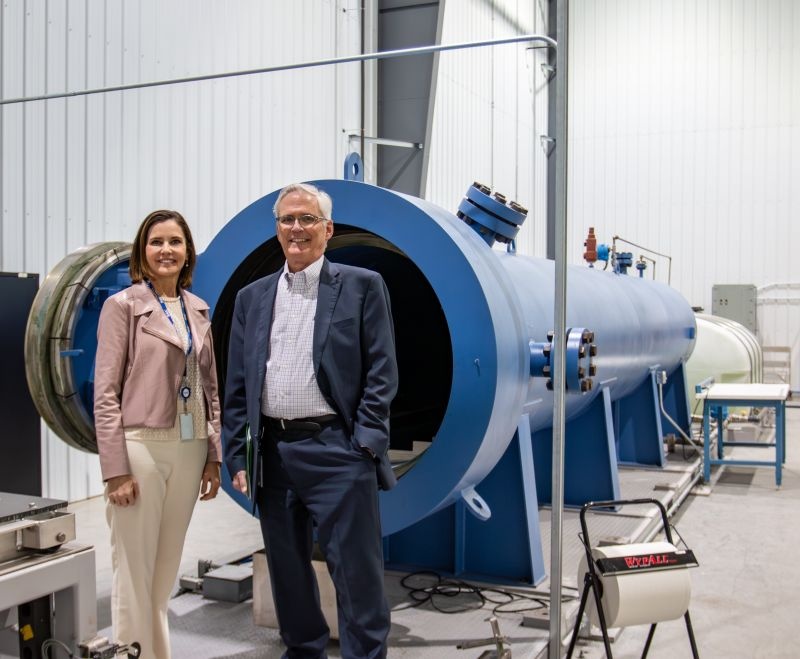
A visit to SAIC teams in Bedford, Indiana, and at Naval Surface Warfare Center Crane gave that operational focus a physical setting. Alongside Barbara Supplee, Reagan highlighted work in manufacturing, production support, sensors and radar, including components for the Navy’s MK48 heavyweight torpedo. He described more than 1,100 SAIC employees in Indiana and a presence extending beyond 25 years. Behind the financial vocabulary were workshops, equipment and people building things.
By August 31, 2026, SAIC was reporting second-quarter fiscal 2027 revenue of $1.88 billion and organic growth of 5.3%. The same release reported a quarterly book-to-bill ratio of 0.6, meaning new bookings were below revenue for the period. Both figures belong in the picture. Better current performance and the need to replenish future work can occupy the same earnings release. Reagan’s assignment continued beyond a promising quarter.
Revenue earned. Orders booked.
A boardroom with a much longer memory
Outside SAIC, his responsibilities include chairing the Jamestown Rediscovery Foundation’s board. The organization supports archaeology, preservation and education at Historic Jamestowne. Its work stretches across centuries, while its operations depend on present-day stewardship: it receives no regular federal or state operating funding. For an executive accustomed to quarterly reporting, it is an institution with a markedly different time horizon.
There is also Wolf Trap. Reagan joined the performing arts foundation’s board in 2019. In 2024, he and his wife, Donna, appeared at its “Dim All the Lights” ball, an event benefiting arts and education programs. The foundation’s account shows the couple arriving for the evening. The résumé that can look like an uninterrupted procession of finance titles has room for a performing arts stage and a Virginia archaeological site.
Then there is that Atlantic ambition, still expressed as something he hopes to do. Reagan has described the appeal of “sailing across the Atlantic Ocean in my own sailboat.” It is a specific wish, with a vessel, a destination and a sizable stretch of uncertainty between them. For now, he has accepted another demanding passage. The director became the temporary operator, discovered he liked the work, and agreed to stay at the helm.