In the beginning there was a data grid. It was 2006, web applications still behaved like web pages, and Jack Slocum was writing extensions for Yahoo's YUI library. Buttons, trees, layouts and tables may sound like the crockery of software, but the browser needed a proper cupboard. His side project, YUI-ext, became Ext JS. By April 2007 it stood on its own, ready to work with YUI, jQuery, Prototype or no outside library at all.
Slocum was not merely decorating pages. He was trying to make the browser hospitable to whole business applications. Before Ext JS 2.0, he argued that developers needed a cohesive framework whose components had been designed to work together. The phrase was technical, but the instinct was larger: take a messy field of choices and give people a system they can reason about.
Nearly two decades later, that instinct sits behind Option Alpha, where Slocum is CEO and co-founder. The raw materials have changed from widgets and event handlers to probabilities, spreads, backtests and brokerage connections. The human wish has not. People would like a complicated machine to behave consistently, preferably before lunch.
The bug was personal
Slocum did not come to trading automation as a serenely profitable oracle. He came as a father looking for extra income. Around 2007 and 2008, he experimented with stocks on NinjaTrader, coding algorithms around technical indicators. RSI below 30 could look less like a clue than a commandment. His capital was limited, so even a correct stock trade did not move much. Then he discovered options and their leverage.
The market obliged with an expensive education. Slocum has described those first calls and puts, placed around the 2008 market collapse, as a crash-and-burn period. Indicators were not guarantees. Leverage was not generosity. And a clever developer remained entirely capable of making a foolish trade.
Never get into a trade unless you're willing to take the max loss.Jack Slocum
The most revealing part of his account is not that he lost. Plenty of traders can furnish that anecdote. It is the precision with which he identified his own failure mode. Slocum called himself explosive when things went wrong. Two losses could awaken the gambler's fantasy that the third attempt was now somehow owed a victory. Code offered distance. A system could wait for a condition without boredom, take an exit without wounded pride and decline to avenge yesterday.
Where discretion leaks out
His current risk rule is blunt: accept the maximum loss before entering. He also warns against imagining that a stop order guarantees a tidy escape. In a fast move, spreads can widen and fills can arrive somewhere considerably less charming than the plan. The point is not pessimism. It is consent. Risk should be known before the position exists, while the mind is still capable of behaving like a committee rather than a fire alarm.
Frameworks, again
Ext JS grew because the framework solved a broad problem and the community supplied imagination. Developers shared extensions, demonstrated applications and helped one another turn a toolkit into working software. The project became Sencha, part of a development platform that reached more than two million customers, including 70 percent of the Fortune 500 and eight of the ten largest financial institutions.
That scale did not appear from a conventional launch campaign. The libraries first circulated through Slocum's blog. In February 2007, John Resig announced that the jQuery team would work with Slocum so Ext could run natively on jQuery. It was an alliance between projects with different strengths: jQuery handled a lean foundation; Ext supplied a developed suite of interface components. The collaboration widened the door without forcing either community to abandon what it already used. It also revealed a recurring Slocum preference. Compatibility is not administrative tidiness. It is a growth strategy.
Alta5, founded in 2014 as an options platform for coders, carried the same architectural taste into finance. It acquired Option Alpha in 2018. What emerged was not simply a robot that places trades. Option Alpha lets users move through a sequence: find opportunities, test an idea against historical data, define a plan, automate its execution and monitor the results. Community members can share and clone bots, much as developers once passed around extensions.
The partnership with Du Plessis added another kind of compatibility. Du Plessis had built Option Alpha's education business and audience; Slocum brought a history of product architecture and trading code. One explained the craft while the other worked to encode it, though their roles now overlap in a company that publishes lessons, research, product notes and videos. The acquisition joined a classroom to a workshop. A trader could learn a rule, test its assumptions and then hand its repetitive execution to a bot without leaving the same environment.
The Slocum loop
the signal
the logic
the rules
the result
This is the through-line in Slocum's career. The customer moved from programmer to trader, and the consequences acquired dollar signs, but his preferred answer to complexity remained a framework. The pieces should fit. The rules should be visible. The user should be able to extend the system without rebuilding the plumbing.
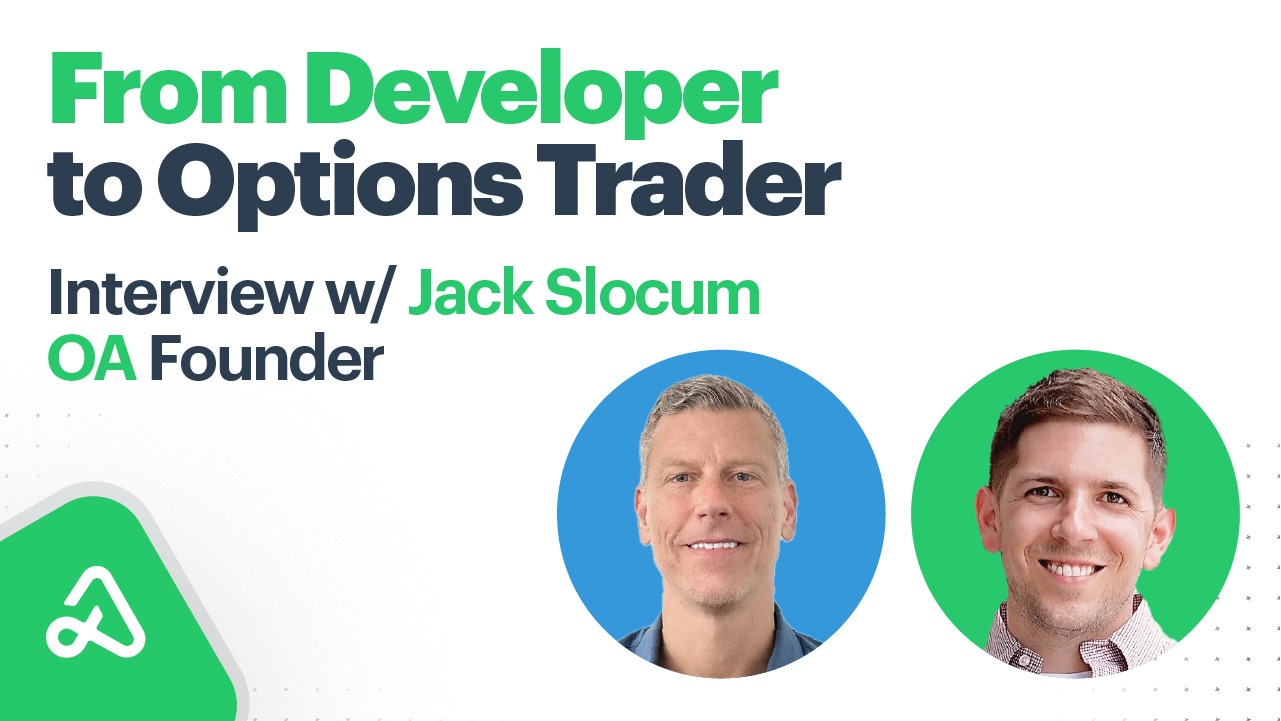
The founder as test environment
At his earlier software company, Slocum had a habit before a release: build a real application with the new features. A demo could reveal what an isolated feature test politely concealed. At Option Alpha he applies the same method with higher stakes. He trades on the platform daily, encountering the awkwardness, ambiguity and missing tools as a user would.
This makes his own behavior part of the laboratory. A founder who knows the product only through a roadmap can mistake shipping for success. Slocum wants to feel where the workflow snags. Option Alpha's recent releases show the accumulated results: minute-level backtesting, opening-range-breakout decisions, gamma-exposure tools, automated portfolios, more realistic exit conditions and strategies extending as far as 45 days to expiration.
The company publishes these updates with unusually practical detail. A February 2025 release, for example, added an option requiring a profit target to be present for two consecutive one-minute intervals before a backtest counts the exit. It is a small, fussy choice. It is also the kind of fuss that separates a handsome simulation from a fill a broker might actually make.
Kirk Du Plessis, his Option Alpha partner, attributes that question to Slocum. It fits both his product work and his stated faith. Slocum credits his Christian belief for resilience and for the conviction that a closed problem can be opened by a better question. His free time is built around faith, his children, outdoor activities and basketball. The picture is less of a market obsessive who never leaves the screen than a systems builder trying to make the screen demand less of everyone.
Logic without the lab coat
Trading culture has an affection for certainty, preferably drawn as a green arrow. Slocum's own story is an argument for humbler machinery. He mixes strategies with different probability and payoff profiles. He can feel uneasy about a bot that risks $925 to make $75 even when the structure has a logical place in a broader portfolio. Automation does not abolish discomfort. It stops discomfort from grabbing the steering wheel.
Nor does a backtest become a prophecy merely because it has decimal places. Option Alpha's tools are built to compare choices, account for slippage and make assumptions explicit. That is the useful lesson from a developer who once thought several indicators lining up meant a winner was guaranteed. More computation should produce better questions, not theatrical confidence.
There is a quiet comedy in spending a career making machines more powerful, only to discover that the essential feature may be restraint. Ext JS gave developers more capable browser components. Option Alpha gives traders scanners, bots and schedules. Yet the purpose of all that capability is to make fewer improvised decisions at the worst possible moment.
Every trade should have a clear, logical reason behind it.Jack Slocum's stated trading principle
Slocum's work remains unfinished in the ordinary founder sense. New strategies require new tests. Brokers change. Market structure shifts. Users find combinations the product team did not anticipate. In August 2026, Option Alpha added Strategy Insights to its backtester, automated portfolios and more opening-range-breakout decisions. The framework keeps absorbing what its community learns.
But the deeper project is stable. Slocum is still arranging complicated parts so that ordinary people can build coherent systems. He did it when browsers were unruly. He is doing it where money and emotion meet. The code has changed. The debugging target has become more candid.