A factory can become so good at serving its biggest customers that it quietly makes life harder for everyone else. The machines get larger. The minimum order grows. Somewhere, a small brand with a promising product discovers that its next purchase must include rather more bags than it would like. Jack Knott knew the system from the inside. He had spent decades helping to build and run packaging businesses. Then he helped create a company around the customers being squeezed out.
That company was ePac Flexible Packaging. Its founding proposition had a pleasing lack of glamour: make it easier to buy the right amount of packaging, quickly, with graphics that could hold their own on a shelf. Behind it sat a more awkward question for an industry veteran. What if the habits that made a large manufacturer efficient were the very habits preventing a different business from working?
Knott’s answer involved digital presses, local plants and two fellow founders, Carl Joachim and Virag Patel. It also involved reconsidering how he himself had built companies. The interesting part of this story is the distance between those two kinds of experience: knowing an industry thoroughly, and remaining willing to rearrange it.
The consolidator changes the question
Knott came to ePac with a career in packaging and petrochemicals already behind him. A chemical engineer by background, he had held senior roles at CT Film, Rexene, Huntsman Packaging and Pliant. In October 2005, he became chairman and chief executive of Exopack. This was a career spent with physical products, manufacturing assets and the practical consequences of getting operations right.
In 2011, Sun Capital Partners appointed him a managing director on its operations team. At Exopack, his work had included acquisitions, integrations, investment in equipment and improvements to operations. He had also chaired the Flexible Packaging Association. He understood the commercial logic of bringing businesses together because he had been responsible for doing it.
Yet consolidation looks different from the other end of the order form. As large consumer brands and their suppliers grew, the equipment serving them grew too. The economics rewarded longer runs. Smaller businesses still needed attractive, professionally printed packaging, but their quantities and deadlines were an increasingly awkward fit. A favorable price per bag is less comforting when the purchase includes a warehouse’s worth of confidence in tomorrow.
Knott would later describe his previous approach with unusual directness: “I traditionally built companies from the top down”. At ePac, he wanted room for local initiative. The admission matters because the new business was asking him to change more than a printing process. It was asking him to change the arrangement of authority around it.
“I traditionally built companies from the top down”
Jack Knott, 2019
Three founders, one unhelpful minimum order
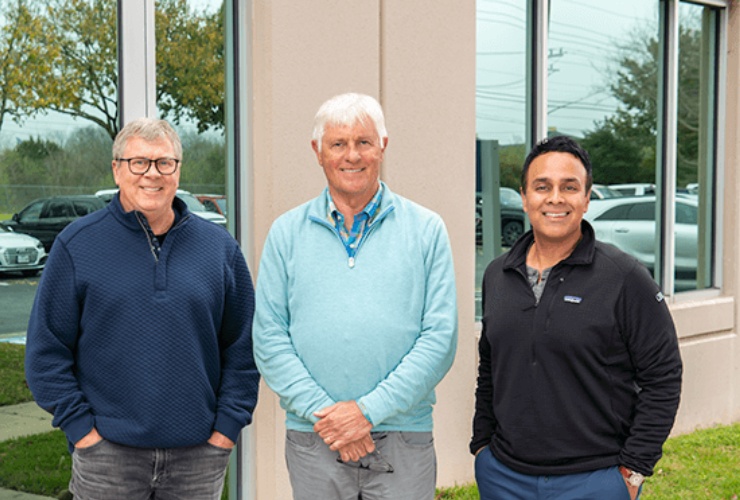
Knott, Joachim and Patel began developing their shared vision in 2013. Their experience overlapped without being identical. Knott brought leadership across packaging companies. Patel had worked in procurement, strategy, market development and other leadership roles at Exopack and Coveris. Joachim had spent years bringing production digital printing to market at companies including Xerox, Océ and Ricoh. The team could examine both the factory and the technology supplier’s promise.
In 2014, Cal Poly’s Graphic Communication department helped them investigate the market through research and brand focus groups. The pressures they were studying were specific: more product variants, shorter lead times and demand for lower minimum quantities. Conventional suppliers were improving their economics for large orders while leaving a growing mismatch elsewhere. The founders saw a potential business in that mismatch.
Emerald Packaging, led by Kevin Kelly, was already beta testing an HP Indigo 20000 digital press. The founders explored approaches with Emerald and decided to establish a separate company. Emerald became an investor, exchanging its digital press for equity in ePac. A piece of manufacturing equipment thus entered the new venture with a rather more interesting job description than usual.
The choice to start separately was deliberate. Knott believed an established converter would find it difficult to position digital printing properly inside a conventional operation. A new company could build its workflow and service model around digital from the beginning. Formation came in 2015, followed by the first Wisconsin operation in 2016. The question now had a factory attached to it.
A local factory with a repeat button
The first plant opened in the Madison area, in Middleton, Wisconsin. From the start, ePac offered digital printing alongside the finishing work that makes printed film useful: lamination and pouch making. Its February 2016 launch announcement described a business for short runs, multiple product variants and quick turnaround. A press alone could print an attractive idea. The whole operation had to turn it into packaging a customer could use.
Knott was already talking about replication in 2016. Prove the first plant, then reproduce the model in other geographies. Digital artwork could move between locations, allowing the company to offer consistent output across its network. The underlying ambition was international, but the customer relationship was meant to remain close to the place where a brand actually operated.
Boulder followed Wisconsin. As the business expanded, new territories could start selling before their plants were ready, with existing locations fulfilling the early orders. By opening day, the new operation could have customers and a clearer picture of demand. This made expansion a coordinated exercise in sales, equipment delivery, training and available capacity. The factory acquired its market before acquiring its opening-day bustle.
For Knott, the local model also had a human component. He described employees bringing entrepreneurial resources of their own and building relationships within their communities. His resistance to the familiar objection, “you can’t do it this way”, was part of the operating idea. People close to customers needed enough freedom to respond to them.
- 2013Knott, Joachim and Patel begin developing the idea.
- 2016The first Wisconsin plant begins operations.
- 2018An order for 10 more HP Indigo presses supports US expansion.
- 2022ePacONE is announced across a network of 24 plants.
- 2023Knott hands the CEO role to Patel.
The bag is also a calendar
Packaging fixes decisions in physical form. Once a design is printed, a business owns the consequences: the quantity, the wording, the product variant and the space required to store it. Digital printing changes the cost and difficulty of making some of those decisions again. With no printing plates required, shorter runs and design changes become easier to accommodate.
That was the appeal Knott kept returning to. A brand could order closer to actual demand, introduce variants and run promotions without committing so much inventory in advance. In ePac’s model, the customer’s ability to move mattered alongside the quality of the graphics. Packaging bought months ahead can be an unusually bulky form of optimism.
The company’s equipment commitments show how far the idea traveled. In February 2018, HP announced ePac’s purchase of 10 additional Indigo 20000 presses for its US rollout. In August 2020, HP and ePac announced a further rollout of 26 digital presses as expansion extended across North America, Europe and Asia Pacific. These were announced purchases and deployment plans, a measure of commitment rather than a substitute for financial results.
They also show Knott working through partnerships rather than trying to invent every component himself. HP supplied the printing platform; ePac organized the business around it. The distinction is useful. A technology can become available to an entire industry while the opportunity still belongs to the people who work out whom it should serve.
From separate presses to one network
By November 2022, ePac described a network of 24 plants. Its next step, ePacONE, addressed the difficulty of making geographically separate operations function together. The cloud-based manufacturing platform was intended to connect locations and assets so production could be managed across the network. Replicating factories had created reach. Connecting them was another job.
Knott explained the shift by recalling the progression from calculators and typewriters to computers and mobile devices. Smaller and faster machines were useful, but connection changed what they could accomplish together. He was drawing an analogy to the internet, and using it to explain why improving one standalone machine was different from coordinating a manufacturing system.
His ambitions for the platform were concrete. In 2022, he described customers obtaining recommendations and prices, uploading artwork, viewing a three-dimensional rendering and placing an order. He expected the technology to be fully operational by the end of the first quarter of 2023. These were the capabilities and timetable he outlined then. The purpose was a shorter path between a customer’s decision and production.
Conceptual diagram of the distributed model, not a map of individual locations.
A builder knows when to hand over
On July 13, 2023, Knott stepped down as ePac’s CEO. The company announced Patel’s appointment five days later, with Knott continuing in an advisory role. Patel had already carried much of the operational responsibility as COO. The handover kept leadership with a fellow founder who knew how the business worked.
Knott’s explanation was revealing. He called building the company “my forte” and described the next stage as a job suited to Patel’s operating abilities. Founders are not always so willing to put a boundary around their own gifts. Here was an executive whose career had included running established businesses, explicitly recognizing a colleague’s fitness for what came next.
His involvement in the industry continued. The 2026 Global Pouch Forum listed him as CEO of Group 1123 and paired him with Mezzo’s Jonathan White for a session on digitalization in flexible packaging. The event’s presentation archive identifies their subject as rethinking digital print. Years after ePac’s first plant, the relationship between technology and the organization using it remained on his agenda.
That continuity gives Knott’s story its shape. He helped consolidate packaging businesses, then helped build a network designed around smaller customers. At ePac, experience supplied both the knowledge and something to reconsider. The small order, easy to treat as an inconvenience, became a starting point. A business could be built by taking it seriously enough.