The first thing a young snack company learns about packaging is that a bag is never just a bag. It is a purchase order, a production schedule, a bet on demand and a tiny billboard that must work under supermarket lighting. Conventional flexible-packaging plants are happiest when that bet is large and uncomplicated: one design, one long run, one predictable setup. Emerging brands tend to arrive with the opposite. They have five flavors, a seasonal experiment, uncertain sales and cash they would rather spend on ingredients than six months of empty pouches.
ePac Flexible Packaging was organized around that mismatch. The company uses digital printing to make custom pouches and rollstock without the printing plates required by conventional flexographic work. Removing plates does more than save a line item. It makes shorter runs and multiple designs less punishing, so a brand can order closer to actual demand. ePac advertises production in 10 business days for rollstock and 15 for finished pouches after artwork approval. The useful comparison is the six-to-eight-week cycle its founders saw in the market before the company opened.
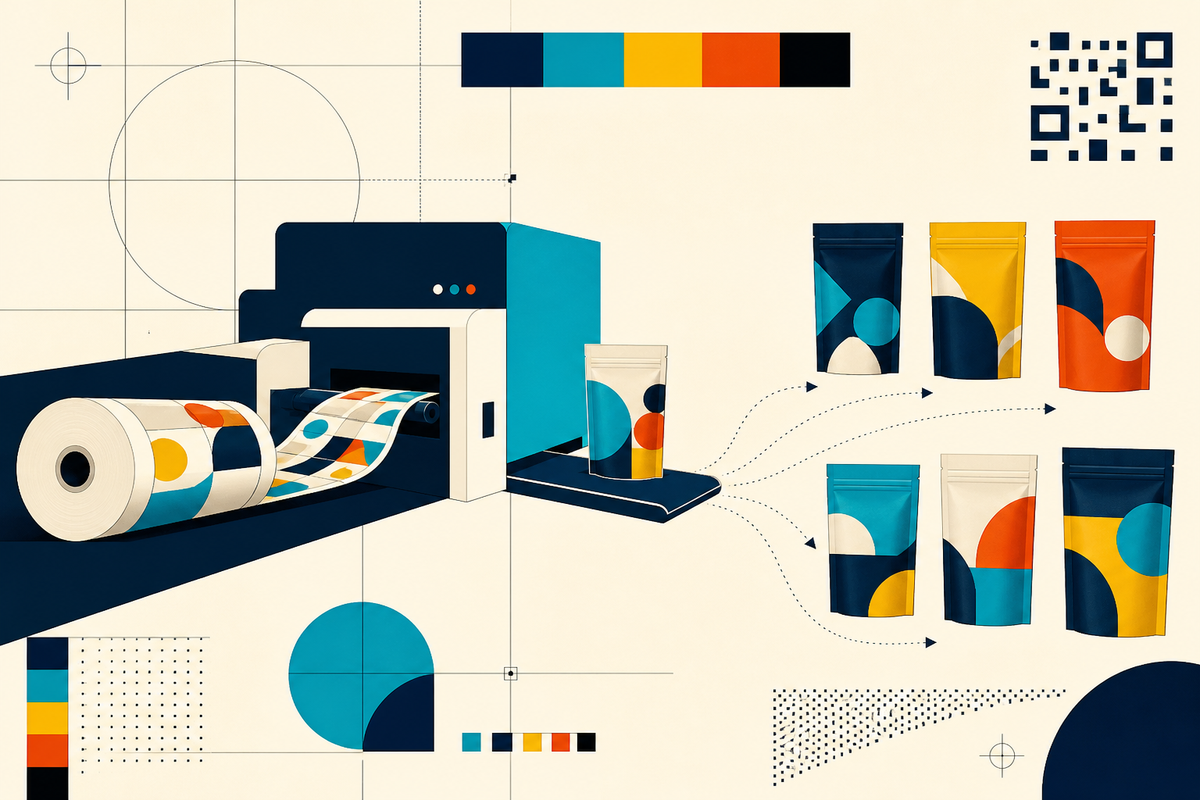
A factory for the awkward middle
The idea began in 2013, when packaging veterans Jack Knott, Carl Joachim and Virag Patel noticed three curves moving together: more SKUs, demand for shorter lead times and pressure for lower minimum orders. Large converters were adding equipment to push unit costs down for major consumer-goods customers, which often meant larger minimums. The trio suspected HP's then-new Indigo 20000 digital press could support another model. Cal Poly's Graphic Communication department helped them test the premise with focus groups in 2014. ePac was formed in 2015, and its first plant opened in Madison, Wisconsin, in April 2016.
The customer it had in mind was not mysterious. It was the local coffee roaster, pet-treat maker, supplement startup or beauty brand whose product was ready for a shelf but whose order volume did not excite a conventional converter. One public case study follows Granarly, a whiskey-soaked granola company whose founder, Morgan Potts, had been drawing labels by hand and sticking them to kraft bags. That method carried her into 70 stores, then became expensive and slow. A custom pouch was not decoration at that point. It was an operating upgrade.
The pouch is where brand ambition collides with working capital. ePac sells a softer collision.
The product is time, wrapped in film
ePac's catalog covers stand-up and lay-flat pouches, flat-bottom and quad-seal bags, child-resistant formats, resealable closures and custom rollstock for brands or co-packers that form their own packages. Film structures can be tuned for moisture, oxygen, aroma, puncture resistance, freezer use and food contact. A printed outer layer carries the design; sealant protects the ink and helps the package close; barrier material protects what is inside. In early 2026, the company added a peelable high-barrier film for coffee bags, designed to open without scissors or a tear notch while preserving aroma and freshness.
The commercial model is straightforward business-to-business manufacturing. Customers pay for material, format, dimensions, closures, finish and volume. The more interesting economics sit behind the invoice. A digitally printed order can contain many SKUs without a plate for each design. That lets a company test a flavor, localize artwork, run a promotion or refresh a label without ordering a warehouse full of the old version. Quick replenishment can shift packaging from a forecast-heavy asset toward something closer to a responsive input.
A manufacturing cloud, with laminators
ePac's differentiator is not simply owning digital presses. Other converters can buy equipment. The harder project is making a network of plants behave consistently. The company calls its proprietary operating layer ePacONE. It connects quoting, orders and job routing across locations, allowing work to move through the network according to capacity and capability. The analogy to cloud computing is imperfect but helpful: customers see one service while the system decides where the physical job should run.
The distributed model is sometimes described as a “plant in a box.” Standardized equipment, software, training and operating procedures can be repeated in a new market. Local production shortens the distance to customers, while shared workflow provides scale across sites. ePac now markets from locations across North America, Europe, Africa, Australia and Asia Pacific. Its public LinkedIn profile places the company in the 201-to-500 employee band; supplied business data estimates 390 employees and $255.5 million in annual revenue, figures that should be read as directional rather than audited disclosures.
Connected packaging adds a second digital layer. ePacConnect, built with Scantrust, prints a unique serialized QR code on each package. A scan can authenticate a product, show origin or supply-chain information, open a campaign or loyalty experience, and give the brand unit-level engagement data. Static QR codes already make packages clickable. Serialization makes every physical item individually addressable. For a small brand, that can provide anti-counterfeit and traceability tools that once belonged mainly to large enterprises.
What the sustainability claim can - and cannot - do
Flexible packaging has an environmental paradox. It is light, efficient to ship and can protect food from spoilage, but multilayer films can be difficult to collect and recycle. ePac offers recyclable polyethylene structures, including options pre-qualified for U.S. store drop-off programs, as well as films with post-consumer recycled content. Its solventless lamination avoids the volatile organic compounds associated with solvent-based processes. Digital printing can also reduce setup waste and, by supporting demand-led orders, lower the risk that obsolete printed packaging is discarded.
The measurable lever
Order less packaging before demand is proven. Fewer obsolete designs can mean less inventory written off when a recipe, regulation or logo changes.
The stubborn limit
A recyclable specification is not the same as a recycled pouch. Collection, consumer behavior and local processing still decide the ending.
Those are useful improvements, not a permission slip. A high-barrier package may require layers that complicate recycling, and “store drop-off” depends on programs people can actually reach. ePac fits in the pragmatic part of the market: reduce material and inventory where possible, provide mono-material or recycled-content paths where performance allows, and preserve the shelf life that packaging exists to protect.
The long run arrives
For most of its first decade, ePac's sharpest contrast with incumbents was short-to-medium work. The next chapter tests whether its digital system can travel farther up the volume curve. HP said in February 2026 that the companies had signed an approximately $50 million, three-year commercial agreement covering equipment, consumables and services. More than 10 Indigo 200K presses are expected to join a fleet already exceeding 50 HP Indigo presses worldwide. ePac also announced a new Phoenix site and added capacity or technology in Atlanta, Philadelphia and Vancouver.
The capital arrived after a change in ownership. Butterfly Equity, a Los Angeles private-equity firm focused on food and beverage, acquired a majority stake in January 2026 from a consortium that included Amcor and INDEVCO North America. Terms were not disclosed. Amcor separately reported proceeds of about $79 million from selling its investment, including contingent consideration, but that is not the purchase price for the whole company. Virag Patel remained chief executive, and the incumbent team retained a significant ownership interest.
That combination is revealing. Butterfly brings a portfolio of food brands that live with packaging decisions; HP supplies the production engine; ePac supplies the workflow and customer network. Competitors include global converters such as Amcor, ProAmpac, Printpack, TC Transcontinental, Constantia Flexibles and Coveris, alongside regional pouch makers. Their capabilities overlap, and several operate at far greater scale. ePac's place is at the junction of digital print, distributed manufacturing and the unruly needs of growing CPG brands.
The lesson inside the bag
There is a portable business idea here. Incumbents often optimize for the largest customer and call the remaining friction unavoidable. ePac started with the friction: plate charges, high minimums, long waits, too much inventory and too little room to experiment. Then it assembled existing digital-print technology, repeatable plants and proprietary workflow around a different buyer.
For a brand, the practical use is equally plain. Launch a product without committing to a heroic pouch forecast. Put several flavors into one order. Localize a design. Replenish after sales data arrives. Add a code that turns a package into a direct channel. The bag still has to seal, survive shipping and keep oxygen out. But it no longer has to demand that its customer predict the future quite so confidently.