Before Jack Herrick had a website, he had a box. A milk crate of books traveled with him while he lived in a truck and went rock climbing. He called it his “knowledge box.” A manual could explain a knot, a technique, a way up. You read something, tried it, and became capable of doing something you had previously only watched other people do.
It is an appealingly literal origin for wikiHow. The service would eventually spread instructions across millions of screens, but its founder had first experienced the attraction at a much smaller scale. A book took up space in a truck because the information inside it earned its passage. Knowledge had to be useful when you got out of the vehicle.
Today, Herrick is wikiHow’s founder and chairman, a former CEO and an angel investor. Those titles describe the businesses. The box explains the interest that kept bringing him back to instructions: someone has already worked out a way to do the thing that is puzzling you. With a little help, you might manage it too.
The education between the degrees
Herrick grew up in Palo Alto, where his early enterprises included a neighborhood car wash business. He studied history at Stanford, graduating in 1991, and later earned his MBA at Dartmouth’s Tuck School of Business in 1997. Between those institutions came the climbing years, in Yosemite and the Southwest. His education had acquired a rather different campus.
There is something pleasing about a future purveyor of instructions choosing history. The discipline asks how things happened; his eventual company would help readers make things happen themselves. The connection is an interpretation, but his appetite for learning is explicit. He has described curiosity as a quality he looks for in the founders he backs.
His working life also provided opportunities to be a beginner. After a stint at McKinsey, he co-founded BigTray in 1999, selling restaurant equipment online. From 1999 to 2001, he served as its CEO. A restaurant supplier is an excellent reminder that commerce includes refrigerators, shelving, and a great many objects too heavy to fit in a pitch deck.
In 2002, he co-founded Luminescent Technologies with Dan Abrams, Eli Yablonovitch, and Stanley Osher. Its field was computational semiconductor lithography. Herrick was the business participant among scientists, later serving as CFO. The subject matter had changed considerably from restaurant equipment. The practical task of building a company remained.
A profitable answer to the wrong question
Herrick and business partner Josh Hannah bought eHow in 2004. This distinction matters: he acquired the existing site rather than founding it. It was an opportunity to revive a collection of practical instructions, and the pair made the business work. Yet a functioning business could still fall short of the resource he wanted to build.
Paying writers created a stubborn arithmetic problem. An article had to justify its cost. Subjects attractive to advertisers were easier to commission than obscure subjects or material in languages with smaller advertising markets. A universal manual would have to make room for questions whose commercial prospects were unremarkable. The person asking one still needed an answer.
Herrick explained that dilemma in 2009: professional production could force a choice between covering more ground and maintaining quality. His ambition required both. The economics of a useful article and the economics of a lucrative article were sometimes pulling in different directions. Hiring another writer would not, by itself, settle the argument.
Wikipedia offered a possible way through. People could contribute what they knew, while other people corrected and extended it. The method gave a project access to knowledge that no commissioning editor could hope to purchase topic by topic. Herrick began building a separate site around that possibility.
The birthday party with hardly any guests
wikiHow launched on January 15, 2005, deliberately sharing Wikipedia’s birthday. It used a modified version of MediaWiki, the software behind its inspiration. Borrowing the birthday was a gracious acknowledgment. Borrowing the software was practical. Neither arrangement came with a crowd waiting outside.
Early traffic amounted to only a few thousand visitors in the first month. The mechanism depended on a small fraction of them doing something more demanding than reading: noticing an omission, pressing edit, and leaving the page better. There were very few editors at first. A wiki can have an excellent theory of participation and an embarrassingly quiet afternoon.
The important unit was the improvement. One reader knew a detail the article lacked. A subsequent reader found a more helpful page and might add another detail. The result could attract the next person. Herrick’s account of growth was a cycle of readers, contributors, and better instructions, repeated until the numbers became noticeable.
Better instructions bring another reader. The loop starts again.
By 2007, his Wikimania presenter biography reported more than five million visitors a month. The 2009 conference biography reported more than sixteen million. These were historical snapshots of a project finding its audience. The quiet start and the later scale belonged to the same undertaking, separated by years of repeated work.
Trust, with an escape hatch
The early collaboration involved a question more awkward than software: why should volunteers improve a privately owned business? Herrick’s answer included a tangible safeguard. Under the Creative Commons arrangements of that period, contributors could take the shared material elsewhere. He described the ability to fork as a reason people could trust the project with their work.
The idea gave the community some independence from the founder’s future decisions. If the relationship failed, leaving did not have to mean abandoning everything the contributors had made. For the early wikiHow, generosity was part of the operating arrangement. It helped explain why strangers might spend their evening fixing someone else’s instructions.
In January 2009, the site reached 50,000 articles. The milestone entry concerned obtaining a copy of a birth certificate in New Mexico. It is difficult to imagine a more fitting monument to practical knowledge. No ceremonial rocket, no grand pronouncement: a document someone needed, in a particular place, with a procedure to follow.
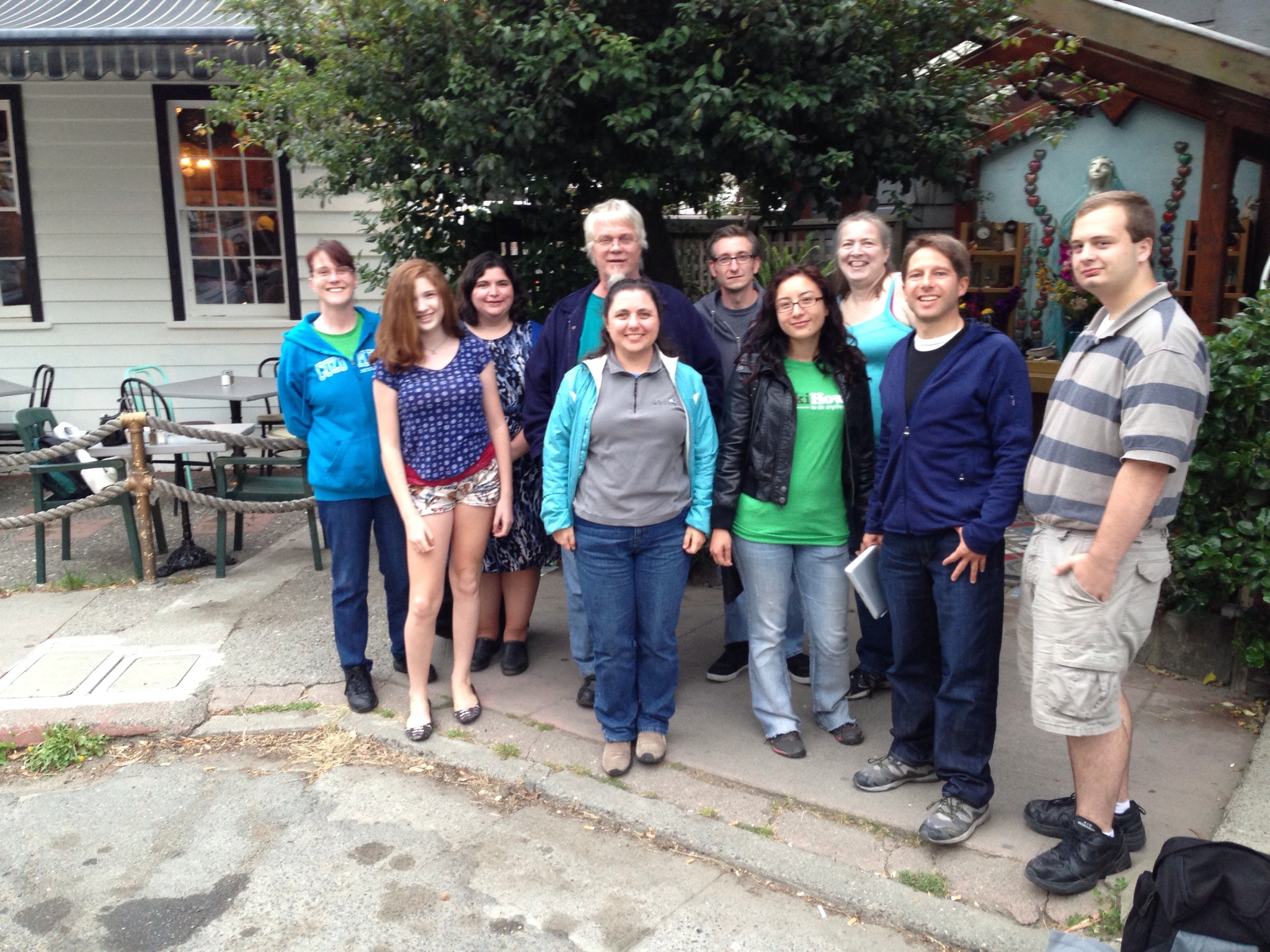
Herrick also made a point of encouraging the early editors personally. He recalled sending notes to people who changed the site and watching each alteration. The later reach can make that work seem quaint. At the beginning, it was the work. Someone needed to notice that another person had bothered.
A company allowed to take its time
In 2006, Herrick and Hannah sold eHow to Demand Media while retaining wikiHow. The sale supplied money for a project still developing its own business. It also gave Herrick the ability to concentrate on the version of the how-to manual that interested him most.
He chose to keep wikiHow free of venture funding. His previous companies had used outside capital, so this was a choice made with experience of the alternative. wikiHow’s schedule would depend on its mission and its ability to support itself. A company built to last needed room for the unglamorous intervals when improvement preceded visible results.
By 2012, fourteen employees worked from a house in downtown Palo Alto. Advertising supported the operation, and Herrick said the company had been profitable for several years. The domestic setting was deliberate: he thought people could feel more relaxed and creative in a house. The headquarters sounded better suited to a conversation than a corporate procession.
“I just prefer the title, Founder.”
Jack Herrick, speaking to Lon Safko when wikiHow had three employees
That preference appeared early, when an interviewer introduced him as CEO of what was then a three-person company. Herrick thought the designation rather lofty. A title could wait for the organization to grow into it. There were instructions to improve in the meantime.
The tie, the egg, and the next question
His growth advice was similarly concrete. Writing in 2009, he pointed to the difference between a carefully developed article and an unfinished draft. Better pages could draw vastly more readers. He also encouraged publishers to let people collaborate on shared work, describing a team rather than a collection of individuals each doing a separate activity.
A hard-boiled egg was one of his examples of useful content. Another favorite was tying a tie. When his fourteen-year-old son was preparing for a first dance, Herrick gave him the wikiHow article and watched him follow it. The founder had become a reader’s parent. The instructions had reached the household test.
His ambitions now extend to backing other founders. In a 2025 interview, he described having invested in more than one hundred early-stage companies. He emphasized persistence, learning, and honesty about weaknesses. The investor who wants accurate information from a founder has something in common with the reader who wants an accurate sequence of steps.
That same year, Herrick addressed a new difficulty for instructional publishing: search engines could summarize an answer with AI before anyone reached the underlying page. He argued that visitors arriving after those summaries would want greater depth. The job was changing again. A useful manual would have to keep earning the visit.
It brings the story back to the box. The attraction was always the chance to try something beyond what you already knew. A climbing technique, a business, a knot in a tie: each has its own particulars. Herrick has spent years making a place where someone might explain them. The next question, inevitably, belongs to somebody else.
More from Jack’s world
- wikiHow
- Jack’s wikiHow page
- X / @JackH
- Tuck: the 2025 interview
- Mixergy: the founder interview
- Wikinews: the early vision
- Inc.: the self-funded company
- WIRED: instructions for everyday life
- Google: Herrick on content and community
- Creative Commons: 50,000 articles
- YouTube: Meet AdSense Publisher wikiHow
- Lon Safko: the early interview