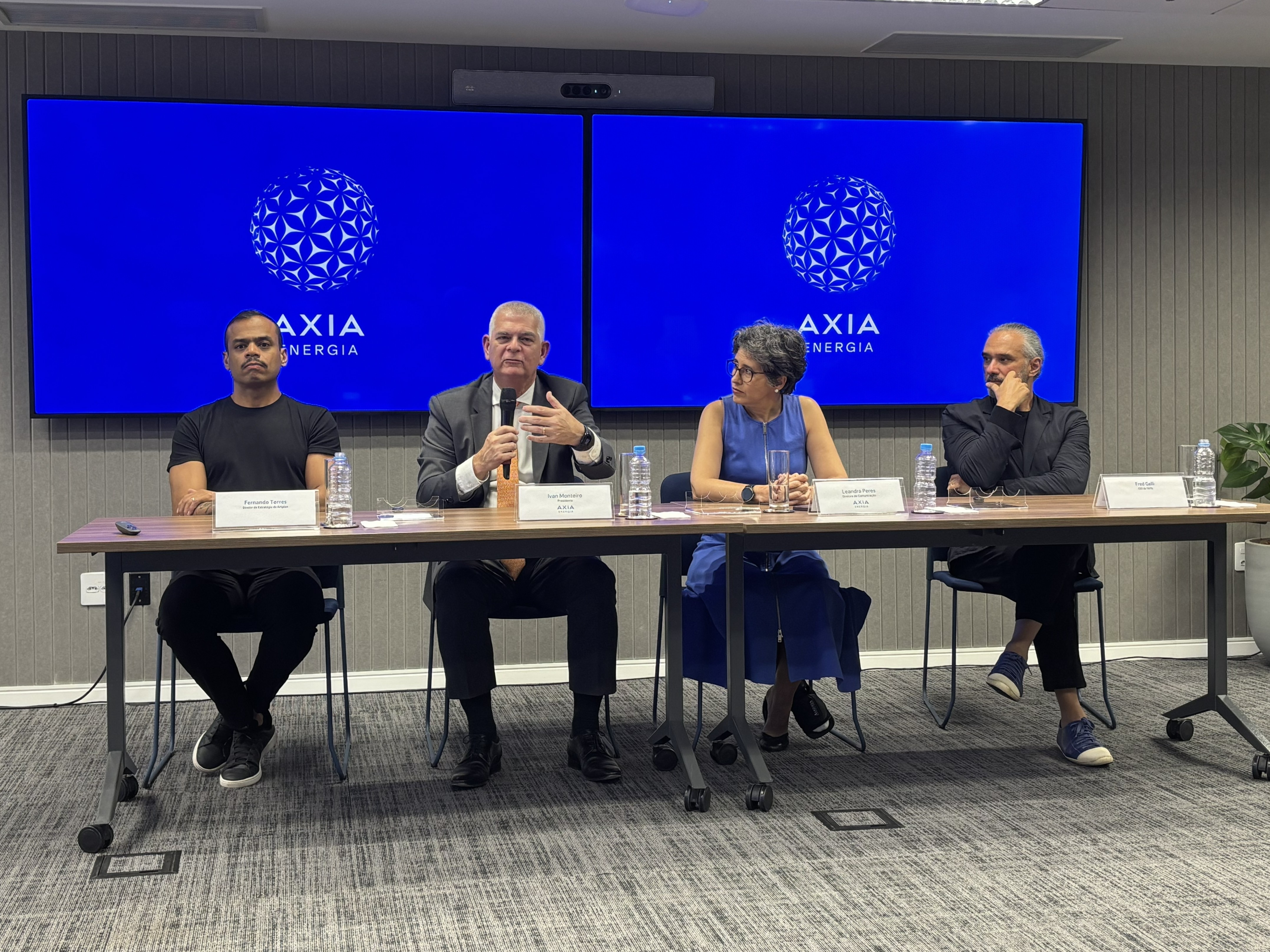
Ivan Monteiro had a complaint about Eletrobras. Foreigners could not pronounce it. In October 2025, explaining why the electricity company he ran would become AXIA Energia, he invited his audience to imagine an American or a Briton wrestling with the old name. Even a business with dams and transmission lines could have a problem at the level of the syllable.
It was a small joke attached to a substantial change. Eletrobras had been privatized in 2022. Monteiro became its chief executive in August 2023. Now he was explaining how a company accustomed to its place in Brazil's infrastructure would compete for customers and attract patient international capital. The new sign would be the easy part. The contracts behind the sign had rather longer memories.
That difference between announcing a change and making it work runs through Monteiro's career. He trained as an engineer, spent decades in banking, took charge of finances at Petrobras and eventually became its president. At AXIA, the assignment has included turning a collection of regional businesses into a more unified operation. In 2026, another transition joined the list: preparing the company for his departure.
A bank clerk before an engineering graduate
Monteiro was born in Manaus in 1960 and moved with his family to Rio de Janeiro during childhood. He studied electronic engineering and telecommunications at Inatel, in Santa Rita do Sapucaí, Minas Gerais. He joined Banco do Brasil as a clerk in 1983, while still a student, and graduated in 1986. His working life began before his university education had finished.
The dates puncture any impression of an executive career assembled from a succession of dramatic entrances. Banco do Brasil occupied more than three decades of it. Along the way came further study: an executive MBA in finance at IBMEC in Rio and an MBA in management at PUC-Rio. An engineering qualification had become the starting point for a career spent largely among financial institutions.
When Inatel's alumni association gave him its national distinction at Futurecom in 2023, he returned to the subject of foundations. He credited his family first, then the institute. He described a career requiring forty years of study and dedication. “Sem a base a trajetória de sucesso não acontece,” he said. Without a foundation, a successful career does not happen. The explanation was refreshingly short on shortcuts.
“Sem a base a trajetória de sucesso não acontece.”
Ivan Monteiro, at the AdInatel awards, 2023
New York, with unfortunate timing
His bank assignments eventually took him well beyond Brazil. In 2007 he became general manager for Banco do Brasil's Lisbon and Africa operation, with a restructuring assignment. The following year he took the corresponding job in New York. A posting to the financial capital in 2008 came with an education that no prospectus would have advertised.
He returned to Brazil in 2009 to become the bank's vice president for financial management and investor relations. The position put him at the junction of a large institution's internal decisions and the outsiders supplying its capital. That junction would become familiar territory. So would the task of explaining complicated organizations to people who needed a reason to trust them.
Banco do Brasil, Petrobras and Eletrobras occupy different corners of Brazilian life. All require managers to understand money, public expectations and institutional history together. Monteiro's progression through them helps explain his later emphasis on predictability. A company can promise a new direction in a morning. Investors, employees and counterparties have to live with the consequences over years.
Clerk
CFO
President
CEO
The promotion nobody could call quiet
Monteiro arrived at Petrobras in 2015 as finance and investor relations director, following Aldemir Bendine from Banco do Brasil. The oil company was dealing with the fallout from a corruption scandal and a heavy debt burden. His financial responsibilities continued under Pedro Parente. Then, in June 2018, a nationwide truckers' strike and a dispute over fuel pricing brought another abrupt change.
Parente resigned. Monteiro, already the chief financial officer, became interim chief executive on June 1; the board confirmed him as president on June 4. It was a promotion delivered with a national argument attached. Fuel prices reached far beyond the company, into freight costs, government policy and everyday spending. The chief executive's chair offered an unusually clear view of all three.
Contemporary accounts emphasized continuity. Investors wanted to know whether debt reduction and the existing business direction would survive the change at the top. Monteiro's experience inside Petrobras mattered because he already knew the financial problems. His presidency lasted into January 2019, when Roberto Castello Branco succeeded him. Seven months was enough to add a very public chapter to a mostly financial career.
The practical limits were visible during his tenure, too. In November 2018, Monteiro acknowledged that Petrobras would miss its $21 billion divestment target for 2017-2018, with legal obstacles affecting important sales. It was a reminder that a disposal plan has several authors: management, buyers, courts and a calendar. Only one of them has to refuse for the timetable to slip.
Three hundred reasons to be patient
After Petrobras came roles including work with Nubank's risk committee and senior positions at Credit Suisse Brasil. His experience spanned an established state-controlled bank, an oil producer, a digital banking business and investment banking. In August 2022, he joined the newly privatized Eletrobras board and became its chairman. A year later, he moved into the executive job, succeeding Wilson Ferreira Júnior.
By September 2025, he had a useful way of describing what privatization left behind. Imagine arriving at your desk to find 300 legacy contracts, he told an infrastructure audience. A change in the company's ownership did not end those agreements. They had to run their course. The ceremony might be over; the paperwork was still very much employed.
He also described a shift toward negotiated settlements of liabilities associated with compulsory loans, rather than prolonged litigation. The broader point was predictability: making future obligations easier to understand so the company could plan investment and distributions. His language kept returning to the mechanics of change. The work involved assets and contracts, alongside the more photogenic business of a new corporate identity.
A shorter name, a longer investment horizon
The AXIA launch made that identity question explicit. Monteiro described a future in which consumers would choose their electricity supplier and the company would have to earn their preference. He talked about competitiveness and service, including what happens after the sale. For a business known through its infrastructure, it was a notably customer-facing account of the job ahead.
His comments about foreigners pronouncing Eletrobras belonged to the same argument. International investors were an audience for the new identity. Expansion abroad was a different question: he emphasized the opportunities available within Brazil. A company could seek capital internationally while keeping its immediate operating ambitions at home. His banking past made that distinction particularly familiar.
In October 2025 he said the company expected annual investment close to R$10 billion, compared with roughly R$2.5 billion to R$3 billion under its earlier state-owned model. He pointed toward modernization, reinforcement of existing assets and auctions. These were expectations stated at the time, rather than a final accounting of spending. The distinction matters whenever a chief executive talks about the future.
Monteiro's comparison at the brand launch. Earlier level is a range; 2025 figure is an expectation. Bars use its upper bound.
He also said large acquisitions were outside the immediate plan. That choice gave the strategy a particular character: devote attention to what the company owned and to specific investment opportunities. Corporate ambition is often photographed beside an acquisition announcement. Here it also involved the less theatrical prospect of improving equipment already on the books.
The engineer returns to the conversation
In August 2026, Monteiro sat down with interviewer Marisa Wanzeller at AXIA's Rio de Janeiro headquarters for the opening episode of iNFRAideias. The subjects ranged across the physical and commercial electricity system: batteries, pumped-storage hydropower, limits on renewable generation, market opening and artificial intelligence for weather forecasting and asset management. The trained engineer had plenty to discuss with the financial executive.

The interview covered the unification of four regional companies and the disposal of coal, gas-fired and nuclear interests as the business moved toward an entirely renewable generation portfolio. These are company decisions made by teams and boards across time. Their place in his story is the responsibility of explaining how the pieces fit together, and what the resulting business should do next.
In October, he appeared as the guest in Tátil’s Leadership Transformation series, presented by Pedro Medicis and Olga Loffredi. The episode put him in a conversation framed around brands and organizational change. A year after the AXIA name arrived, the relationship between the business inside and the identity outside remained a subject for discussion.
Putting a date on the handover
AXIA had already announced the beginning of its succession process on May 6, 2026. Monteiro's current term ends on April 30, 2027. From June 1, Élio Wolff took a temporary executive vice president position as a potential successor. Several operating functions would report through that position during the transition, while finance, governance and legal functions continued reporting directly to Monteiro.
The arrangement gives the closing stretch of his tenure a concrete shape. Responsibilities move before the chief executive does. The board monitors the process, and the company has a stated endpoint for the transition. For someone who has spent so much of his career managing institutions through changes, his own handover now belongs among the assignments.
The pronunciation joke remains a good opening to his AXIA years because it catches both the public performance and the work underneath. A shorter name can be announced at a press conference. Agreements take time to expire, equipment takes money to improve, and a successor needs room to prepare. Monteiro has a date for leaving the chair. Until then, there is a company to run.