Richard Calleri has a useful problem for anyone trying to sell the future: the thing he wants to sell is underground. It cannot pose for a photograph, attend an investor meeting or promise to behave. A geothermal prospect offers clues before it offers electricity. Someone has to pay to turn those clues into evidence, and someone has to decide when the evidence justifies another cheque. Calleri has spent his career on both sides of that conversation.
He is the founder and CEO of Ignis H2 Energy, a geothermal exploration and development company, and the owner and CEO of GEOLOG, an energy services business. Before those roles came eleven years in investment banking. His route to renewable energy runs through mergers, financing, drilling information and the awkward interval between a promising asset and a dependable business.
It is a career with an unusual continuity. The setting changed from financial transactions to the subsurface. The question of what a person should believe before committing money remained.
Eleven years learning the price of uncertainty
Calleri studied economics at City University in London and earned an MBA at the University of Chicago Booth School of Business. His banking work covered mergers and acquisitions, leveraged finance and restructuring, across industries including energy, technology, media and telecommunications. He worked at Credit Suisse and Citi; his last banking position was executive director at Goldman Sachs in London.
Those disciplines deal with different moments in a company’s life. An acquisition asks what a business is worth to a buyer. Leveraged finance asks how much borrowing its earnings can support. Restructuring arrives when earlier assumptions need a rather less comfortable conversation. Together, they offer an education in the consequences of being wrong about an asset.
That background helps explain the financial vocabulary around Ignis. The company talks about advancing projects through successive investment decisions, reducing uncertainty before committing to construction. For Calleri, the geothermal proposition brings a familiar commercial problem into physical terrain: how to judge an opportunity whose most consequential details still need to be established.
A deal at the wellsite
GEOLOG supplied the next setting for that work. The company provides surface logging and drilling solutions, gathering information that helps operators understand the formations and fluids encountered during drilling. Its customers need usable knowledge while a well is being made, when decisions carry costs in equipment, time and performance.
In April 2020, with Calleri as CEO, GEOLOG agreed to acquire Nabors Industries’ US mudlogging assets, previously known as EPOCH. GEOLOG had entered the US market in 2014 and, by the announcement, had logged more than 300 wells across onshore and offshore settings.
The transaction brought experienced engineers into the business alongside those assets. Calleri’s comments at the time emphasized the combination of personnel and technology. The acquisition was a practical expression of that pairing: an instrument needs someone who knows what its reading means, and a capable team needs instruments worth reading.
Nabors would later appear in another part of his career, as an investor in Ignis. The connection joins a drilling-services transaction to a geothermal funding round. In Calleri’s professional world, finance and field operations repeatedly meet at the same table.
The portfolio takes shape
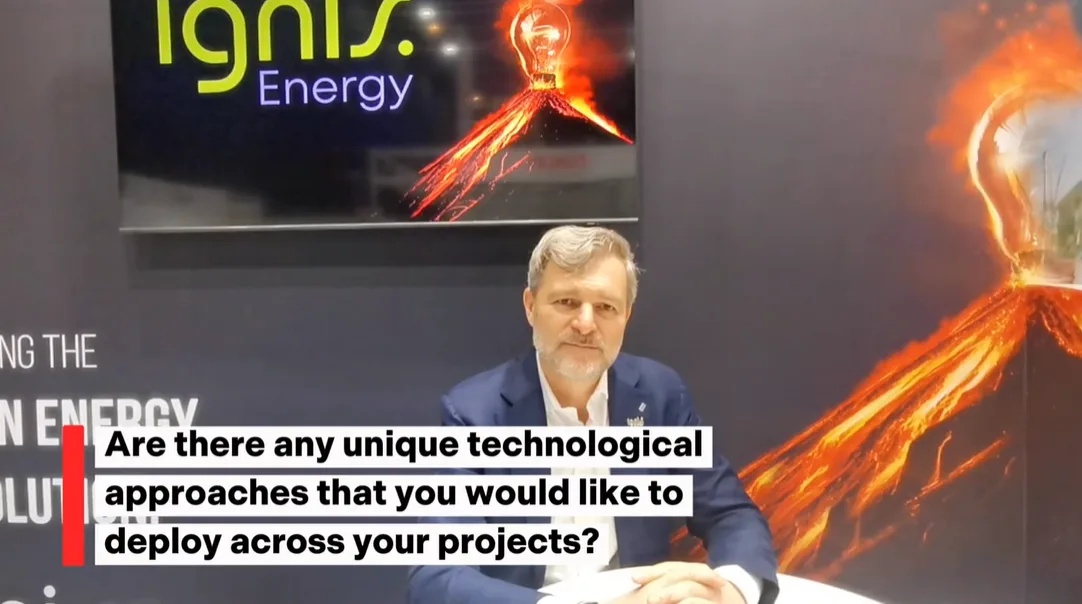
Ignis records its incorporation on September 9, 2021. By March 2023, it had entered a cooperation agreement with GeoAlaska for opportunities at Mount Augustine. That year also brought the formation of its Türkiye business and concessions in Eastern Anatolia. US leases and additional partnerships followed.
The resulting geography is part of the business model. Ignis develops a portfolio across basins and countries, spreading exposure across resources, regulations and development schedules. A developer with several prospects can compare where its next investment might do the most useful work. Each site, however, still needs to justify itself.
Technology selection follows the reservoir. Ignis considers conventional hydrothermal development, enhanced geothermal systems and advanced geothermal approaches where appropriate. Its stated approach leaves room to choose a method after examining the resource. A preferred piece of machinery does not get to rewrite the geology.
The ambition is substantial but specific: one gigawatt of documented producible geothermal reserves by 2030. That is a reserves target. It describes what Ignis wants to establish underground, rather than a claim that a gigawatt of power plants is already operating.
Each stage has to support the next decision.
A thermometer in Eastern Anatolia
At Kaynarpınar, the portfolio acquires a name, a place and a measurement. The concession sits in the Bingöl region of eastern Türkiye. Hot springs and shallow wells give visible signs of geothermal activity, while the region’s faults and volcanic history make the underground picture more complicated than a warm patch on a map.
Ignis combined field geology with geophysical surveys. Its 2023 programme included measurements at 65 magnetotelluric stations and 310 gravity stations. Those methods investigate different physical properties of the subsurface. Used together with geological observations, they help build a model of where the geothermal system might be and how it might be arranged.
A 758-meter test well followed in the fourth quarter of 2024. At the end of 2025, Ignis reported successful tests of the YDS-1 cored well, which had been drilled to validate its model. The results included artesian flow, an 80°C wellhead temperature and 85°C measured at 740 meters.
For Calleri, that sequence gives the development story a concrete foundation. A model was built, a well was drilled, and observations were obtained. The measurements support another round of decisions about the field. They are a milestone in exploration, with further work between that milestone and a power plant.
Measured at 740 meters.
Artesian flow confirmed in the well test.
Two American tests of the same idea
Mount Augustine offers a very different setting: a volcanic island in Alaska’s lower Cook Inlet. Ignis and GeoAlaska carried out exploration campaigns in 2023 and 2024, using gravity and electromagnetic surveys to investigate the southern flank.
The project’s published pre-drill estimate puts its median potential electrical capacity at 204 megawatts. That figure gives the opportunity a scale; confirmation drilling must still test the underlying interpretation. The distinction matters in Calleri’s business. An estimate can justify investigation without becoming a meter reading from an operating generator.
California’s Mount Olive prospect supplies another version of the challenge. It sits within the Clear Lake Volcanic Field, near The Geysers. A legacy well measured 274°C at depth, and a 2025 three-dimensional magnetotelluric survey identified three priority target areas.
There, the opportunity involves revisiting an explored resource with new data and more deliberate well placement. The preliminary estimate of 88-147 megawatts remains a pre-drill resource estimate. Calleri’s portfolio contains different kinds of evidence at different stages: historical measurements in one place, new survey interpretations in another, recent well tests elsewhere. Managing those differences is part of running the company.
The people beside the instruments
Calleri’s public comments also spend time on the people doing the work. After visiting teams, clients and partners in Saudi Arabia and Qatar in 2026, he described team morale and service quality before discussing technical advances. He credited local leaders Merouane Tebbal and Naceur Souguir by name.
The technical work he described included rare-earth exploration and identification with Aramco and advances in surface-based measurements in Qatar. Yet the order of the account is revealing: people appeared before the instruments. It is a small detail, but a useful one in a career often described through company names and financing milestones.
His connections extend beyond the two businesses he leads. He chairs GeoAlaska’s board, and Bardasz announced his appointment as a board director in May 2026. The latter develops operational intelligence for well construction, placing him beside another business concerned with turning data into decisions.
There is also a connection to the next generation of technical work. The 2026 Ettore Carcione geothermal thesis award is sponsored by SPE Italy, GEOLOG and Ignis; its announcement lists Calleri as Ignis CEO. The €3,600 prize pool is modest beside a development budget. Its subject is precisely the knowledge those larger investments depend on.
The distance from heat to a customer
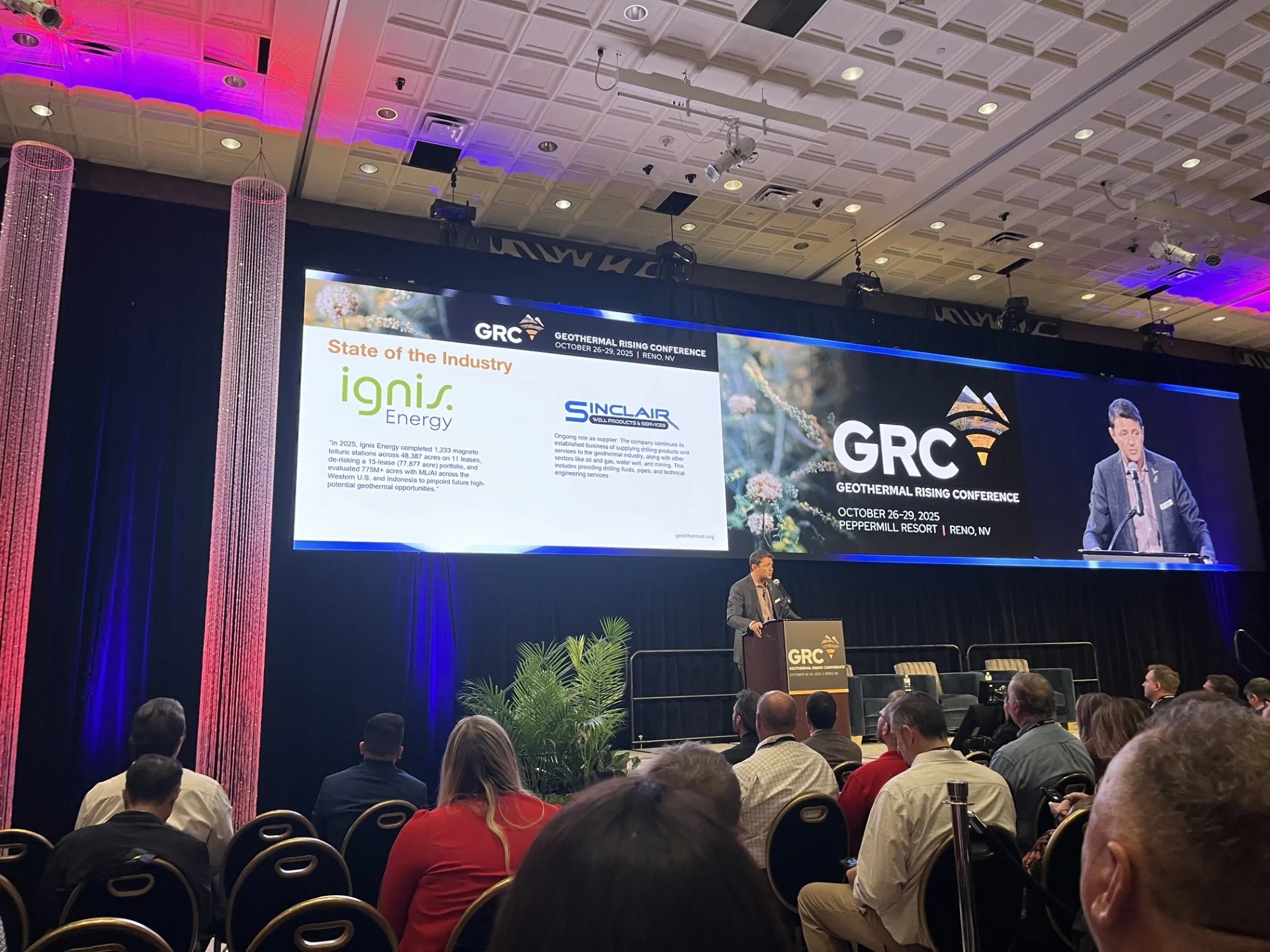
In June 2025, Ignis closed its Series A at $13.6 million. The investors included alfa8, Nabors, Twynam and GEOLOG, alongside private investors and family offices. The round supplied money to advance exploration projects toward the more expensive stages of development.
“Without proven heat in the ground, there’s nothing to scale.”
Richard Calleri · June 2025
A year later, another relationship brought the commercial destination into view. Clean Energy Alliance announced letters of intent with three geothermal developers, including Ignis. The Ignis project was Weepah Hills in Nevada. CEA described a process of supporting development early and pursuing long-term power purchase agreements as projects mature.
A letter of intent gives the developer and a prospective buyer a basis for working together. There is still a well to confirm, a project to finance and electricity to deliver. For Calleri, this is where the banker’s questions and the exploration team’s measurements have to agree.
His career has brought him to a business in which ambition travels widely and proof remains stubbornly local. Alaska cannot supply a missing test result in Türkiye. A financing announcement cannot raise a reservoir’s temperature. The next chapter belongs to the work that connects those separate facts: a better model, a tested well, a buyer prepared to continue the conversation. The Earth may be generous with heat. It remains refreshingly unmoved by a pitch.