In January 2009, a drilling rig rose beside a parking lot at the Oregon Institute of Technology. Students lost roughly 75 parking spaces. The bigger wager was below their feet: a deep well that might help power the Klamath Falls campus. ThermaSource had the drilling contract, and the machine on site was a visible reminder that clean energy sometimes begins with a very large hole.
- ThermaSource began in 1980 as a geothermal engineering consultancy in Santa Rosa, California.
- When drilling rigs grew scarce, it bought its first one in 2006 and built a staffed fleet.
- It added cementing, drilling fluids and geological logging to cover more of a well's journey.
- The Oregon Tech well showed the business's unavoidable limit: the rock gets the last word.
The hoped-for prize was hot water for a larger electricity project. ThermaSource drilled to about 5,300 feet, while its Tecton Geologic unit supplied mud logging. The temperature was around 200°F, short of the initial high-temperature power plan. With no sign of rising heat and funding under pressure, the rig was released in March. The campus still had a resource to use, but the proposed route to electricity had changed. The well was evidence, even if it was not the evidence the original plan wanted.
A consultant meets a bottleneck
Louis E. Capuano Jr. founded ThermaSource in 1980. For its first quarter-century, the business was largely engineering, project management and advice for geothermal developers. That work matters because a reservoir is not a bathtub waiting obligingly under a site. A commercial prospect needs enough heat, enough fluid and rock through which the fluid can move. Geologists and engineers can narrow the search. A well settles the argument.
By 2006, the argument was getting harder to schedule. Geothermal drilling had accelerated, and available rigs were scarce. ThermaSource bought a refurbished rig from the oil and gas market. It was a practical reversal: the firm that helped clients plan wells would now arrive with its own crews and equipment to drill them.
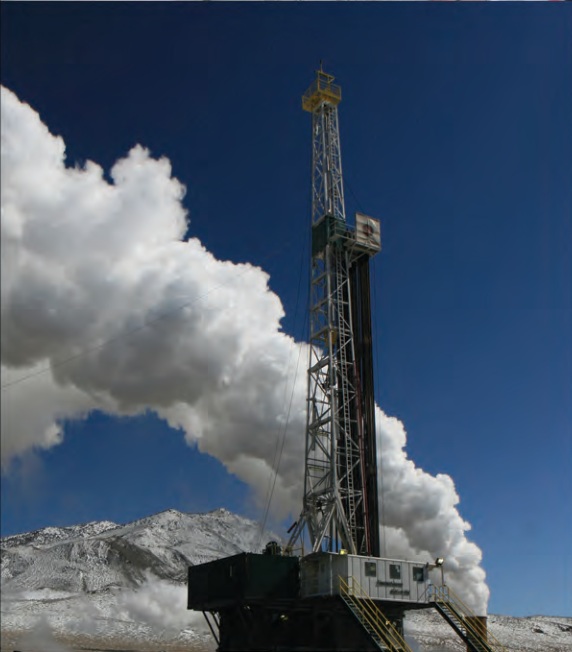
The expansion was fast enough to invite a second look. Contemporary trade reporting put ThermaSource at three employees in 2006 and more than 235 in 2008. The owned fleet grew from one rig to eight, with two more on order. Those 2008 numbers capture what happened when a supply shortage met a company willing to buy the supply.
The price of that choice was substantial. New rigs ordered for ThermaSource in 2008 averaged about $10.5 million to $11 million apiece. A later account put its 2007 capital injection at $20 million and another 2008 financing at about $42 million; the company also described investor support for new and refurbished equipment. This was an equipment and labor business with renewable energy customers, not a piece of software that became cheaper each time someone opened it.
The well is the product
ThermaSource's customers were geothermal developers and project owners, not households buying electricity. They paid for engineering, staffed drilling rigs and the work around the hole: cementing the casing, managing drilling fluids, and logging what the well revealed. The company built those adjacent services through ThermaSource Cementing, ChemTech and Tecton Geologic. An ad placed in a geothermal trade bulletin in 2014 still presented drilling, cementing and geology together.
Engineering and resource work turn surface clues into a drilling program.
A staffed rig cuts the well; casing, cement and fluids make it workable.
Logs and well tests reveal temperature, flow and whether the project can proceed.
That combination is what distinguished ThermaSource from a pure engineering shop or a rig owner with little geothermal specialization. It could advise on the target, drill toward it and interpret the results. At Nevada's Blue Mountain field, its rigs worked alongside Ensign's. At Nicaragua's San Jacinto expansion, an International Finance Corporation disclosure identified ThermaSource as the drilling contractor among a multinational group of suppliers. This is a service role in someone else's power project, and it is a useful one: before a turbine can earn revenue, a developer must know whether a viable well exists.
“We want to be more than a rig and personnel. We want to be the engineering group that helps you be where you want to be.”Louis E. Capuano Jr., 2009
Three days can be a business case
Some of ThermaSource's most revealing decisions were mechanical. Geothermal wells need high flow rates, which can mean wider holes and taller rig substructures than a familiar oil well. At a multi-well pad, moving the rig to the next hole can consume days. ThermaSource executive Jim Hanson said a skiddable rig could move in about three days. Without that ability, a move could take seven to ten days and cost $200,000 to $300,000. One of the company's newer rigs could travel in 16 loads, compared with 28 for an older design.
There is a lesson a developer can borrow without buying a drill: count the moves, not merely the wells. A smaller pad, a rig that skids and a drilling sequence planned before the first hole can remove time that produces no heat and no information. That calculation is specific to the field. Tight sites, unsuitable ground, permitting rules or too few wells on a pad can change the answer.
About 5,300 feet drilled. Roughly 200°F found. The original, hotter power plan needed another answer.
The rock has a veto
Oregon Tech makes the point with unusual clarity. The school had a real use for underground heat. It also had a forecast for a deep well and a larger electricity plant. The well was drilled, measured and logged, and the numbers forced a revision. Oregon Tech dedicated a smaller geothermal combined heat-and-power plant in 2010 using existing wells, while describing the deep well as part of a planned larger project. That is not a neat triumph-or-failure parable. It is how exploration works: evidence arrives after money has been spent.
ThermaSource's business rested on being useful before and during that moment. Its engineers could improve a plan; its rigs could make a test possible; its logging and cementing crews could help turn a hole into a reliable well. None of those services could guarantee the temperature, permeability or economics of the rock. For geothermal developers, that is the sober bargain. Buy expertise to make the question sharper. Then pay to ask the earth.