Eleven units a day. That was the production pace assumed in Fluence’s late-summer 2026 plan for its Houston contract-manufacturing facility. August’s actual average was less than one. By September, corrective work had raised output to roughly three. For Julian Nebreda, a chief executive whose business depends on helping electricity arrive at the right moment, the arithmetic was uncomfortable.
On September 16, Fluence lowered its fiscal-year revenue outlook to about $2.4 billion, against a previous midpoint of $3 billion. Its projected adjusted EBITDA loss widened to about $200 million. These were revised expectations, with the final results still to come. Nebreda identified the Houston ramp as the principal reason for the change.
The episode brings two parts of his work into view. He sells the usefulness of timing: batteries that respond to a grid’s changing needs, and software that helps manage energy assets. He must also manage the timing of suppliers, factories and deliveries. A grid can have plenty of equipment and still struggle to coordinate it. A company can face a related problem.
His career has taken him through both sides of that coordination problem: legal training in Caracas, development finance in Washington, years running power businesses, and then the leadership of a storage technology company. Nebreda arrived at batteries by a route with rather more contracts than circuit diagrams.
A law degree with an unexpected destination
Born in Caracas in 1966, Nebreda began studying law at Universidad Católica Andrés Bello in 1983. His father was a lawyer. During his first year, he hitched rides to campus; eventually, he bought a car. He became president of the law student centre and remembers building alliances with other schools. He later described those alliances as lessons in building trust.
He graduated with honours in 1988. A Fulbright fellowship took him to Georgetown, where he completed a master’s in common law. He also earned a second Georgetown master’s in securities and financial regulation. Although he had imagined a legal career, he says he never worked as a litigator.
The qualifications proved useful elsewhere. From 1993 to 1999, he worked at the Inter-American Development Bank as counsellor to the executive director representing Panama and Venezuela. Development finance placed him near the institutions that help turn infrastructure proposals into funded projects. Electricity would become the field in which he used that combination of legal and financial knowledge.
The map kept getting larger
His later AES responsibilities stretched from individual utilities to whole regions. He led AES Dominicana between 2003 and 2005, then Electricidad de Caracas from 2005 to 2007. Central America and the Caribbean followed. From 2009 to April 2016, he headed the company’s Europe business unit; Brazil and then South America came next.
Those dates contain very different operating assignments. A regional electricity executive has to understand the customer, the generation portfolio and the rules under which both meet. Moving between markets means learning those relationships again. The career record shows repeated exposure to that task, without requiring any claim that the markets themselves were interchangeable.
His work included the Andrés generation facility and LNG terminal in the Dominican Republic, and the shift toward renewable energy at AES Gener in Chile. In January 2022, he became AES’s executive vice president and president of US & Global Business Lines, with responsibility for US renewables growth and supply-chain strategy.
The move to Fluence came later that year. He had already joined its board in September 2021. On September 1, 2022, he succeeded Manuel Pérez Dubuc as president and chief executive. He was taking charge of a business he had encountered from the boardroom before assuming responsibility for its daily performance.
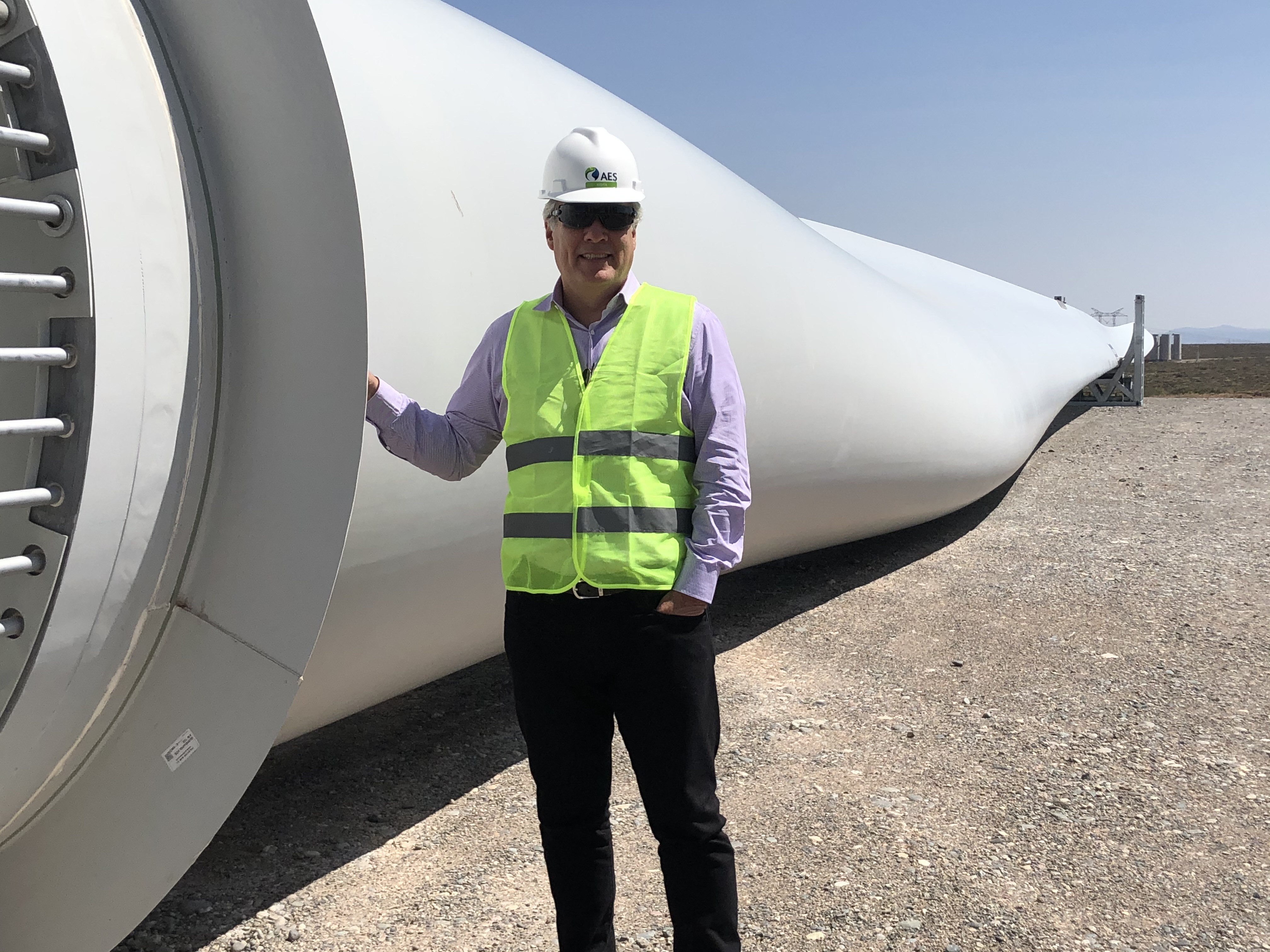
From owning the plant to selling the system
Fluence began in 2018 as a Siemens and AES joint venture and went public in 2021. Its business combines energy storage equipment, operational services and software for managing storage and renewable assets. For Nebreda, the change in employer also meant a change in perspective: from running electricity businesses to supplying technology those businesses could use.
At a 2024 industry seminar, he discussed the tension between keeping an entrepreneurial culture and introducing the operational processes needed to scale. The conversation included the role of systems such as SAP in coordinating a growing international company. It is a less photogenic subject than a battery installation, but a revealing one. Someone has to make the orders, parts and accounts agree.
His 2023 discussion of India offers a practical example. Fluence had formed a joint venture with ReNew to serve the market. Nebreda described seeking local suppliers with potential to support exports, while developing the technology centre and recruiting engineers, data scientists and financial specialists.
That is a broad definition of expansion. Customers, production and expertise all have to develop together. The plan also exposes how many relationships sit behind a finished storage installation. The container at the project site is the visible result of decisions made in procurement, finance, software and manufacturing, often in different places.
“And then you will be happy even if you are not rich.”
Julian Nebreda, on leadership and being true to yourself, 2023
The electricity business discovers a clock
Nebreda’s public case for batteries centres on flexibility. In his March 2026 argument about the AI era, he urged attention to how power resources work together as electricity demand changes. His position is that storage can help integrate different sources and improve the performance of the wider system.
The distinction between producing electricity and deciding when it is available matters. A battery must first be charged. Its contribution depends on the power it can deliver, the energy it holds and the way it is operated. Adding storage therefore creates another set of choices about the timing of supply and use.
In a February 2026 conversation with Ed Crooks and Amy Myers Jaffe, Nebreda described batteries as system optimisers. The discussion covered fast response, grid stability, extreme weather and the pressure from new data centres. His argument extended beyond storing renewable output: storage could help generation assets operate more efficiently together.
He also pointed to the urgency of getting power to new facilities. For a data-centre developer, the interval between deciding to build and securing electricity can become a business constraint. That makes delivery schedules part of the energy discussion before the first battery is connected. Nebreda’s customers have their own clocks running.
Move energy through time
Four hours, expressed in concrete
The scale of Fluence’s ambitions is visible in Jänschwalde, Germany. In November 2025, the company and LEAG announced a planned battery installation rated at 1 gigawatt of power and 4 gigawatt-hours of energy, using Fluence’s Smartstack platform. The announcement described a four-hour system intended to support grid services, trading and renewable integration.
The two numbers answer different questions. The gigawatt rating describes the rate of delivery. The gigawatt-hour figure describes stored energy. Dividing four by one gives the nominal four-hour duration. That is a useful way to understand the design, rather than a claim that any installation runs at full output regardless of conditions.
For Nebreda, an agreement at that scale is also an operating commitment. The project was announced as a development to be built. Its significance lies partly in the distance between signing and service: engineering, equipment, installation and commissioning must still join up. A photograph of executives shaking hands records a beginning.
Nominal duration: 4 hours. Announced design, not a completed operating result.
When the timetable becomes the story
The Houston problems show the other end of that commitment. In September 2026, Nebreda said domestic and international demand remained strong, while production delays were disrupting the US business. Fluence said it was restructuring operations and bringing supply-chain, manufacturing and delivery planning into closer coordination.
The production gap was substantial. The late-summer plan assumed eleven units a day; the reported August average fell below one. Early-September improvement to roughly three units a day represented progress from that low base, while leaving a considerable distance to the earlier assumption. The figures describe different periods, not a single day’s factory performance.
Fluence’s response also involved money and pace. Finance chief Ahmed Pasha set out the objective of turning backlog into revenue and cash, improving working capital, and supporting the fiscal 2027 plan without external capital. Those were management objectives. They had yet to become demonstrated outcomes.
For a leader discussing flexibility, this was a demanding application of the idea inside his own organisation. Customers could still want the product while the company struggled to deliver enough of it on schedule. The September reset put manufacturing performance at the centre of the next chapter of his tenure.
The person beyond the portfolio
Outside work, Nebreda enjoys running and spending time with his dog, Luna. He is married to Adela Bello and has four children. In 2022, he said he had lived in eight countries and thanked his wife and children for supporting a career that had taken the family across cultures.
His advice to younger professionals has included planning clearly, pursuing ambitious goals and staying true to themselves. In 2023, he ended that advice with a disarmingly modest measure of success: happiness could survive the absence of riches. It is an interesting sentiment from someone whose working days involve large investments.
The record gives him experience across legal, financial and operating problems. It does not settle how Fluence’s current difficulties will end. What it does show is the assignment immediately in front of him. The batteries have to reach their sites, the installations have to work, and customers have to receive what the company promised. For Nebreda, the next proof will arrive on a delivery schedule.