An accountant can finish entering a number and still be nowhere near finished with it. The number must leave the books, reach the tax return, survive review, and become something a client understands. Each move creates another chance to retype, chase a document, or open the wrong window. Intuit Accountants has built a business around that journey. Its newest products suggest the space between tasks deserves as much attention as the tasks themselves.
- About 600,000 tax and accounting professionals use Intuit’s ecosystem, the company says.
- ProConnect, Lacerte, and ProSeries serve different tax-preparation workflows.
- Accountant Suite brings firm operations and client work together; Core is free.
- The payoff depends on connected data, suitable products, and professional review.
A checkbook, then a much bigger desk
The origin is pleasingly domestic. In Intuit’s telling, Scott Cook watched his wife struggle to balance the family checkbook in 1983. Cook and programmer Tom Proulx created Quicken. The observation was small and useful: a familiar financial chore involved too much effort. Today’s accountant-facing business belongs to that parent company. It sells the tools professionals use to prepare returns, maintain books, manage firms, and explain financial choices.
Its customers range from solo preparers to multi-service accounting practices. Behind them sit individuals, business owners, and growing companies. That arrangement matters. Intuit sells to a professional whose recommendation can shape a client’s software choices. The accountant is both customer and guide. QuickBooks supplies the bookkeeping connection; the professional tax products handle another demanding part of the relationship.
“We fall in love with our customers’ problems.”
Intuit’s published operating values
Why keep three ways to do the taxes?
In June 1998, Intuit paid $400 million cash for substantially all of Lacerte’s assets. Lacerte already had more than 30,000 customers. Intuit also owned ProSeries. The interesting decision was to preserve the distinction. Its acquisition filing described ProSeries’ forms-oriented approach and Lacerte’s customized input sheets. Two interfaces could address different preparers’ habits. The company was buying another way to work.
That logic remains visible. Lacerte targets complex returns, advertising more than 25,000 automated diagnostics and 7,200 tax forms. ProSeries offers familiar forms-based preparation. Both are desktop products with optional Rightworks hosting. ProConnect runs in a browser. A firm can choose according to complexity, return mix, and working preferences rather than assuming cloud software suits every desk.
Connected books to tax
Desktop + optional hosting
Desktop + optional hosting
There is a consequential boundary: Intuit’s current comparison identifies ProConnect as the tax product integrated with Accountant Suite. Lacerte and ProSeries do not offer that same integration. A shared corporate owner does not make every connection interchangeable. Firms choosing an interface are also choosing which connections they can use.
The missing product was the handoff
Intuit announced Accountant Suite in October 2025. By its August 2026 update, the company was describing a specific complaint from accountants: constantly switching among systems, client files, and communication channels. That feedback gives the platform a clearer purpose than the usual promise of an intelligent dashboard. An inbox, multiple client tabs, and a consolidated view of support tickets address recognizable interruptions.
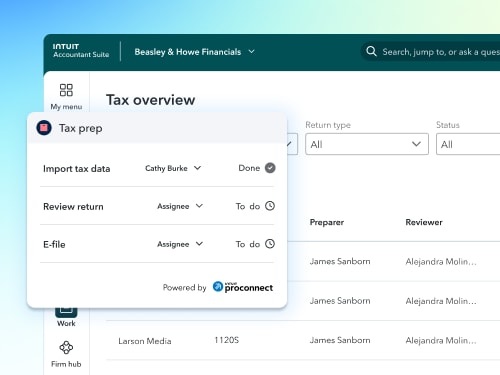
Premium Accelerate features include portfolio summaries and cross-client insights, several labeled beta. They aim to help a firm spot patterns across its clients. Playbooks standardize recurring workflows. This is an attempt to make the accountant’s own business easier to run, alongside the businesses it serves. The practical test is whether staff spend less time locating work and more time completing it.

Some friction has been more basic. Intuit’s public accountant updates describe fixing imported bills that overrode a supplier’s chosen expense category. Its October Canadian update emphasizes faster loading and reporting improvements alongside new AI features. These are useful admissions about product priorities. Automation earns confidence when it preserves a deliberate choice and gets an ordinary workflow right.
The bill has more than one line
Accountant Suite Core is free. As of October 24, 2026, the US pricing page lists Accelerate at $149 monthly beginning January 20, 2027, after an extended free beta. Earlier guidance had named July 2026. The revised schedule matters to anyone budgeting a switch. QuickBooks Online Accountant is scheduled to be discontinued in December 2026; its replacement makes this an operational decision for existing firms.
Tax software has its own bill. ProSeries currently advertises Professional Pay-per-return starting at $539 annually, with return charges as needed; Basic starts at $729 for twenty individual returns. These are advertised starting prices, not complete firm budgets. Hosting adds a monthly subscription. Return volume, users, services, and renewal terms can change the arithmetic. The sensible comparison prices the workflow a firm will actually use.
What happens after the return?
Tax Advisor, launched in 2022, uses Lacerte or ProConnect return data to develop planning scenarios and client-facing reports. A preparer can review suggested strategies, add or dismiss them, adjust assumptions, and explain the result. The expertise remains with the professional. The software helps package an informed conversation about the future using information already collected about the past.
Intuit competes with Drake, Thomson Reuters UltraTax CS, and Wolters Kluwer CCH Axcess Tax. Its distinctive position combines several tax interfaces with the QuickBooks relationship and firm-management tools. That advantage is most relevant when clients already use compatible Intuit products. A practice organized around another accounting system, unsupported returns, or established specialist tools should test the connections before valuing the convenience.
There is a useful idea here for any firm: inspect one complete client journey. Mark where a number is re-entered, a message gets lost, or responsibility changes hands. Try a representative case before standardizing the process. Measure the handoffs alongside preparation time. The question that began beside a household checkbook still works at a larger desk: which part of this familiar chore needs so much effort?
Open another useful tab
Explore Intuit Accountants, current Suite pricing, the August product update, and the Tax Pro Center.
Follow on LinkedIn, X, Instagram, Facebook, or YouTube.
↗ Watch: Hector Garcia’s Suite walkthrough 36 min · February 2026; pricing dates later revised↗ Watch: Intuit’s switching demonstration Product tour · In the Know