Gerry Wagner had a problem that no amount of HVAC expertise could fix. His training depended on travel. When the pandemic stopped the trips, it stopped the classroom, too. GREE had already commissioned a digital mini-split from Interplay Learning. Equipment built for a screen became the center of webinars. A trainer skeptical of online teaching suddenly had a reason to reconsider. The air conditioner had stayed put. The audience could be anywhere.
- Practice diagnosing trade problems in interactive 3D, with VR optional.
- Give employers and schools a shared curriculum and a view of learner progress.
- Use digital rehearsal to make time with real equipment more productive.
The scarce thing is a second attempt
Consider the awkward position of a new technician. Watching an experienced colleague work is useful. Understanding why that colleague rejected three plausible diagnoses is harder. A customer’s house offers limited room for experiments. Every additional attempt occupies somebody’s time, and the equipment still has to work when the van leaves.
Interplay sells practice for that interval between recognizing a component and knowing what to do with it. Its catalog pairs expert-led video with simulated equipment, knowledge checks and assessments. Learners can work through technical problems repeatedly. Managers can assign paths and inspect progress. HVAC sits alongside plumbing, electrical, appliances, facilities maintenance and other trades.
The distinction from a video library is participation. The learner must act inside a modeled situation. That makes Interplay part technical publisher, part simulation studio and part training-management software company. Its expertise lies in translating equipment, procedures and diagnostic decisions into something a learner can manipulate.
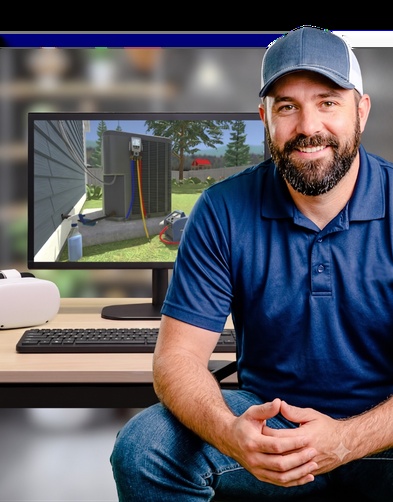
A classroom without the mileage
The GREE case supplies unusually concrete economics. Interplay’s account reports classes averaging 20 people, an initial webinar audience of 600, and a later average around 50. Reported weekly trainer travel savings were $1,500-$3,000. Those figures describe this customer’s experience; they do not establish the return every subscriber should expect.
Vendor case study. Initial attendance was a spike, not the ongoing average. Bar lengths share a zero baseline.
The useful lesson is about preparation. A digital version of the equipment existed before the delivery model failed. GREE could change where teaching happened without starting its teaching materials from scratch. For another employer, the equivalent move might be much smaller: build one dependable lesson around a recurring service problem before the next busy season.
The headset is optional. The schedule matters.
SkillMill, the familiar product name in older materials, is now the Interplay Career Development Platform. Its current packages separate smaller teams from organizations needing fuller reporting, support and licensing. Team and Enterprise list 500 hours of content. An individual subscription is also available. Interplay Academy packages learning into career-readiness programs for education and workforce providers.
Buyers include service businesses, property-maintenance teams, schools and workforce organizations. The homepage advertises more than 14,000 companies and 500,000 learners. Those are Interplay’s cumulative claims, rather than a count of today’s paying seats. Santa Rosa Junior College documents a practical institutional use: Interplay modules delivered inside Canvas courses.
Budgeting means choosing the package, learner access and services, then accounting for devices and instructor time. Enterprise buyers are directed to a quote. A headset is optional, while simulations require suitable computers, tablets or VR equipment. Phone-friendly videos should not be confused with full phone-based simulation.
My advice for a buyer: begin with a task your team repeatedly struggles with. Reserve practice time, review the resulting assessment gaps, and arrange a supervised equipment check. Software access is easy to count. Improved diagnosis takes observation.
The alternatives are familiar: apprenticeships, trade schools, manufacturer classes and a senior technician explaining a job in progress. Interplay can sit beside those arrangements. The purchase makes most sense when several learners need the same foundations, but access to equipment or an experienced instructor is uneven. It offers a way to standardize the rehearsal while leaving room for local instruction.
The mentor who slows down the answer
In 2023, Interplay introduced SAM, short for Skill Advisor and Mentor. Its announced design was to guide learners with questions and context, encouraging them to work toward an answer. That is an interesting choice for an AI feature: a quick response can end the very thinking a training exercise is supposed to provoke.
The original beta documentation drew useful boundaries. SAM supported training rather than field advice, and it was not intended to replace instructors. That distinction matters when the subject includes electricity and mechanical systems. An explanation on a screen earns its value through what the learner can subsequently understand and demonstrate.
Follow the cooling pipes to the data center
Co-founders Doug Donovan and Steve Quirk built a company whose stated mission connects technical learning with better careers. The current business dates its start to 2016. Its remote-first careers page also describes education reimbursement and internal promotion, applying the career-development theme to its own employees.
Interplay raised a $5.5 million Series A in 2019 and an $18 million Series B in 2021. In September 2024, it announced an undisclosed growth investment from Goldman Sachs Alternatives and acquired Industrial Training International. ITI brought crane, rigging and load-handling training into the group.
The expansion continued in June 2026 with a data center maintenance catalog covering electrical, mechanical, cooling and safety skills. September brought America’s Mission Critical Workforce, an initiative with founding members including Cengage, NAIA and YouthBuild. AI infrastructure gives this training company a very physical opportunity.
“Data centers do not run on computing power alone.”
Doug Donovan, CEO / September 2026
Show me the steps
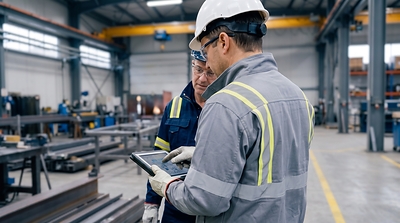
October 2026 brought Skill Verification: simulated tasks assessed step by step. The promise is more specific evidence for decisions about placement, dispatch and promotion. Completing a course tells a supervisor that someone reached the end. A task assessment can expose where the reasoning or sequence still needs work.
There is a sensible limit. A modeled task cannot reproduce every physical condition. Interplay’s own recent writing describes digital preparation paired with precise physical training. Programs without appropriate devices, protected practice time or supervised application will have difficulty turning a subscription into competence.
That is the idea a reader can borrow: move repeatable instruction and rehearsal into a format that scales, then spend scarce human attention on the parts that need a person. A second attempt should be easy to arrange before the first customer is waiting.