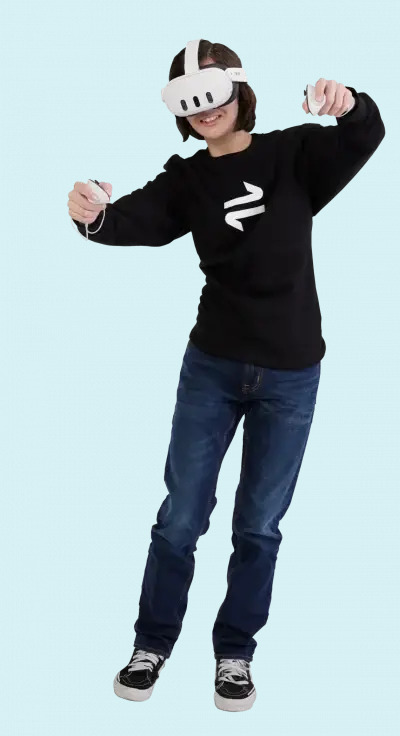
Career day has always demanded an odd act of imagination. A teenager reads “industrial maintenance technician” on a handout and is expected to picture a life. Transfr offers a more tactile proposition: put on a headset, enter a simulated workplace and try the opening moves. Change the oil. Inspect equipment. Take a patient history. Make a harmless mistake near virtual electricity. The job is still real, but the first encounter no longer has to involve a live wire, a crowded shop floor or a bus ride to an employer.
Founded in 2017 by Bharani Rajakumar, the New York company sells a multimodal platform to schools, community colleges, workforce boards, governments, employers and nonprofits. Transfr Trek handles career discovery and planning. Transfr Train handles foundational and technical practice. Around them sit the less photogenic pieces that make software usable in an institution: lesson plans, assessments, digital badges, learner dashboards, rostering, support and reporting.
The first product was too broad
Transfr did not arrive fully formed as a workforce system. Its early catalog was a grab bag of mentor-based VR instruction, with subjects reportedly ranging from bartending to surgical skills. A catalog that can teach anything sounds enormous. It also makes the buyer blurry. In 2020, Rajakumar told TechCrunch that the shift came after the company followed purchasing power. Entry-level workers needed training, but employers and workforce institutions had the economic reason to pay for better-prepared people.
That was the first thing that failed: not the technology, but the market definition. The change of mind was practical. Companies absorb the cost of vacancies, inconsistent onboarding and scarce instructors. Schools and public workforce programs are judged on participation, credentials and employment outcomes. A simulation became easier to buy once it was attached to those problems.
The business is software licensing, sold through quote-based packages. Transfr’s pricing page does not publish a number. A 2020 TechCrunch report said licenses could run up to $10,000 depending on workforce size, an old figure that should be treated as context rather than a current quote. The modern offer bundles onboarding, product training, curriculum, an assigned customer-success manager, grant guidance and technical support. In other words, the invoice covers an operating system for a program, not merely a headset full of videos.
What is actually inside the headset
Trek is the wide end of the funnel. It matches interests, shows profiles for more than 150 careers, offers over 50 short “day in the life” VR experiences and lets learners compare occupations, education requirements, salary data and budgets. Its purpose is not mastery. It is to replace an abstract occupation name with enough sensory evidence to provoke a better question: could I see myself doing this?
Train goes deeper. At its 2025 launch, Transfr said the product drew from more than 330 simulations across eight high-growth sectors. A Fundamental Skills program contains 70 simulations covering safety, measurement, material handling, hand tools, power tools and electrical basics. Structured pre-employment programs run for 20 hours and mix online lessons, VR practice, assessments, microcredentials and a completion certificate. Healthcare content adds peer review and simulation standards because “close enough” is a terrible curriculum principle in a clinic.
“Potential is everywhere. Opportunity should be too.”Bharani Rajakumar, founder and CEO
The interface is only half the product. Transfr works with subject-matter experts and employers to break a task into teachable steps. The digital coach corrects the learner. The dashboard records activity and performance. An instructor can assign, reorder or hide simulations and wrap them in classroom work. The result occupies a useful middle ground between passive e-learning and an expensive physical lab.
The strongest case is repetition
At TRIO Electric, Transfr’s simulations became part of a program serving adult job seekers and high-school students. The company case study reports 292 trainees, more than 3,600 simulations and 11 sites. TRIO’s team helped decompose electrical tasks into virtual steps, while instructors kept the physical and contextual parts in the real curriculum. The appeal is almost comically concrete: virtual conduit does not become a pile of bent metal, and a learner can practice without consuming wire or monopolizing an instructor.
TRIO CEO Beau Pollock used an admirably unscientific procurement test: he let his child try several headsets. Within minutes on Transfr, the child was changing a car’s oil. Ease of use mattered because training programs cannot afford a technician beside every learner. Yet the formal co-development was laborious. Task documents went back and forth. Experts debated what could be taught without the weight of a tool or resistance of a material. That contrast is the point: the learner experience should feel obvious because specialists did the unobvious work.
Other deployments show the range of the customer base. The Technical College System of Georgia added health-sciences simulations. MOZAIC used career exploration with people with disabilities. Pender County schools brought job previews to middle-school students. The AED Foundation partnership aligns diesel and equipment content with industry standards. In rural Texas, Etex and Transfr created an employer-led broadband pathway. A 2026 Colorado collaboration reported rotating only three headsets among several organizations and reaching more than 260 students. Scale sometimes looks like a nationwide contract; sometimes it looks like a very organized trunk.
The copyable playbook
Founders should resist copying the fashionable part. “Add VR” is not a strategy. The reusable pattern is to locate a costly first encounter. Look for skills where beginners need repetitions but equipment is dangerous, consumables are expensive, experts are scarce or the real workplace is difficult to visit. Simulate the sequence and feedback. Then sell it to the organization already paying for the failure: the employer losing candidates, the college with a constrained lab or the workforce board accountable for placements.
Second, package the adoption work. A dazzling five-minute demo can spend the rest of its life in a locked cabinet. Rostering, lesson plans, facilitator training, device management, support and simple reporting are what turn novelty into a Tuesday class. Third, let industry define competence. Transfr’s useful partnerships are not logo swaps; they help determine task order, standards and the handoff from simulation to real practice.
It works best when
- real practice is risky, scarce or wasteful
- the buyer runs repeat cohorts
- instructors connect VR to a curriculum
- employers validate the skills
- outcomes extend beyond headset time
It breaks when
- tactile feel is the skill itself
- a one-off demo replaces a program
- devices lack an owner or support
- motion sickness or access needs are ignored
- completion is mistaken for employment
Where the model stops
VR cannot reproduce the heft of a tool, the smell that warns a mechanic, a patient’s unpredictable expression or a veteran instructor’s judgment. It does not manufacture local jobs, transportation or childcare. A digital badge is not automatically an employer-recognized credential. Even a confident learner still needs supervised practice and a hiring door that opens.
This matters because Transfr’s biggest promise is upward mobility, while most public evidence still concerns reach, engagement, simulations completed and company case studies. Its 2025 product announcement cited a pilot with a 55 percent placement rate and better retention than web materials, promising signals that deserve replication across programs and longer follow-up. The market will eventually care less about how many virtual bolts were tightened than whether wages, retention and advancement moved.
The company sits among enterprise VR trainers such as Strivr and Talespin, skilled-trades platforms such as Interplay Learning, immersive classroom vendors and the oldest competitors of all: labs, apprenticeships, job shadows and videos. Its differentiation is breadth across exploration and training, plus an explicit focus on middle-skill pathways and institutional coalitions. The moat, if one develops, will not be photorealism. It will be trusted content, workflow integration, distribution and evidence that a classroom experience survives contact with a payroll.
Rajakumar’s own route explains the obsession. The son of immigrants, he has spoken about growing up working class, starting at Wendy’s, feeling unmoved by the narrow menu of doctor, lawyer or engineer, then passing through finance and education technology. He says he became Transfr’s de facto founder because nobody else wanted to leave a job to pursue the idea. It is an origin story with the right amount of awkwardness: careers rarely look inevitable while they are happening.
Transfr’s contribution is to make that uncertainty cheaper to explore. A headset cannot choose a life. It can, however, let someone discover that aviation maintenance is fascinating, that clinical work feels wrong, or that a power tool is less frightening after ten private repetitions. For a student staring at a list of job titles, that is not the whole bridge from classroom to career. It is a useful first plank.